Uttarakhand CB CID Probe and BNS Dowry Death Case
Source:theprint ↗
Why It Matters
The case demonstrates the interplay between local political representatives, the Chief Minister's executive power, and state investigative agencies (CB-CID). It also serves as a practical example of the application of the newly enacted Bharatiya Nyaya Sanhita (BNS), specifically concerning dowry deaths, which is relevant for the Polity and Social Justice segments of the UKPSC PCS Prelims.
Summary
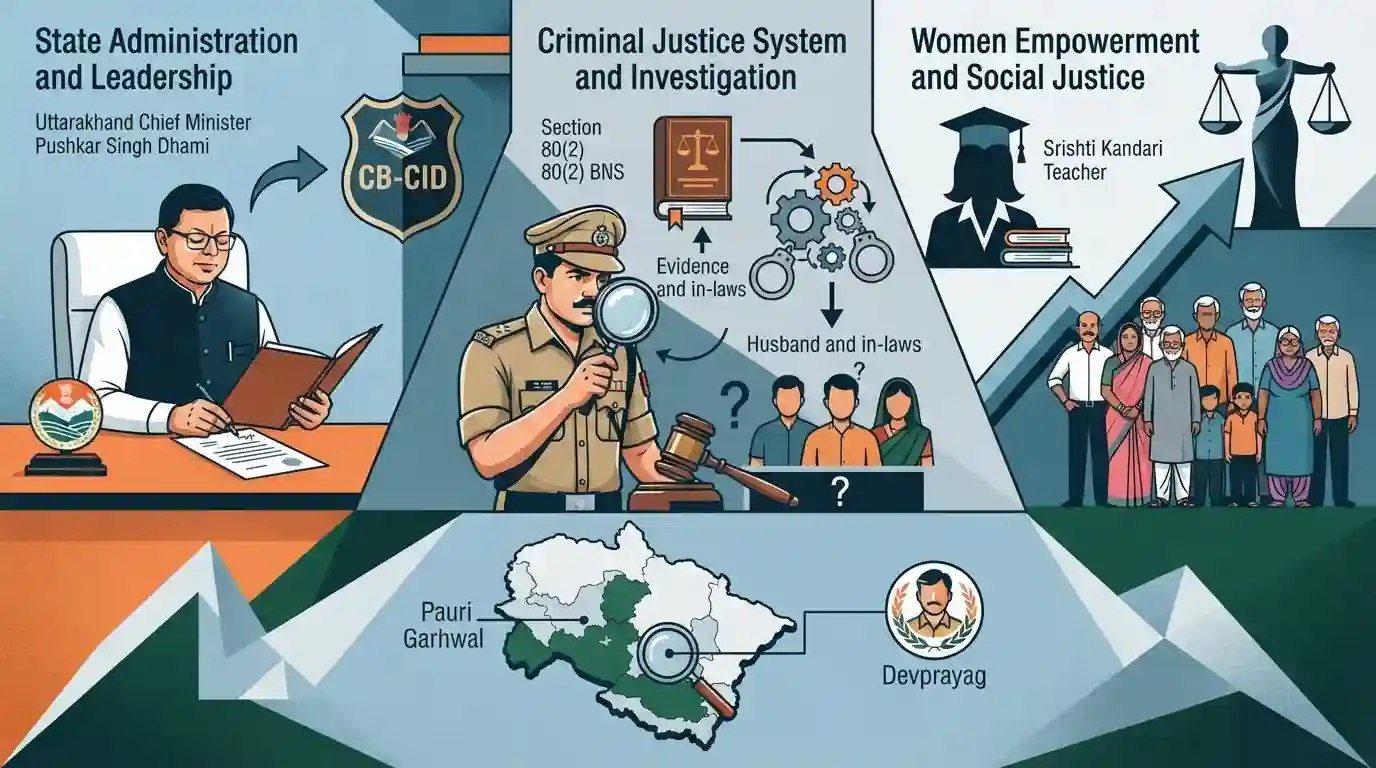
Uttarakhand Chief Minister Pushkar Singh Dhami has ordered a CB-CID investigation into the alleged suicide of a 28-year-old school teacher, Srishti Kandari, in the Pauri Garhwal district. The action was taken following a request by Devprayag BJP MLA Vinod Kandari. The local police had already registered a case against the woman's husband and in-laws under Section 80(2) of the Bharatiya Nyaya Sanhita (BNS), which pertains to dowry death. The incident brings focus to state administration, law enforcement, and women's issues in Uttarakhand.
Key Points
- Uttarakhand Chief Minister Pushkar Singh Dhami ordered a CB-CID investigation into the alleged suicide of a 28-year-old woman teacher, Srishti Kandari, in Srinagar.
- An FIR has been registered against her husband and in-laws for dowry death under Section 80(2) of the Bharatiya Nyaya Sanhita (BNS).
- The intervention by Devprayag MLA Vinod Kandari prompted the Chief Minister to transfer the probe to the state-level agency, CB-CID.
- The incident highlights the administrative response mechanisms in Uttarakhand regarding women's safety and the implementation of the new criminal law (BNS) for dowry-related offenses.
Important Terms
Bharatiya Nyaya Sanhita (BNS) Section 80(2)

The specific provision under BNS that mandates punishment for dowry death, imposing a minimum prison sentence of seven years up to life imprisonment.
UPSC context
GS Paper II: Criminal Justice. Tests understanding of legal deterrents against gender-based crimes and changes from the IPC.
CB-CID
The Crime Branch-Criminal Investigation Department, a specialized detective wing of state police forces in India investigating high-profile, complex, or inter-district crimes.
UPSC context
GS Paper II: State Administration. Tests knowledge of state-level investigative agencies and police accountability.
Dowry Death
The death of a woman within seven years of marriage due to burns, bodily injury, or abnormal circumstances, linked to dowry harassment by her husband or in-laws.
UPSC context
GS Paper I & II: Social Issues. Tests awareness of systemic gender violence and domestic abuse laws in India.
Bharatiya Nyaya Sanhita (BNS)
The modern codification of substantive criminal law in India, which replaced the British-era Indian Penal Code (IPC) starting July 1, 2024.
UPSC context
GS Paper II: Judiciary and Governance. Tests knowledge of landmark criminal law reforms, modernizing Indian jurisprudence.
Prelims Trap
CB-CID is a specialized central agency for investigating high-profile crimes.
CB-CID (Crime Branch-Criminal Investigation Department) is a state-level investigative wing operating under respective state police forces, unlike the CBI which is a central agency.
Static Concepts Connected
How do the new criminal laws address dowry deaths?
- BNS Section 80: Replaces IPC 304B, mandating 7 years to life imprisonment for dowry death, notably with no provision for a fine.
- BSA Section 118: Replaces IEA 113B, creating a mandatory legal presumption ('shall presume') that shifts the burden of proof to the accused.
- Dowry Definition: Both laws align with the Dowry Prohibition Act, 1961, explicitly excluding 'mahr' under Muslim Personal Law from the definition of dowry.
What is the historical origin of the CB-CID in India?
- Fraser Commission (1902): Traces back to the recommendations of the Indian Police Commission of 1902, headed by Andrew Fraser.
- 1929 Structural Split: The department was structurally divided into the Special Branch and the Crime Branch (CID) in 1929.
- State Jurisdiction: It operates as a specialized investigative wing of the state police, strictly under the jurisdiction of the state government.
Cross-Topic Patterns
Overlapping GS1 & GS2: Dowry and BNS
Dowry issues bridge GS1 (Society) and GS2 (Criminal Justice). UPSC often tests the socio-legal efficacy of new frameworks like the BNS and BSA in protecting vulnerable sections.
Colonial origins of police machinery
The Fraser Commission (1902) laid the foundation for CID. UPSC frequently links colonial-era administrative reforms to present-day governance structures and police machinery.

Expect a GS2 mains question evaluating if the BNS and BSA genuinely strengthen legal deterrence against gender-based violence like dowry.
Linked PYQs · 2
Linked PYQs · 2
- 2024UKPSC_PRELIMSGS1
How many of the following women M.L.A.s were there in the first Legislative Assembly of Uttarakhand ?
- 2025UKPSC_PRELIMSGS1
Consider the following statements with reference to Uttarakhand and choose the correct answer: 1. The executive of Uttarakhand includes Governor as the head of the state. 2. It also includes the Chief Minister and his/her council of ministers.
