Uttarakhand clears High Court land transfer to Haldwani
Source:newindianexpress ↗
Why It Matters
The article details significant regional governance decisions in Uttarakhand, prominently the shifting of the High Court and infrastructure tie-ups like the Ganga Expressway extension. It is highly relevant for UKPSC prelims and mains covering state-specific current affairs, legislative rules (Code on Wages), and primary sector livelihood schemes (cattle rearing scheme).
Summary
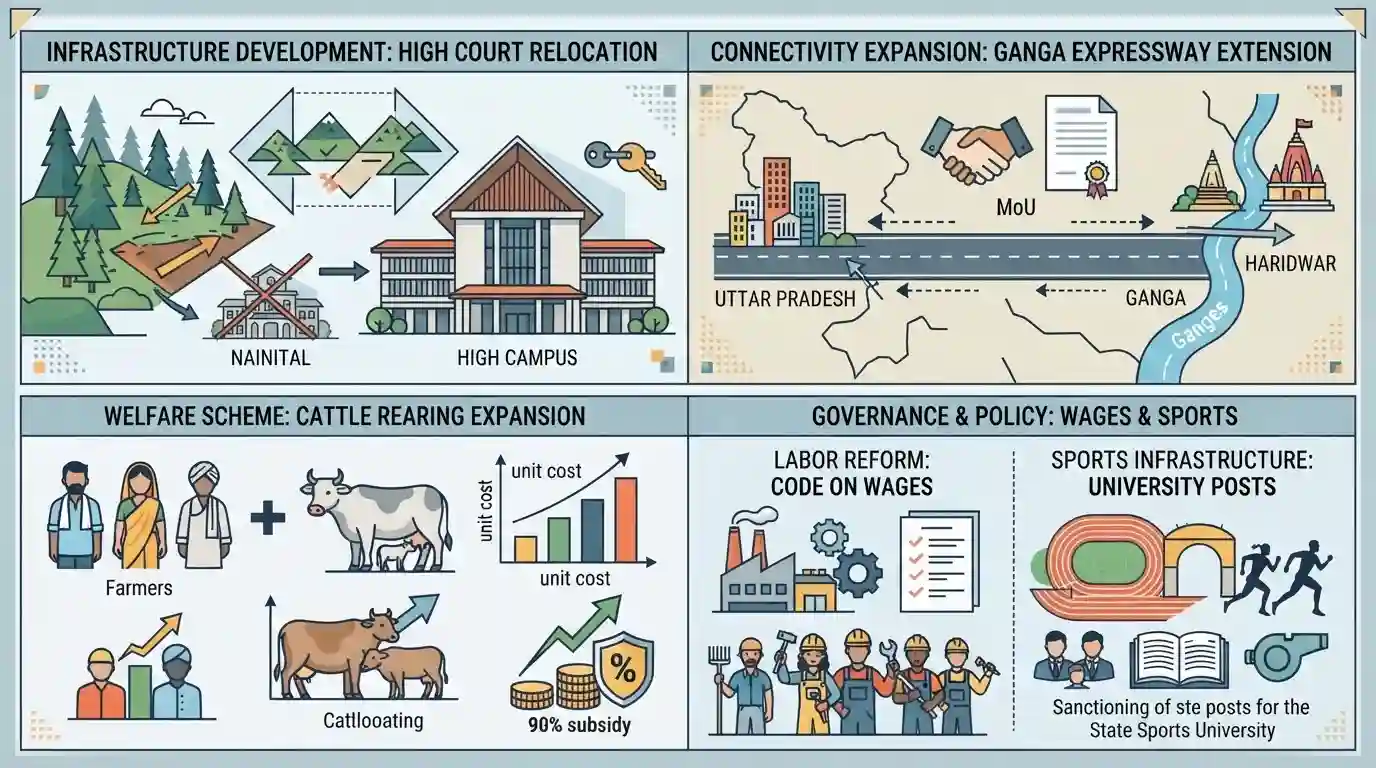
The Uttarakhand Cabinet has approved major infrastructure and welfare initiatives, including the transfer of forest land in Lamachaur, Haldwani, for a new High Court campus, shifting it from Nainital. An MoU with Uttar Pradesh was cleared to extend the Ganga Expressway to Haridwar. In a boost to the rural economy and animal husbandry, the cattle rearing scheme was expanded to general-category farmers with a unit cost hike to ₹60,000 and subsidies up to 90%. Furthermore, the state approved the Uttarakhand Code on Wages Rules, 2026, and sanctioned posts for the State Sports University in Gaulapar, Haldwani.
Key Points
- Uttarakhand Cabinet approved 40 hectares of forest land transfer at Lamachaur, Haldwani, for building a new High Court complex, shifting it from Nainital.
- An MoU with the UP government was cleared to extend the Ganga Expressway from Meerut to Haridwar, aiming to enhance connectivity and religious tourism.
- Uttarakhand Code on Wages Rules, 2026, was approved, ensuring minimum wages, timely disbursal, digital payments, and equal remuneration.
- The state cattle rearing scheme was expanded to include general-category farmers, with the unit cost increased to ₹60,000, offering subsidies of 90% for SC/STs and 60% for the general category.
- The government also sanctioned 122 regular posts for the upcoming State Sports University at Gaulapar in Haldwani.
Important Terms
Uttarakhand Code on Wages Rules, 2026

State-level framework implementing the central Code on Wages, 2019. It mandates salary disbursal by the 7th of each month, double overtime pay, digital payments, and equal remuneration for men and women.
UPSC context
Relevant for GS Paper 2 and 3 (Labour Reforms, Social Justice). Tests knowledge of concurrent list subjects and labor laws.
Cattle rearing scheme
A state initiative expanded to general-category farmers, providing subsidies (90% for SC/ST, 60% for general) up to a ₹60,000 unit cost for purchasing cows and buffaloes to support rural livelihoods.
UPSC context
GS Paper 3 (Animal Husbandry, Rural Economy). Highlights targeted interventions for self-employment and curbing rural out-migration in Himalayan states.
Uttarakhand High Court
The state's top judicial body, relocating from a colonial-era Nainital campus to Lamachaur, Haldwani. The Supreme Court recently facilitated this move by ruling that relocating courts is an administrative, not judicial, function.
UPSC context
GS Paper 2 (Judiciary). Essential for understanding the separation of administrative and judicial powers regarding court infrastructure modernization.
State Sports University
Uttarakhand's first dedicated sports university, being established in Gaulapar, Haldwani. It will provide specialized academic degrees in sports science alongside professional athletic training, coaching, and state-of-the-art research facilities.
UPSC context
GS Paper 2 (Education, Human Resources). Demonstrates state-led infrastructure development to nurture talent, empower rural youth, and build a sporting ecosystem.
Prelims Trap
State cabinets have autonomous power to transfer forest land for non-forest public utilities like courts.
Under the Forest (Conservation) Act, 1980, diverting forest land for non-forestry purposes requires prior approval from the Central Government, even if a State cabinet clears it.
Static Concepts Connected
How is the principal seat of a High Court determined and shifted?
- Establishment Acts: Initially defined by the specific Act of Parliament that created the State or the High Court (e.g., UP Reorganisation Act 2000).
- Modification Mechanism: Shifting the principal seat or establishing permanent benches typically requires a Presidential order or Parliamentary amendment, acting on proposals from the State Government and Chief Justice.
- State's Role: While the State Cabinet approves the land and infrastructure transfer, it cannot unilaterally shift the constitutional seat of the Court.
How is the Code on Wages implemented under India's federal structure?
- Concurrent Subject: 'Labour' is in the Concurrent List (Schedule VII), meaning both Parliament and State Legislatures can make laws on it.
- Rule-Making Power: The Central Government enacted the Code on Wages, 2019, but States must draft and notify their own specific rules to operationalize it locally.
- Appropriate Government: The 'Appropriate Government' (Centre for railways/mines, States for most private sectors) holds the authority to fix and revise minimum wages.
Cross-Topic Patterns
Labour Codes + Concurrent List friction
The protracted rollout of India's four Labour Codes stems from 'Labour' being a Concurrent List subject, requiring states like Uttarakhand to formulate distinct rules before local implementation.
Forest Diversion + Public Infrastructure
The Haldwani High Court land transfer mirrors the ongoing tension between expanding public infrastructure and adhering to the Forest (Conservation) Act's strict central diversion protocols.

Expect a statement-based Prelims question on the constitutional mechanism for shifting a High Court's principal seat or creating new benches.
Linked PYQs · 1
Linked PYQs · 1
- 2025UKPSC_PRELIMSGS1
Consider the following statements with reference to animal husbandry in Uttarakhand. Select the correct answer from the codes given below : 1. Animal husbandry is a supplementary occupation of agriculture. 2. Sheep rearing in the mountainous areas has been affected by environmental degradation.
