Uttarakhand Cabinet Approves New Irrigation Bill
Source:timesofindia-indiatimes ↗
Why It Matters
Replacing a 153-year-old colonial-era law marks a significant step towards decolonizing archaic legal frameworks and modernizing state-level resource management and infrastructure governance in Uttarakhand.
Summary
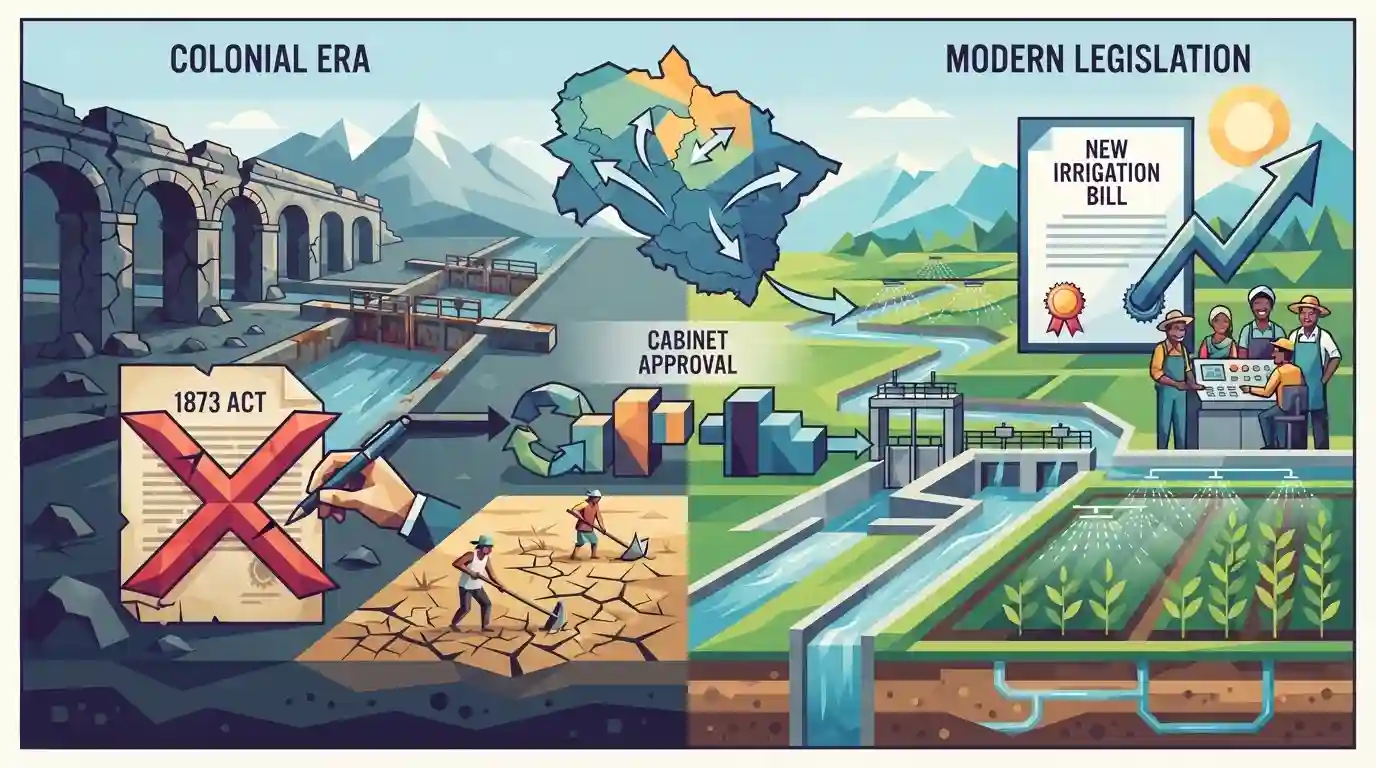
The Uttarakhand cabinet has approved a new irrigation bill designed to supersede the colonial-era Northern India Canal and Drainage Act of 1873, which has been in force for 153 years. The updated legislation seeks to overhaul irrigation, canal management, and drainage systems across the state to meet modern agricultural and infrastructural requirements.
Key Points
- The Uttarakhand cabinet approved a new irrigation bill to replace the 153-year-old Northern India Canal and Drainage Act, 1873 (a colonial-era law).
- The new legislation aims to modernize water resource management, irrigation systems, and drainage regulations in the state in line with contemporary needs.
- This move is part of a broader administrative push to repeal outdated colonial-era laws and streamline local governance and infrastructure management in Uttarakhand.
Important Terms
New Irrigation Bill

A newly approved state legislation designed to replace the 153-year-old British-era Northern India Canal and Drainage Act, 1873, to modernize canal management and address Uttarakhand's unique mountainous topography.
UPSC context
UKPSC GS Paper-V (Uttarakhand Polity, Governance & Economy): Tests knowledge of state legislation, administrative reforms, and repeal of colonial laws.
Northern India Canal and Drainage Act, 1873
A colonial-era enactment of 1873 that regulated canal irrigation, water flow, and drainage administration across northern India for over a century and a half.
UPSC context
UKPSC GS Paper-I/V: Important for questions on colonial legislation, legal history, and evolution of irrigation frameworks in India.
Uttarakhand Cabinet
The highest executive decision-making body of the state government, headed by the Chief Minister, responsible for formulating state policies and approving legislative bills.
UPSC context
UKPSC GS Paper-V (Uttarakhand Governance): Tests understanding of the executive branch, state decision-making processes, and legislative approvals.
Prelims Trap
Northern India Canal and Drainage Act of 1873 was a post-independence central enactment.
Aspirants often confuse the Northern India Canal and Drainage Act of 1873 with post-independence central water statutes; it was a foundational British statute enacted across northern provinces.
Static Concepts Connected
What is the legislative process for a State Bill to become an Act in Uttarakhand?
- Cabinet Approval:: Drafting and Approval: Prepared by the concerned department (e.g., Irrigation) and approved by the State Cabinet.
- Vidhan Sabha:: Legislative Assembly: Introduced in the Uttarakhand Legislative Assembly (Vidhan Sabha), debated, and passed by a majority vote.
- Governor Assent:: Assent: Becomes law after receiving assent from the Governor of Uttarakhand (or the President in specific reserved matters).
Cross-Topic Patterns
Colonial Law Repeals + Federal Legislative Overhauls
Replacing colonial-era statutes like the 1873 Canal Act connects state-level administrative reforms to federal initiatives for purging obsolete British-era penal and civil codes.
Irrigation Modernization + Hill State Agriculture Economy
Modernizing canal management directly impacts hill agriculture productivity, linking state irrigation policy with the broader UKPSC syllabus on Himalayan agro-climatic challenges.

Expect a factual matching or statement-based question on the replacement of the 1873 colonial canal act with Uttarakhand's new irrigation bill.
Linked PYQs · 2
Linked PYQs · 2
- 2021UKPSC_PRELIMSGS1
The Uttaranchal (Change of Name) Act, came into existence is which of the following years ?
- 2025UKPSC_PRELIMSGS1
What were the duties of 'KAMIN' in Uttarakhand during the Colonial period?
