Uttarakhand Cabinet Clears Major Reforms in Health and Land
Why It Matters
Cabinet decisions covering critical sectors like land reforms, tribal welfare, and industrial growth provide direct insight into Uttarakhand's state-level governance framework, administrative priorities, and socio-economic development strategies which are essential for regional civil services exams.
Summary
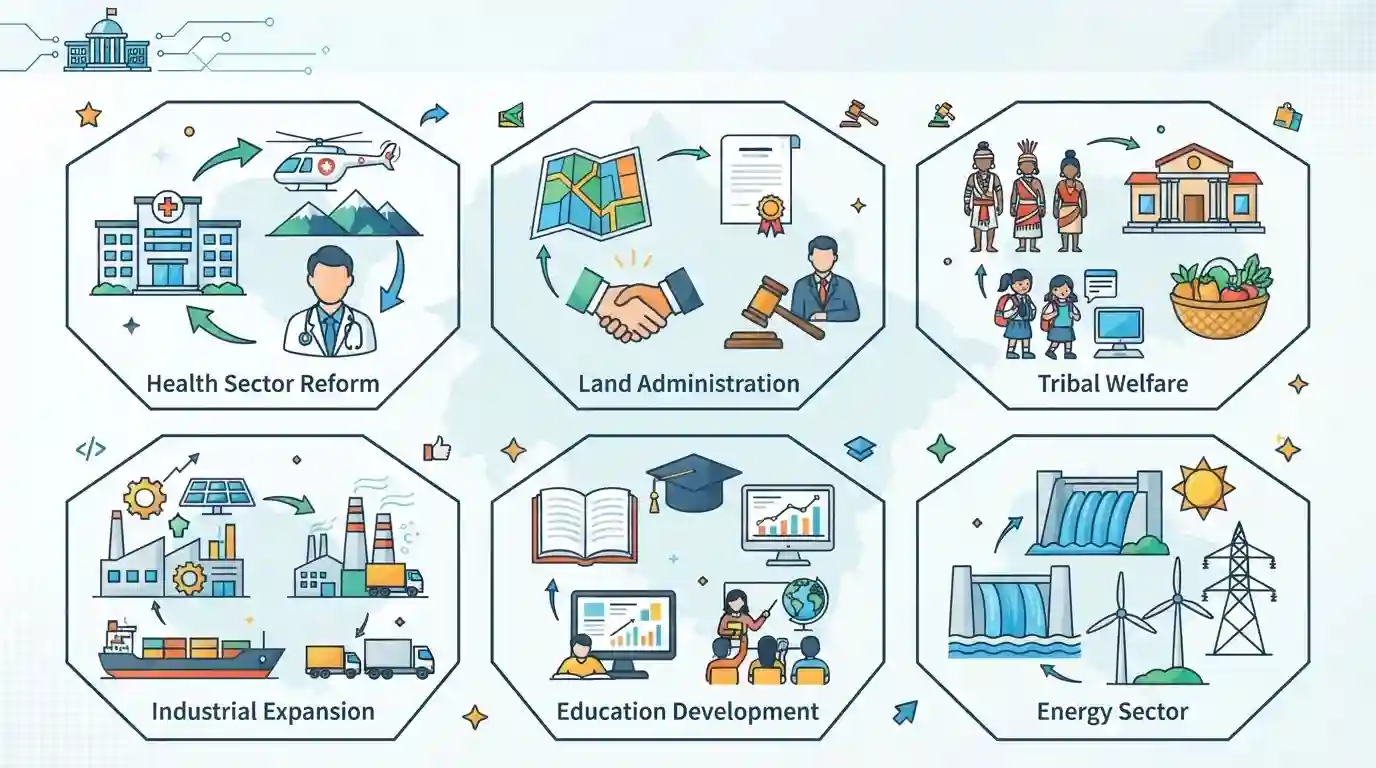
The Uttarakhand Cabinet has cleared several critical policy reforms and development initiatives spanning health, land administration, tribal welfare, industrial expansion, education, and energy sectors to propel overall growth and governance in the state.
Key Points
- The Uttarakhand Cabinet approved multiple major policy decisions targeting health, land reforms, tribal welfare, industrial growth, education, and energy sectors.
- These decisions are aimed at boosting regional economic development, improving administrative and social infrastructure, and streamlining land and welfare policies across the state.
- The comprehensive policy push encompasses initiatives tailored for marginalized communities, infrastructure expansion, and sustainable energy framework optimization in Uttarakhand.
Important Terms
Uttarakhand Cabinet

The core executive body of the state government, headed by the Chief Minister, responsible for formulating administrative policies, legislative proposals, and developmental initiatives across various state sectors.
UPSC context
Crucial for UKPSC Mains (Polity and Governance, State Executive) – tests understanding of cabinet decision-making, policy formulation, and executive powers in Uttarakhand.
Prelims Trap
The livestock scheme provides a uniform 90% subsidy for purchasing cows or buffaloes across all categories in Uttarakhand.
Aspirants often confuse the 90% SC/ST livestock subsidy with a universal 90% subsidy for all farmers, ignoring that general category farmers receive up to 60%.
Static Concepts Connected
What are the key mechanisms and objectives of Land Consolidation (Chakbandi) in hilly terrains?
- Definition: Combines scattered small landholdings of a farmer into one compact block to reduce operational costs and improve farming efficiency.
- Hill Context: Addresses severe land fragmentation caused by traditional inheritance laws in hill districts like Uttarakhand.
- Objectives: Aims to increase agricultural productivity, make irrigation viable, and curb forced migration (Palayan) from mountain villages.
Which districts in Uttarakhand have significant Scheduled Tribe (ST) populations targeted by special welfare schemes?
- Key Districts: Concentrated primarily in Dehradun (Jaunsar-Bawar region), Udham Singh Nagar (Tharu and Buksa tribes), Chamoli, and Pithoragarh (Bhotia tribe).
- Border Tribes: Includes semi-nomadic and pastoral communities residing along the Indo-Tibetan border regions requiring specialized administrative focus.
Cross-Topic Patterns
Hill State Land Reforms & Migration Patterns
Uttarakhand's Chakbandi policy and forest boundary demarcation directly link to hill state land tenure systems and demographic reverse-migration challenges unique to the Central Himalayas.
Tribal Welfare & Border District Governance
Subsidized livestock schemes combined with ST officer service rules test the efficacy of targeted welfare administration in border districts like Pithoragarh and Chamoli.

UKPSC frequently tests specific hill-state policy nuances like Chakbandi targets, forest boundary buffer rules, and subsidy tiers. Priority: Medium.
Linked PYQs · 5
Linked PYQs · 5
- 2024UKPSC_PRELIMSGS1
UTDB is established in Uttarakhand to promote:
- 2025UKPSC_PRELIMSGS1
Which of the following records is not maintained by the Panchayats in Uttarakhand?
- 2025UKPSC_PRELIMSGS1
Which of the following districts of Uttarakhand has the highest agricultural land ?
- 2024UKPSC_PRELIMSGS1
What percentage (approximately) of Uttarakhand is plain area ?
- 2025UKPSC_PRELIMSGS1
Consider the following statements and select the correct answer from the options given below : Statement 1 : Uttarakhand is highly vulnerable to climate change. Statement 2 : Climate change is causing water stress and depleting biodiversity in Uttarakhand.
