Uttarakhand Cabinet clears reforms in health, land and tribal welfare
Why It Matters
Important for understanding major policy shifts, administrative reforms, and welfare measures undertaken by the Uttarakhand state government across key sectors.
Summary
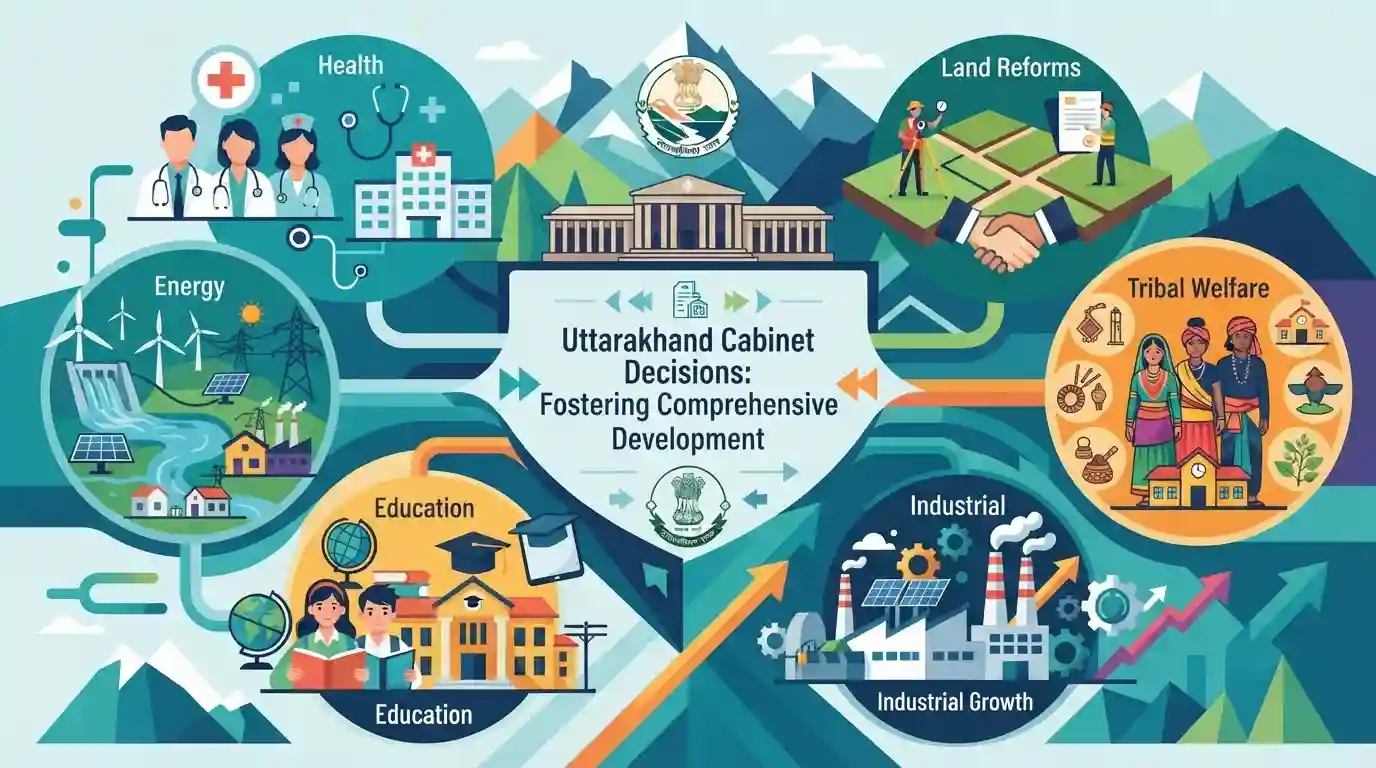
The Uttarakhand Cabinet cleared major policy decisions covering diverse domains including health, land reforms, tribal welfare, industrial growth, education, and energy to foster comprehensive development in the hill state.
Key Points
- The Uttarakhand Cabinet approved several multi-sectoral policy decisions impacting health, land reforms, tribal welfare, industrial growth, education, and energy sectors in the state.
- These decisions are aimed at accelerating administrative efficiency, improving grassroots infrastructure, and boosting socio-economic development across Uttarakhand.
- Key administrative and legislative frameworks were streamlined to support industrial expansion and welfare schemes.
Important Terms
Uttarakhand Cabinet

The supreme executive decision-making body of the government of Uttarakhand, headed by the Chief Minister, responsible for framing state policies, legislation, and administrative reforms.
UPSC context
Relevant for UKPSC (GS Paper II / State Governance), testing the structure, executive powers, and policy formulation role of state cabinets in governance.
State Government of Uttarakhand
The apex provincial executive authority in Uttarakhand comprising elected representatives and administrative departments tasked with governance, law enforcement, and socio-economic development of the state.
UPSC context
Important for UKPSC syllabus on Uttarakhand Polity and Administration, focusing on state-level executive machinery and policy implementation.
Prelims Trap
Uttarakhand Voluntary and Partial Consolidation (Chakbandi) Incentive Policy, 2026
Aspirants often assume land consolidation (Chakbandi) is entirely mandatory across all districts, missing that the new 2026 policy is voluntary, partial, and specifically targets only five villages per district annually.
Static Concepts Connected
What are the key institutional bodies and mechanisms governing land reforms and industrial development in Uttarakhand?
- SIDCUL Role: SIDCUL acts as the nodal agency for establishing industrial estates and infrastructure development across the state.
- Land Consolidation: Chakbandi (land consolidation) addresses severe land fragmentation caused by hilly terrain and traditional inheritance laws.
- Tribal Administration: Article 275(1) and Fifth/Sixth Schedule frameworks guide tribal welfare administration in specific hill districts.
Cross-Topic Patterns
Land Reforms vs Industrialization in Hill States
Uttarakhand's Chakbandi policy and land transfer to SIDCUL directly test the friction between eco-fragile mountain topography and industrial land acquisition under the Uttarakhand Land Reforms Act.
Green Energy Transition & Hill Geography
Green Hydrogen Policy 2026 links state-level clean energy transition to national net-zero goals, leveraging Himalayan hydro potential for decentralized power generation.

Expect a statement-based question pairing the Green Hydrogen Policy 2026 with the Chakbandi Incentive Policy targets in UKPSC Mains/Pre.
Linked PYQs · 2
Linked PYQs · 2
- 2025UKPSC_PRELIMSGS1
Consider the following statements and select the correct answer from the options given below : Statement 1 : The State Council for Climate Change (SCCC) of Uttarakhand was established in the year 2011. Statement 2 : The responsibility of preparing Uttarakhand Action Plan on Climate Change (UAPCC) was given to the State Revenue Department.
- 2024UKPSC_PRELIMSGS1
UTDB is established in Uttarakhand to promote:
