Uttarakhand Cabinet Approves Amendments to Uniform Civil Code Rules
Why It Matters
As Uttarakhand becomes a pioneer in considering and refining rules for the Uniform Civil Code (UCC), tracking these administrative modifications is vital for understanding state-level implementation of constitutional objectives like Article 44.
Summary
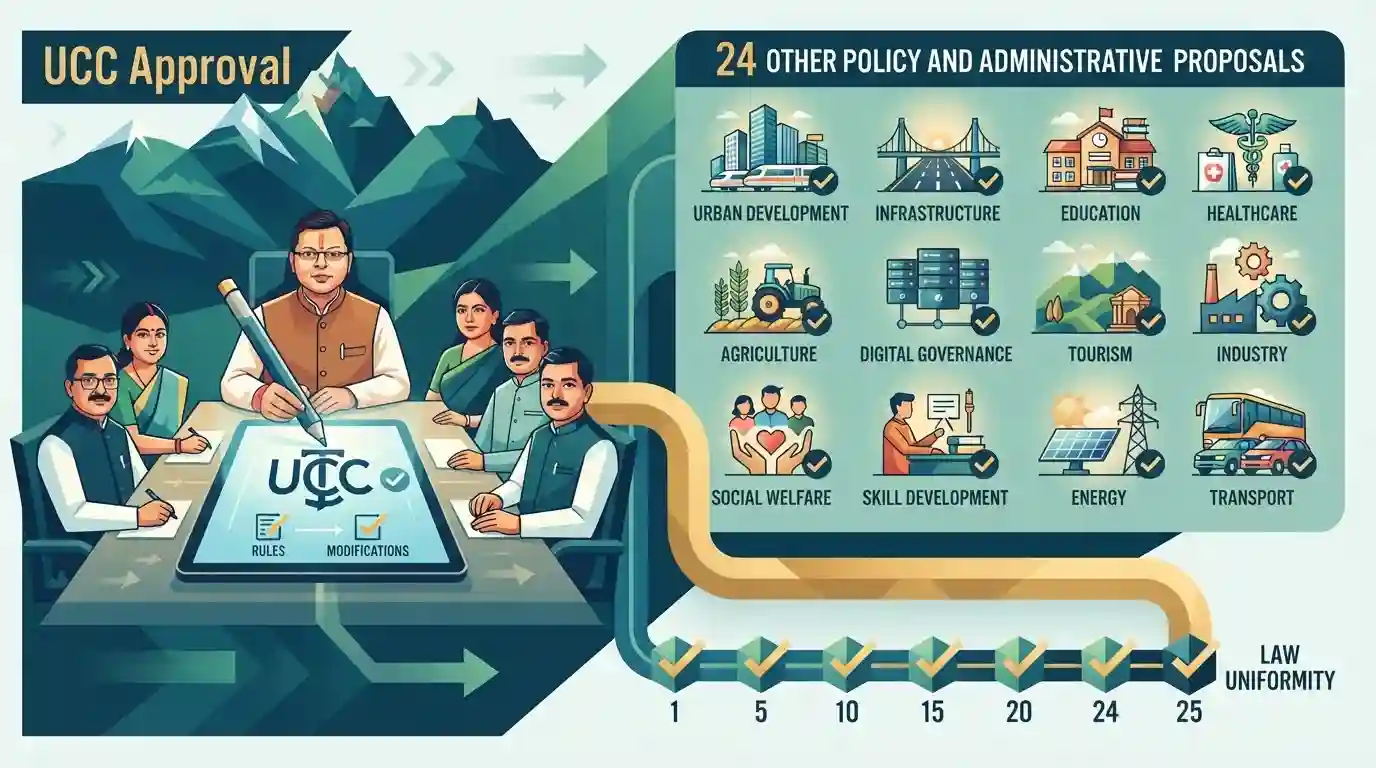
The Uttarakhand Cabinet, led by Chief Minister Pushkar Singh Dhami, approved modifications to the Uniform Civil Code (UCC) rules along with 24 other policy and administrative proposals, advancing the state's legislative agenda regarding civil law uniformity.
Key Points
- The Uttarakhand Cabinet has approved changes and amendments to the Uniform Civil Code (UCC) rules, alongside several other administrative and policy proposals.
- The decisions were taken during a cabinet meeting chaired by Chief Minister Pushkar Singh Dhami in Dehradun.
- The state is positioning itself to implement the landmark UCC framework, making structural refinements to streamline the execution of its rules.
- Other proposals cleared by the cabinet cover various aspects of state governance, infrastructure, and public welfare schemes.
Important Terms
Uniform Civil Code (UCC) Rules

Procedural and administrative regulations framed to implement the Uniform Civil Code Act in Uttarakhand, covering registration of marriages, divorces, live-in relationships, and inheritance.
UPSC context
UKPSC Mains Paper II (Polity and Governance): Tests understanding of state-level legislation, civil law uniformity, and administrative rule-making.
Uttarakhand Cabinet
The executive body of the Uttarakhand government headed by the Chief Minister, responsible for policy formulation, administrative approvals, and state legislative decisions.
UPSC context
UKPSC Prelims and Mains: Tests knowledge of state executive functioning, the role of the Council of Ministers, and governance in Uttarakhand.
State Government of Uttarakhand
The sub-national governing authority of Uttarakhand comprising the Governor, Council of Ministers, and administrative machinery functioning under the Constitution of India.
UPSC context
UKPSC General Studies: Essential for questions relating to state administration, governance structures, policy implementation, and legislative developments in Uttarakhand.
Prelims Trap
Only Parliament holds the constitutional competence to legislate on matters related to the Uniform Civil Code and personal laws.
Aspirants often assume a Uniform Civil Code can only be enacted by Parliament, overlooking that civil law and procedure fall under the Concurrent List (List III) of the Seventh Schedule.
Static Concepts Connected
What are the key constitutional provisions and legislative entries regarding the Uniform Civil Code in India?
- Constitutional Basis: Enshrined under Article 44 of the Directive Principles of State Policy, directing the state to secure a uniform civil code throughout India.
- Legislative Competence: Both Parliament and State Legislatures can legislate on matters in the Concurrent List (List III, Entry 5), which includes 'Marriage and divorce; infants and minors; adoption; wills, intestacy and succession'.
- Precedent: Goa remains the only Indian state to operate a pre-existing uniform civil code based on the Portuguese Civil Code of 1867.
Cross-Topic Patterns
UCC Implementation vs. DPSP Article 44
Article 44 of the Directive Principles of State Policy provides the constitutional anchor for state-led civil legislation experiments like Uttarakhand's UCC.
State Legislation & Presidential Assent Dynamics
State-level enactments requiring Presidential assent under Article 201 highlight the interplay between federal legislative domains and concurrent subject entries.

Uttarakhand's UCC rules and constitutional validity under Concurrent List entries will likely feature in Mains paper analysis.
Linked PYQs · 2
Linked PYQs · 2
- 2021UKPSC_PRELIMSGS1
Who among the following was the Chief Minister of Uttarakhand, who declared in the legislative Assembly that Gairsain would be the summer capital of Uttarakhand ?
- 2024UKPSC_PRELIMSGS1
Regarding the Directive Principles of State Policy, which one of the following statements is not correct ?
