Uttarakhand Cabinet Ends Madrasa Grants and Declares Full Literacy
Source:indianmasterminds ↗
Why It Matters
These state cabinet decisions touch upon demographic milestones (literacy rate), major administrative guidelines (mule insurance on pilgrim routes, reservation verification for statehood agitators), and policy updates (Minority Education Act, institutional land transfers) which are critical topics for state-specific static and current affairs questions in UKPSC PCS Prelims.
Summary
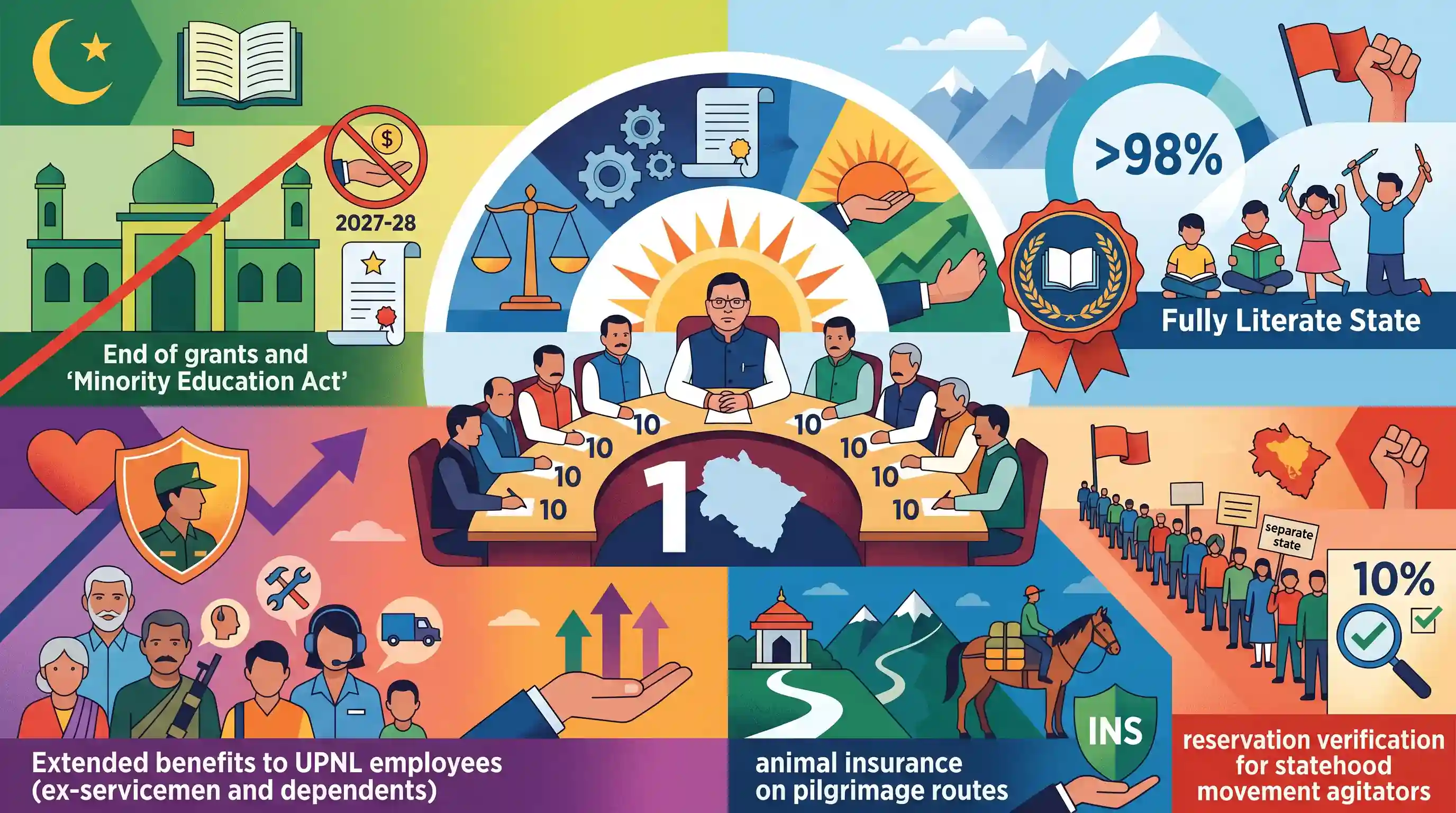
Chaired by Chief Minister Pushkar Singh Dhami, the Uttarakhand Cabinet approved 10 major decisions focusing on governance, minority education, welfare, and infrastructure. Key moves include ending grants-in-aid to Arabia Madrasas from FY 2027-28 under the Uttarakhand Minority Education Act, declaring Uttarakhand a 'Fully Literate State' (crossing 98% literacy), extending benefits to UPNL employees, introducing animal insurance on pilgrimage routes, and facilitating 10% reservation verification for statehood movement agitators.
Key Points
- The Dhami Cabinet approved the elimination of grant-in-aid budget provisions for Arabia Madrasas starting from the financial year 2027-28, aligned with the Uttarakhand Minority Education Act.
- Uttarakhand has been officially declared a 'Fully Literate State' after the state's literacy rate crossed the 98% threshold.
- An insurance support scheme for horses and mules on the Char Dham and Hemkund Sahib routes was cleared, with the state government bearing 20% of the premium and animal owners paying 80%.
- Statehood movement activists and their dependents will get extra time for certificate verification to claim benefits under the 10% reservation in UKSSSC recruitment.
- The cut-off date for UPNL employees under the 'Equal Pay for Equal Work' policy was extended from November 12, 2018, to August 15, 2024.
- Other infrastructure and development decisions include land transfer to the Nanhi Pari Frontier Technology Institute in Pithoragarh, specialist posts for CAP, a PMU for the Overseas Employment Cell, and Akshaya Patra managing PM Poshan meals in Srinagar (Pauri Garhwal).
Important Terms
Uttarakhand Minority Education Act

State legislation that streamlines recognition of minority educational institutions, integrates them into the state education board, and replaces sectarian regulatory boards (such as the Madrasa Board).
UPSC context
GS Paper II: Constitutional provisions (Articles 29-30) and welfare initiatives for minority communities.
PM Poshan Scheme
A centrally sponsored nutrition program, formerly the Mid-Day Meal Scheme, providing hot cooked meals to school children to tackle malnutrition, improve health, and boost enrollment.
UPSC context
GS Paper II: Issues relating to hunger, poverty, and welfare schemes for vulnerable sections.
Akshaya Patra Foundation
A non-profit NGO that operates under a public-private partnership with the Indian government to implement nutritional welfare programs and serve freshly cooked school mid-day meals.
UPSC context
GS Paper II: Role of civil society organizations, NGOs, and public-private partnerships.
Uttarakhand Purva Sainik Kalyan Nigam Limited (UPNL)
A state government undertaking in Uttarakhand that facilitates post-retirement employment, skill development, and contractual welfare for ex-servicemen, their dependents, and general outsourced personnel.
UPSC context
GS Paper II: Welfare schemes for vulnerable sections and human resources in governance.
Centre for Aromatic Plants (CAP)
A scientific state institution in Selaqui, Dehradun, specializing in research, processing, value addition, and commercialization of essential oils, medicinal plants, and high-value aromatic crops.
UPSC context
GS Paper III: Technology missions in agriculture and economic diversification in hilly regions.
Uttarakhand River Rafting/Kayaking (Amendment) Rules, 2026
State-level amendments implemented to make water adventure tourism safer by introducing stricter safety equipment rules, mandatory guide certifications, and penal measures against non-compliant operators.
UPSC context
GS Paper III: Disaster management, hazard mitigation, and adventure tourism regulations.
Prelims Trap
Horizontal reservation for statehood activists is applied additionally on top of vertical quotas, bypassing the 50% overall reservation ceiling.
Horizontal reservations do not add to the overall ceiling; they are adjusted within existing vertical categories (SC/ST/OBC/UR) in an interlocking manner.
Static Concepts Connected
What is the constitutional distinction between Vertical and Horizontal Reservations in India?
- Vertical Reservation: Applies to SCs, STs, and OBCs under Article 16(4), creating separate social groups that do not overlap.
- Horizontal Reservation: Applies to categories like women, veterans, and physical disabilities under Articles 15(3) or 16(1), cutting across the vertical categories.
- Interlocking Adjustment: In Rajesh Kumar Daria v. RPSC, the SC ruled that horizontal quotas are carved out of, not added to, corresponding vertical limits.
What are the key constitutional safeguards and limits for minority educational institutions?
- Article 30(1): Grants all religious and linguistic minorities the right to establish and administer educational institutions of their choice.
- Article 30(2): Prohibits the State from discriminating against any educational institution in granting financial aid on the grounds of minority management.
- Regulatory Limits: The Supreme Court has established that the state can introduce regulatory measures to ensure academic standards, safety, and national security.
Cross-Topic Patterns
Minority education and fiscal federalism
The shift from state-funded madrasa grants to central U-DISE integration highlights how state administrative actions increasingly rely on central digital infrastructure for education tracking.
Literacy targets and MPI outcomes
Achieving 'Fully Literate State' status under ULLAS directly improves multi-dimensional poverty metrics, demonstrating how governance interventions feed into international SDG 4 indices.

2026 Prelims may test the constitutional mechanism of horizontal reservations alongside Article 30 minority education safeguards.
Linked PYQs · 3
Linked PYQs · 3
- 2012UKPSC_PRELIMSGS1
As per 2011 Census, literacy rate of Uttarakhand State is:
- 2024UKPSC_PRELIMSGS1
As per census 2011, which of the following district of Uttarakhand had lowest female literacy rate ?
- 2021UKPSC_PRELIMSGS1
Which of the following places is not associated with SIIDCUL ?
