Uttarakhand Cabinet Approves Literacy Milestone and Welfare Changes
Source:indianmasterminds ↗
Why It Matters
This article details structural policy changes in Uttarakhand (stopping madrasa grants, achieving 98% literacy, animal insurance, and horizontal reservation for statehood activists) which are highly relevant for UKPSC PCS Prelims questions on state demographics, regional administration, social welfare, and polity.
Summary
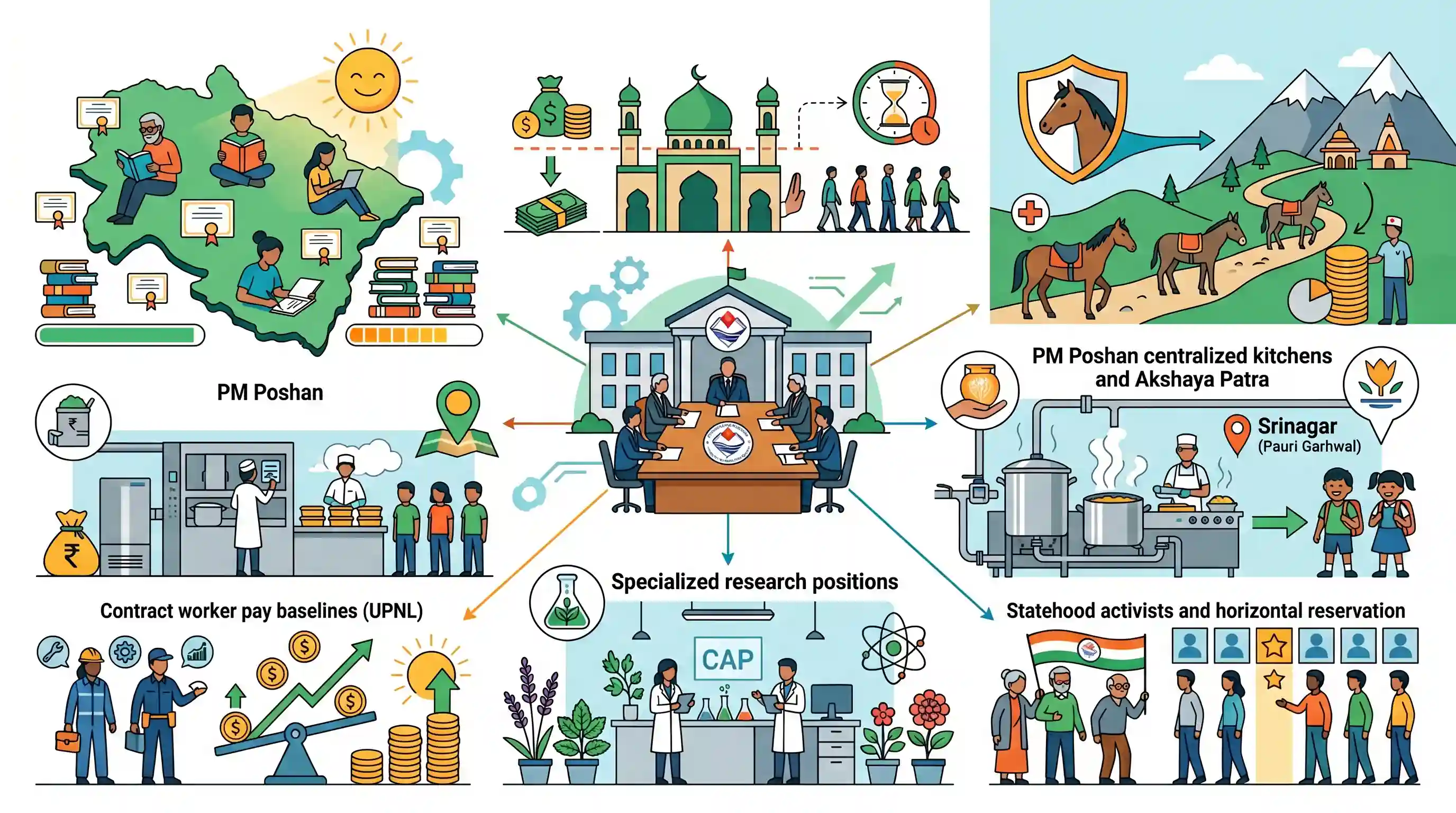
The Uttarakhand State Cabinet, in its recent meeting, passed ten crucial policy decisions. Key highlights include the termination of Arabia Madrasa grant-in-aid starting from FY 2027-28, declaring Uttarakhand a fully literate state with a literacy rate over 98%, launching horse/mule insurance for Char Dham routes (with 20% state-subsidized premium), and introducing PM Poshan centralized kitchens in Srinagar (Pauri Garhwal) managed by the Akshaya Patra Foundation. Furthermore, the cabinet adjusted contract worker pay baselines for UPNL, created specialized research positions at the Centre for Aromatic Plants (CAP) in Selaqui, and provided administrative easements for statehood activists claiming 10% horizontal reservation in state service recruitments.
Key Points
- The Uttarakhand Cabinet approved 10 major decisions, including the phase-out of the grant-in-aid budget for Arabia Madrasas from the 2027-28 financial year under the Uttarakhand Minority Education Act.
- Uttarakhand was officially approved to be declared a 'Fully Literate State' as its literacy rate (for the 7 to 60 age group) crossed 98%.
- Under the PM Poshan Scheme, the Akshaya Patra Foundation was authorized to establish a centralized kitchen in Srinagar (Pauri Garhwal) to supply cooked mid-day meals to government schools (Classes 1 to 8).
- The Cabinet approved an insurance scheme for horses and mules operating on the Char Dham and Hemkund Sahib pilgrim routes, with the state government bearing 20% of the premium and owners paying 80%.
- Approved the creation of 5 specialist posts under the Agriculture Department at the Centre for Aromatic Plants (CAP) located in Selaqui, Dehradun.
- Approved extra time for certificate verification for statehood activists and their dependents who qualify under the 10% horizontal reservation in UKSSSC recruitment.
- Revised the cut-off date to August 15, 2024, to extend 'Equal Pay for Equal Work' benefits to UPNL (Uttarakhand Purva Sainik Kalyan Nigam Limited) employees.
- Approved 14.857 hectares of land transfer in Madhdhura, Pithoragarh, for the Nanhi Pari Frontier Technology Institute, and cleared plans for the International Himalayan Car Rally to boost adventure tourism.
- Authorized adjustments to PWD road project tender limits/rates in response to crude oil price hikes driven by Middle East geopolitical tensions.
- Sanctioned posts for conducting concurrent audits for the upcoming Haridwar Kumbh Mela 2027.
Important Terms
Uttarakhand Minority Education Act

State legislation that abolished the Uttarakhand Madrasa Education Board, mandating madrasas register with the State School Education Board and follow NCERT curriculum for modern subjects.
UPSC context
GS Paper II: Governance & Education Policies. Tests issues surrounding secular curriculum integration and minority educational institutions.
PM Poshan Scheme
A centrally sponsored scheme providing one hot cooked meal daily to students in government and government-aided schools to improve nutritional status and enrollment.
UPSC context
GS Paper II: Social Justice & Welfare Schemes. Tests governance approaches to addressing child malnutrition, hunger, and basic education.
Akshaya Patra Foundation
A non-profit organization in India that collaborates with governments to implement the PM Poshan program via state-of-the-art centralized kitchens.
UPSC context
GS Paper II: Role of NGOs & Civil Society. Analyzes public-private partnerships in public service delivery.
Centre for Aromatic Plants (CAP)
An autonomous research and development institute under the Uttarakhand Department of Horticulture, acting as a nodal agency for the state's aromatic sector.
UPSC context
GS Paper III: Agriculture & Rural Development. Explores value-addition in horticulture and specialized botanical research bodies.
Uttarakhand Purva Sainik Kalyan Nigam Limited (UPNL)
A state public sector undertaking in Uttarakhand that manages contractual recruitment and welfare services, primarily for ex-servicemen and their dependents.
UPSC context
GS Paper II: Government policies & public employment. Concerns veteran welfare and contractual labor reforms.
Nanhi Pari Seemant Engineering Institute
A public engineering college located in Pithoragarh, Uttarakhand, established to make technical higher education accessible in remote border regions.
UPSC context
GS Paper II: Human resource development & education. Evaluates infrastructure development in geographically isolated/border areas.
Prelims Trap
Minority-run institutions have an absolute fundamental right to state grant-in-aid under Article 30.
While Article 30(2) bars discrimination in aid, the Supreme Court has clarified that receiving aid is not an absolute fundamental right of minority institutions.
Static Concepts Connected
What is the constitutional distinction between vertical and horizontal reservation?
- Vertical Reservation: Applies to SCs, STs, and OBCs under Article 16(4), creating distinct, non-overlapping pools.
- Horizontal Reservation: Refers to compartmentalized quotas (e.g., women, statehood activists) cutting across vertical categories under Article 16(1).
- Judicial Precedent: The Supreme Court (Rajesh Kumar Daria case) ruled horizontal quotas adjust within, rather than add to, vertical pools.
Does the Constitution guarantee a fundamental right to state aid for minority institutions?
- Article 30(2): The State cannot discriminate against minority-managed institutions when distributing aid, but funding itself is not guaranteed.
- Supreme Court Stance: The Court holds that receiving state financial aid is a policy matter, not an absolute fundamental right.
- Regulatory Control: Governments can impose non-discriminatory conditions on grants to ensure academic standards and administrative efficiency.
Cross-Topic Patterns
State aid & secular education
Phasing out Madrasa grants highlights the tension between fiscal secularism and protecting the educational rights of minorities under Article 30.
Himalayan tourism & local ecology
Subsidized insurance for pilgrim-route pack animals showcases policy-driven interventions managing high-altitude ecological strain and animal welfare.

The legal boundary of state power in withholding grant-in-aid from minority institutions is highly likely to be tested in CSE Polity.
Linked PYQs · 4
Linked PYQs · 4
- 2012UKPSC_PRELIMSGS1
As per 2011 Census, literacy rate of Uttarakhand State is:
- 2024UKPSC_PRELIMSGS1
As per census 2011, which of the following district of Uttarakhand had lowest female literacy rate ?
- 2025UKPSC_PRELIMSGS1
Consider the following statements about 'Right to Education' and choose the correct answer : 1. It try to achieve the aim of 'Education for All'. 2. Earlier a provision of free and compulsory education was provided in Part IV of the Constitution. 3. It became Fundamental Right after 91ˢᵗ Constitutional Amendment.
- 2012UKPSC_PRELIMSGS1
Under which article of the Constitution reservations in admission to educational institutions, including private and unaided, to OBCs/ST/SC is made?
