Uttarakhand State Budget Analysis Outlines Fiscal Deficit Trends
Source:prsindia ↗
Why It Matters
Understanding state budget allocations, fiscal deficit trends, and revenue sources in Uttarakhand is essential for aspirants preparing for UKPSC PCS Prelims questions regarding state economy and governance.
Summary
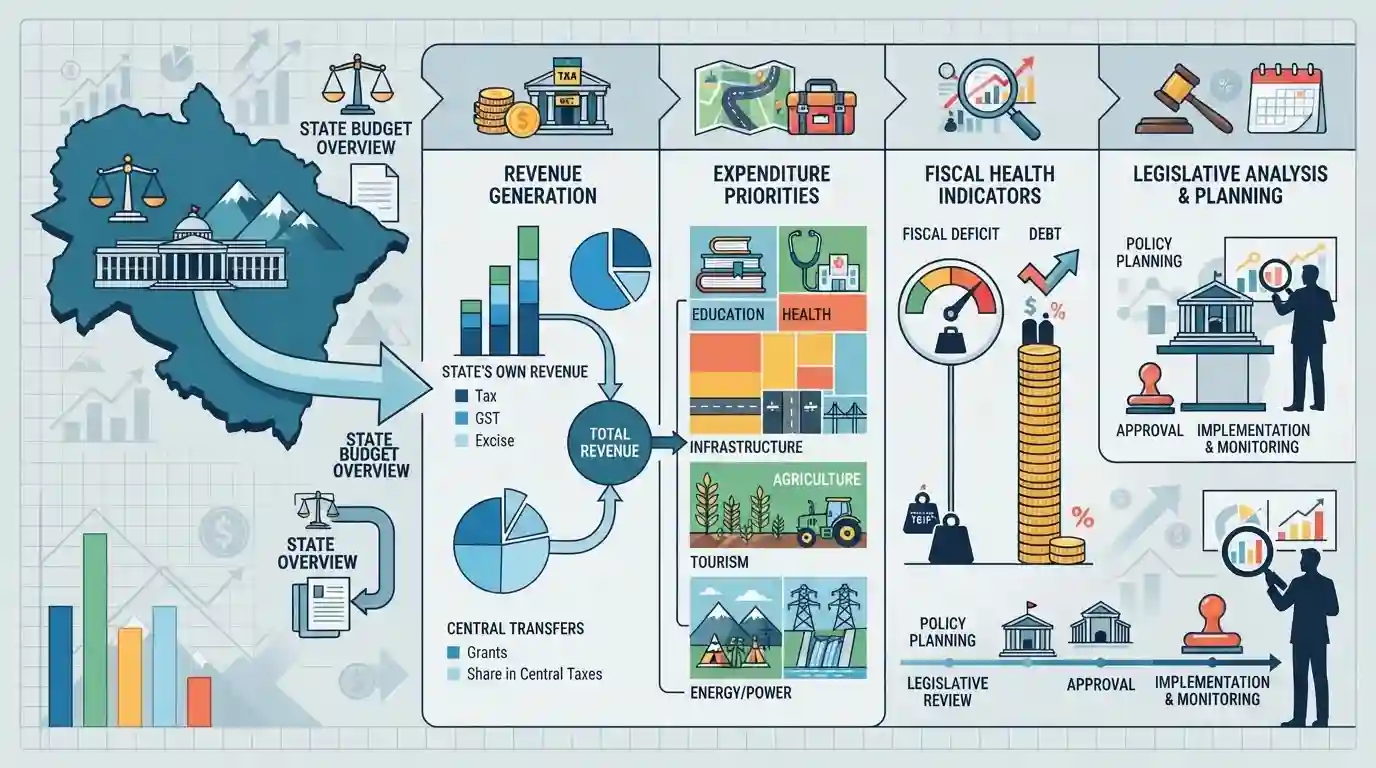
This article provides a comprehensive overview and legislative analysis of the Uttarakhand state budget, focusing on state revenue, expenditure priorities, fiscal health indicators like fiscal deficit and debt, and sector-wise resource allocation crucial for state-level financial planning.
Key Points
- The Uttarakhand state budget analysis outlines key macro-fiscal indicators including total expenditure, receipts, fiscal deficit, and revenue surplus.
- Evaluates the allocation of resources towards key sectors such as education, health, rural development, and infrastructure in Uttarakhand.
- Highlights structural patterns in state finances, including reliance on central transfers, own-tax revenues, and debt management under the FRBM framework.
Important Terms
Uttarakhand Fiscal Responsibility and Budget Management (FRBM) Act 2005

A statutory framework enacted by Uttarakhand in 2005 to ensure fiscal stability, eliminate revenue deficit, and cap fiscal deficit and public debt relative to the Gross State Domestic Product (GSDP).
UPSC context
UPSC/UKPSC GS Paper III (Economy - State Finances, Fiscal Policy). Tests knowledge of statutory fiscal discipline rules.
PRS Legislative Research
An independent policy and legislative research institution that provides analytical summaries, data visualization, and comprehensive breakdowns of Indian state budgets and bills.
UPSC context
UPSC/UKPSC GS Paper II/III (Governance & Budgetary Process). Useful for citing structured analysis of state allocations and deficits.
Government of Uttarakhand
The executive body of Uttarakhand headed by the Chief Minister and Finance Minister, responsible for formulating, presenting, and executing the annual financial statement (state budget) in the legislative assembly.
UPSC context
UPSC/UKPSC GS Paper II (Indian Polity - State Government Executive and Legislature) and Economy.
Prelims Trap
The FRBM Act mandates that Uttarakhand maintain a revenue deficit of 3 percent of GSDP.
Aspirants often confuse the FRBM fiscal deficit ceiling (3% of GSDP) with the revenue deficit target, forgetting that revenue surplus is ideally targeted to fund capital outlays.
Static Concepts Connected
What are the core pillars and fiscal targets under the Uttarakhand FRBM Act?
- Statutory Origin: Legislative enactment enacted in 2005 to ensure long-term macroeconomic stability and fiscal prudence.
- Fiscal Deficit Cap: Limits the annual fiscal deficit to 3 percent of the Gross State Domestic Product (GSDP) as per Finance Commission norms.
- Revenue Surplus: Mandates the elimination of revenue deficit and generation of revenue surplus to fund capital infrastructure.
Cross-Topic Patterns
State Budgets & Finance Commission Devolution
Uttarakhand's dependence on central tax devolution links state budgetary planning directly to the recommendations of the Finance Commission and federal fiscal transfers.
Hilly Eco-Sensitivities & Capital Expenditure
Balancing eco-sensitive zone mandates with infrastructure funding requires innovative green budgeting and capital expenditure strategies in hill states.

Expect a 2-statement question pairing Uttarakhand's FRBM fiscal deficit limits (3% GSDP) with its revenue surplus targets.
Linked PYQs · 2
Linked PYQs · 2
- 2024UKPSC_PRELIMSGS1
When did the Government of Uttarakhand pass the Fiscal Responsibility and Budget Management Act ?
- 2024UKPSC_PRELIMSGS1
On the basis of NFHS 2019-21 survey, the Multidimensional poverty in Uttarakhand in 2019-21 was
