Uttarakhand Minority Education Rules and Authority Setup
Source:myind ↗
Why It Matters
This reform represents a landmark administrative shift in minority education by integrating madrasas into the mainstream state education framework. It balances constitutional protections for minorities under Article 30 with state-level oversight to ensure uniform standards of quality education, modern curriculum implementation, and proper teacher qualifications.
Summary
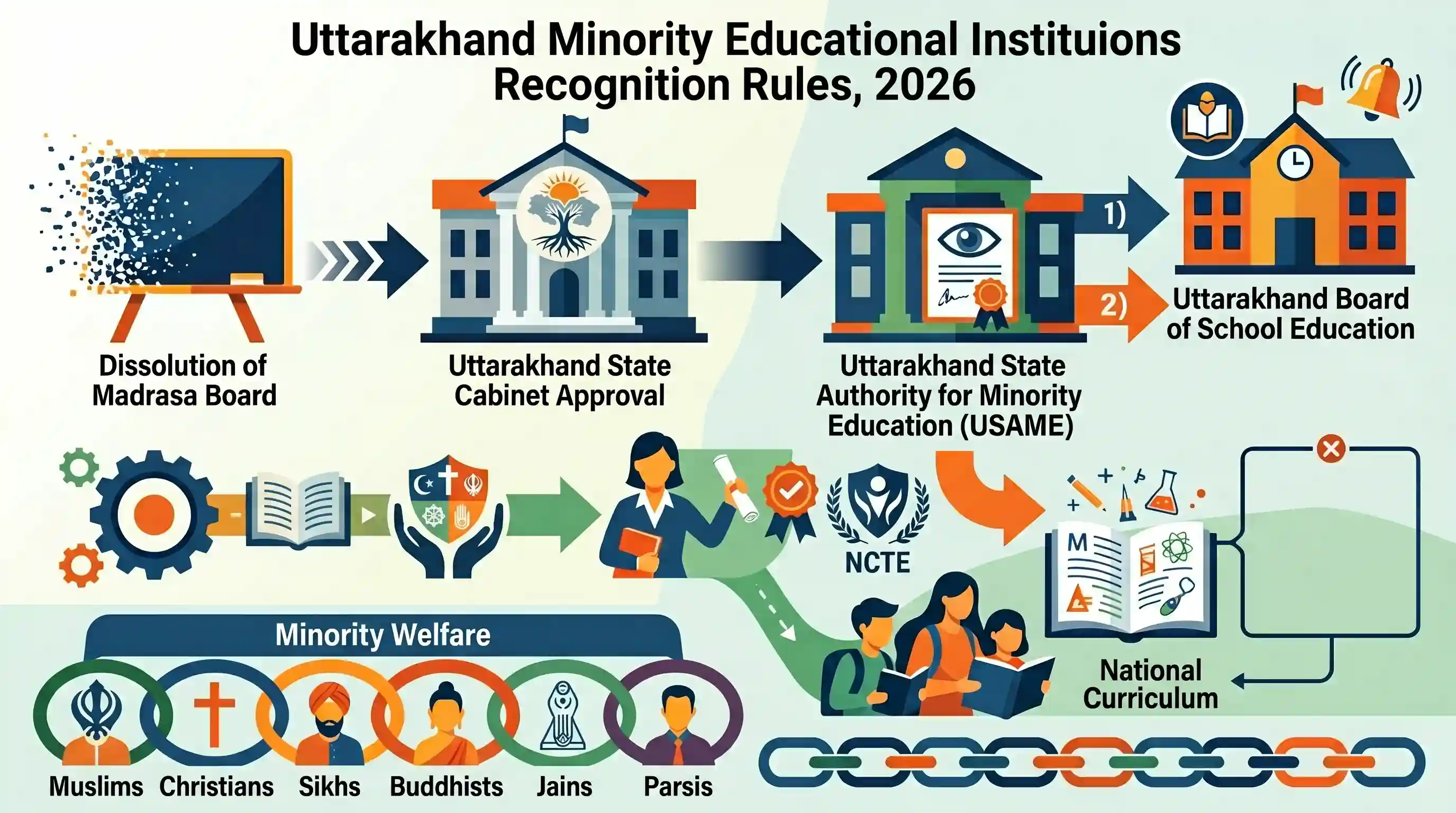
The Uttarakhand state cabinet has approved the Uttarakhand Minority Educational Institutions Recognition Rules, 2026, under Section 19 of the Uttarakhand Minority Education Act, 2025. Set to take effect on July 1, 2026, these rules dissolve the existing Uttarakhand Madrasa Board and replace it with a newly formed Uttarakhand State Authority for Minority Education (USAME). Under the new framework, madrasas and other minority educational institutions must secure affiliation with the Uttarakhand Board of School Education and obtain recognition from USAME. While religious education remains permitted under regulation, institutions must adopt a national curriculum and comply with the teacher qualification standards mandated by the National Council for Teacher Education (NCTE). The rules apply to the state's six recognized minority communities: Muslims, Christians, Sikhs, Buddhists, Jains, and Parsis.
Key Points
- The Uttarakhand Cabinet, chaired by Chief Minister Pushkar Singh Dhami, approved the Uttarakhand Minority Educational Institutions Recognition Rules, 2026.
- Framed under Section 19 of the Uttarakhand Minority Education Act, 2025, the new rules will dissolve the Uttarakhand Madrasa Board effective July 1, 2026.
- A new statutory regulatory body, the Uttarakhand State Authority for Minority Education (USAME), will assume administrative and recognition oversight for all minority educational institutions in the state, including madrasas.
- To operate legally, madrasas must obtain affiliation from the Uttarakhand Board of School Education and formal recognition from USAME.
- Implementing a standardized national curriculum is now compulsory for all registered minority schools, though religious education will be permitted under USAME's regulation.
- Teacher qualifications across all state minority educational institutions must adhere to standards established by the National Council for Teacher Education (NCTE).
- The regulation identifies and covers six notified minority communities: Muslims, Christians, Sikhs, Buddhists, Jains, and Parsis.
Important Terms
Uttarakhand State Authority for Minority Education (USAME)

A newly established statutory body in Uttarakhand that regulates, grants recognition to, and oversees academic standards for all minority educational institutions, replacing the state's former Madrasa Board.
UPSC context
GS Paper II (Statutory Bodies & Social Justice). Tests knowledge of state-level institutional frameworks governing welfare and educational standards of minority communities.
Uttarakhand Minority Education Act, 2025
A state law that consolidates the regulation of minority educational institutions from six notified communities under a single authority, repealing the Madrasa Board and mandating the adoption of a national curriculum.
UPSC context
GS Paper II (Polity & Governance). Tests understanding of state laws regulating minority rights and their alignment with national educational policies.
National Council for Teacher Education (NCTE)
A statutory body of the Government of India established under the NCTE Act, 1993, to plan, coordinate, and regulate standards, procedures, and teacher education programs nationwide.
UPSC context
GS Paper II (Statutory Bodies & Education). Tests understanding of regulatory agencies overseeing teacher qualifications and institutional standards in the education sector.
Uttarakhand Minority Educational Institutions Recognition Rules, 2026
Approved state rules under Section 19 of the 2025 Act that mandate minority institutions to secure affiliation with the school education board and online recognition from USAME.
UPSC context
GS Paper II (Governance & Social Justice). Analyzes delegated state legislation implementing regulatory frameworks for minority and religious schooling.
Uttarakhand Madrasa Board
The state-level statutory body formerly responsible for recognizing and regulating madrasas in Uttarakhand; it was dissolved to unify minority education under a single state authority.
UPSC context
GS Paper II (Governance & Education). Evaluates restructuring of religious educational institutions, standardization of curricula, and implications for administrative autonomy.
Uttarakhand Board of School Education
The primary state agency in Uttarakhand responsible for prescribing secondary school curricula, conducting examinations, and affiliating schools, now tasked with affiliating minority educational institutions.
UPSC context
GS Paper II (Education Reforms). Tests understanding of state-level school boards and their role in integrating religious and minority schools into mainstream education.
Prelims Trap
The State cannot mandate teacher eligibility criteria or national curricula for minority institutions as it violates Article 30.
The Supreme Court has consistently held that regulations ensuring academic excellence, national standards, and teacher qualifications do not infringe upon the rights guaranteed under Article 30.
Static Concepts Connected
Can the State regulate minority educational institutions under Article 30?
- No absolute right: The right to establish and administer under Article 30(1) is not absolute and is subject to reasonable state regulations.
- Permissible regulations: The State can prescribe minimum qualifications for teachers, national curriculum standards, and measures to maintain health and sanitation.
- Judicial precedent: In the West Bengal Madrasah case (2020), the Supreme Court upheld state-created commissions to nominate teachers for minority schools.
Are religious institutions like madrasas bound by the RTE Act, 2009?
- Statutory exemption: Sections 1(4) and 1(5) of the RTE Act, added in 2012, explicitly exempt madrasas, Vedic pathshalas, and religious institutions.
- Exemption impact: Due to this exemption, they are not legally bound to comply with standard RTE rules like reserving 25% seats for EWS.
Cross-Topic Patterns
State-wise minority determination
Under Article 30, minorities must be identified state-wise (TMA Pai), yet states often rely on the central NCM Act's list of six notified communities for administrative regulations.
Cooperative federalism in education
Education sits on the Concurrent List; thus, state-level minority educational reforms must carefully align with central standards established by statutory bodies like the NCTE.

Multi-statement questions on Article 30 limits, NCTE's statutory powers, and RTE Act exemptions for madrasas are highly probable in 2026.
Linked PYQs · 2
Linked PYQs · 2
- 2025UKPSC_PRELIMSGS1
Consider the following statements about 'Right to Education' and choose the correct answer : 1. It try to achieve the aim of 'Education for All'. 2. Earlier a provision of free and compulsory education was provided in Part IV of the Constitution. 3. It became Fundamental Right after 91ˢᵗ Constitutional Amendment.
- 2025UKPSC_PRELIMSGS1
Which of the following Central Ministries are responsible for the implementation of Protection of Civil Right Rules, 1977 ? 1. Ministry of Home Affairs 2. Ministry of Social Justice | Empowerment 3. Ministry of Minority Affairs 4. Ministry of Tribal Affairs
