Uttarakhand Highway Project Triggers Black Harela Protests
Source:newsgram ↗
Why It Matters
Highlights the critical tension between infrastructure expansion and ecological conservation in the fragile Himalayan region. It integrates cultural aspects, like the traditional Harela festival, into modern environmental activism, making it highly relevant for UKPSC questions on state festivals, geography, and ecology.
Summary
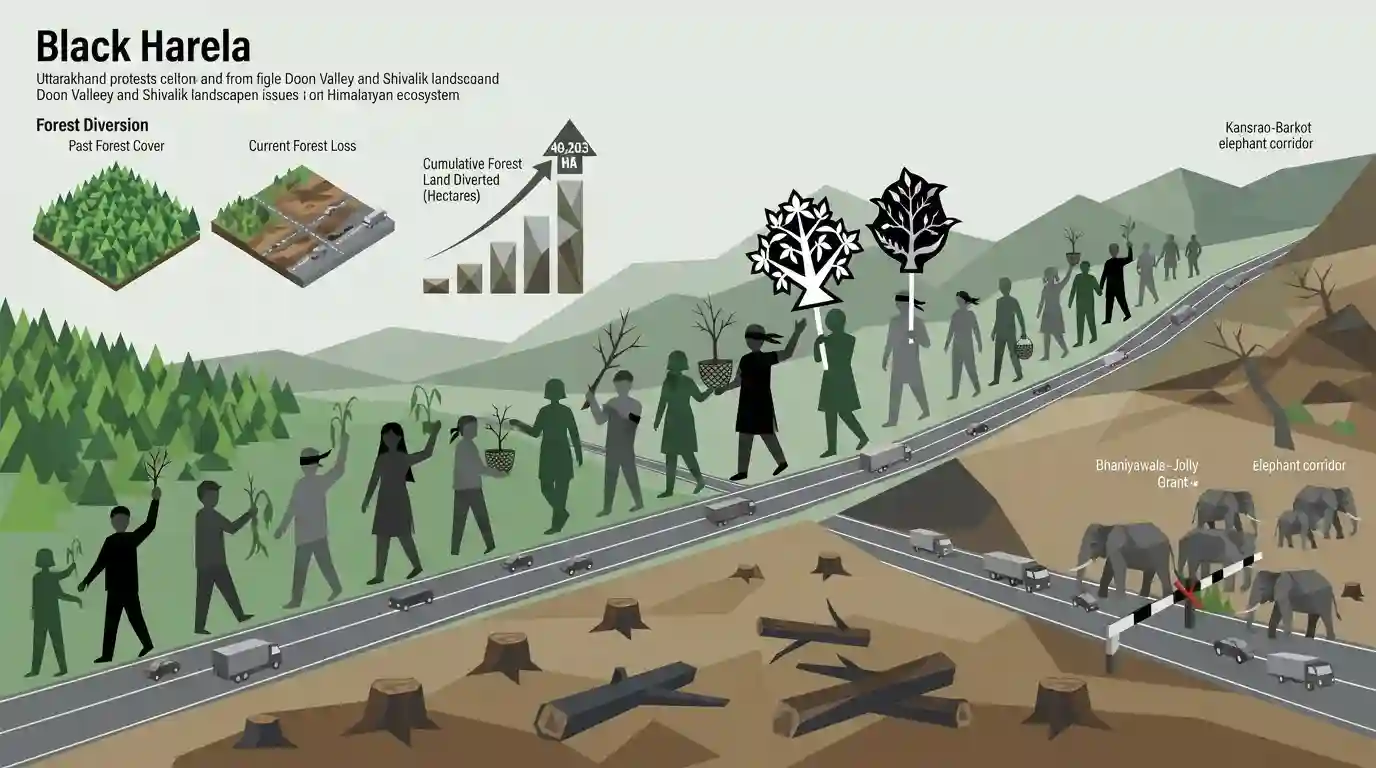
The article outlines the "Black Harela" protests in Uttarakhand against the felling of over 3,000 trees for the ₹743 crore Bhaniyawala–Jolly Grant–Rishikesh highway project. Demonstrators repurposed the traditional Harela festival, which celebrates nature and the monsoon, to mourn the ecological loss in the fragile Doon Valley and Shivalik landscape. The infrastructure project, executed under the Hybrid Annuity Mode (HAM), threatens vital wildlife habitats, including the Kansrao-Barkot elephant corridor. Compounding these concerns, RTI data indicates that Uttarakhand has diverted over 46,203 hectares of forest land since its formation in 2000, raising alarms among environmentalists about the long-term impacts on the Himalayan ecosystem, including increased vulnerability to soil erosion and climate change.
Key Points
- The ₹743 crore Bhaniyawala–Jolly Grant–Rishikesh highway project requires the felling of over 3,000 trees, triggering widespread environmental protests.
- Activists observed "Black Harela," repurposing the traditional Uttarakhand monsoon festival of nature to mourn ecological destruction.
- The highway cuts through the fragile Doon Valley and Shivalik landscape, posing a direct threat to the Kansrao-Barkot elephant corridor.
- RTI data reveals that over 46,203 hectares of forest land have been diverted for development in Uttarakhand since 2000, with nearly half of it in Dehradun district.
Important Terms
Harela Festival

A traditional Hindu agrarian festival in Uttarakhand celebrating nature, the monsoon, and the sowing season. Environmentalists recently observed it as "Black Harela" to protest widespread tree felling for a highway expansion.
UPSC context
GS-1 (Culture) & GS-3 (Environment). Demonstrates the intersection of cultural heritage, eco-consciousness, and modern environmental protest movements.
Hybrid Annuity Mode (HAM)
A Public-Private Partnership (PPP) model where the government pays 40% of the project cost during construction, and the private developer funds the remaining 60%, recovering it later via variable annuity payments.
UPSC context
GS-3 (Infrastructure/Economy). Tests knowledge of PPP models, risk-sharing mechanisms, and highway financing structures like EPC and BOT.
Kansrao-Barkot Elephant Corridor
An essential ecological pathway in Uttarakhand linking the Rajaji Tiger Reserve with the Barkot and Rishikesh ranges. It is currently threatened by linear infrastructure projects causing habitat fragmentation.
UPSC context
GS-3 (Biodiversity). Relevant to questions on wildlife corridors, human-wildlife conflict, and the environmental impact of infrastructure.
Forest Diversion
The authorized reallocation of protected forest land for non-forest activities, such as infrastructure or mining. In Uttarakhand, over 46,000 hectares have been diverted since 2000, triggering severe ecological concerns.
UPSC context
GS-3 (Environment). Crucial for topics concerning the Forest (Conservation) Act, sustainable development, and Himalayan ecological fragility.
National Highways Authority of India (NHAI)
A statutory body under the Ministry of Road Transport and Highways, responsible for the development, maintenance, and management of India's national highway network.
UPSC context
GS-3 (Infrastructure) & GS-2 (Statutory Bodies). Tests awareness of key infrastructure agencies and their role in national development projects.
Prelims Trap
Harela is a major agrarian monsoon festival of Chhattisgarh, while Hareli is celebrated in Uttarakhand.
UPSC often swaps similar-sounding cultural festivals. Harela is celebrated in Uttarakhand, whereas Hareli is celebrated in Chhattisgarh.
Static Concepts Connected
What are the core features of the Hybrid Annuity Model (HAM) in infrastructure?
- Risk allocation: The government (NHAI) bears the entire traffic and revenue risk, protecting the developer from commercial uncertainty.
- Funding split: Government funds 40% of the project cost during construction, while the developer raises the remaining 60%.
- Toll collection: NHAI collects all toll revenues and pays fixed annual payments (annuities) to the developer over 15 years.
What are the geomorphological vulnerabilities of the Shivalik Range and Doon Valley?
- Fragile lithology: Composed of unconsolidated sediments like sand and clay, making the slopes highly susceptible to landslides and erosion.
- Hydrological disruption: Longitudinal tectonic valleys (Duns) that act as crucial water recharge zones; deforestation severely disrupts local hydrology.
Cross-Topic Patterns
Infrastructure finance vs. Eco-clearance
Analyses how rapid clearances for Hybrid Annuity Model (HAM) projects can bypass rigorous Environment Impact Assessments (EIA), highlighting conflicts between infrastructure targets and ecological conservation.
Himalayan ecology vs. disaster vulnerability
Connects Shivalik deforestation to increased disaster vulnerability, highlighting how losing root-binding vegetation directly aggravates flash floods and land subsidence downstream.

UPSC 2026 may frame a GS-3 question linking Himalayan infrastructure expansion with the efficacy of Wildlife Corridor protection laws.
Linked PYQs · 4
Linked PYQs · 4
- 2016UKPSC_PRELIMSGS1
'HARELA' festival of Uttarakhand is related to:
- 2007UKPSC_PRELIMSGS1
Which of the following is not an effect of Deforestation in India?
- 2025UKPSC_PRELIMSGS1
Which of the following is the correct order of the following physiographic regions of Uttarakhand from south to north direction?
- 2025UKPSC_PRELIMSGS1
Consider the following statements with reference to animal husbandry in Uttarakhand. Select the correct answer from the codes given below : 1. Animal husbandry is a supplementary occupation of agriculture. 2. Sheep rearing in the mountainous areas has been affected by environmental degradation.
