Uttarakhand Plans New Eco Tourism Sites to Diversify Mountain Travel
Source:trav-talk-india ↗
Why It Matters
Promoting sustainable, community-led eco-tourism is critical for fragile Himalayan states to balance economic growth and local livelihoods with biodiversity conservation.
Summary
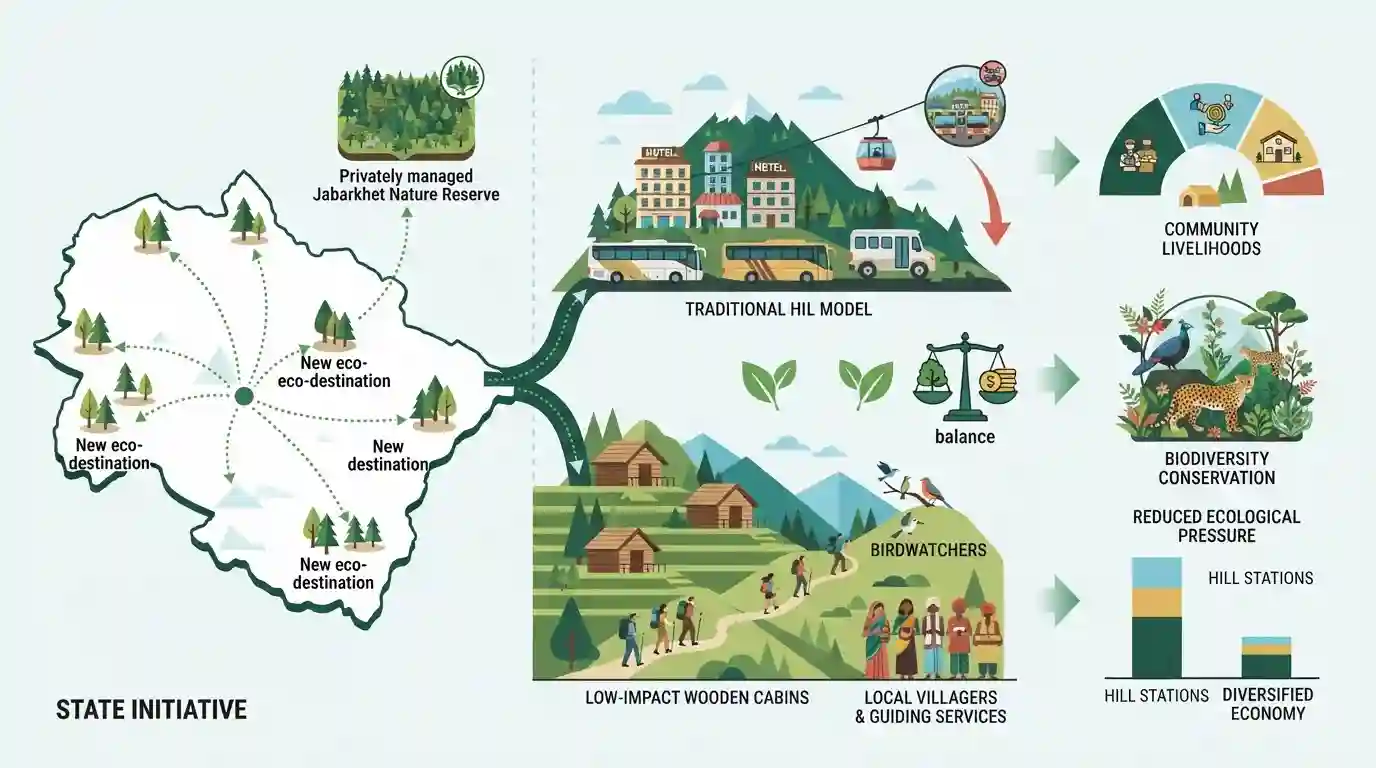
Uttarakhand is set to develop eight new eco-tourism destinations modelled on the privately managed Jabarkhet Nature Reserve. The initiative aims to shift the state's tourism focus towards sustainable, low-impact models that balance biodiversity conservation with community livelihoods. By expanding nature-based tourism, Uttarakhand hopes to diversify beyond its traditional pilgrimage circuits and reduce ecological pressure on crowded hill stations.
Key Points
- Uttarakhand's Forest Department plans to develop eight new eco-tourism destinations inspired by the successful Jabarkhet Nature Reserve model.
- The initiative aims to promote low-impact, conservation-led tourism that integrates scientific management with private participation.
- By shifting focus to eco-tourism, the state seeks to diversify its offerings and reduce pressure on overcrowded traditional pilgrimage and hill-station circuits.
- The project will support local livelihoods through community engagement, habitat restoration, and the creation of eco-lodges and guided experiences.
Important Terms
Jabarkhet Nature Reserve

A 100-acre restored Himalayan woodland near Mussoorie. It is India's first privately owned and operated nature reserve, recognized for prioritizing wildlife conservation, habitat restoration, and low-impact sustainable tourism over mass footfall.
UPSC context
GS-3 Environment. Tests knowledge of alternative conservation models, private sector participation in biodiversity, and sustainable tourism.
Uttarakhand Tourism Development Board (UTDB)
A statutory body chaired by Uttarakhand's Tourism Minister that acts as the highest advisory, regulatory, and licensing authority for tourism. It focuses on eco-friendly development and enhancing local employment.
UPSC context
GS-2 Statutory Bodies / GS-3 Economy. Relevant for state-level tourism administration and community-based revenue generation mechanisms.
Eco-tourism Roadmap
A strategic policy framework designed to transition from traditional mass tourism to sustainable, nature-based travel. It emphasizes low-impact infrastructure, biodiversity preservation, and integrating local communities into conservation-led livelihood models.
UPSC context
GS-3 Environment & Economy. Evaluates understanding of sustainable development goals, ecological carrying capacity, and green economic growth.
Uttarakhand Forest Department
The state government agency responsible for managing and protecting forest resources. In the context of eco-tourism, it identifies ecologically sensitive zones and designs site-specific action plans integrating tourism with conservation.
UPSC context
GS-3 Environment. Highlights the role of state agencies in executing sustainable eco-tourism projects and ensuring regulatory compliance.
Prelims Trap
Jabarkhet Nature Reserve is a Protected Area notified by the Central Government under the Wildlife Protection Act.
Jabarkhet is actually India’s first privately owned and operated wildlife sanctuary, pioneering a self-sustained conservation model outside the standard state-notified WPA protected area network.
Static Concepts Connected
What are the key features of Himalayan Montane Temperate Forests?
- Altitude Range: Typically found at elevations between 1,500 and 3,000 meters in the Himalayan region.
- Key Flora: Dominated by broad-leaved evergreen trees like Oak (Quercus) and Rhododendron, alongside conifers like Deodar and Pine.
- Ecosystem Role: Crucial for soil stabilization and water conservation in the mountains; highly sensitive to climate change, forest fires, and anthropogenic pressures.
How does Indian law formally recognize community participation in conservation?
- Community Reserves: Introduced in 2002 (WPA amendment); can be declared on private or community land where people volunteer to conserve wildlife and its habitat.
- Conservation Reserves: Declared on government-owned lands, acting as buffer zones or connectors between established national parks, sanctuaries, and reserved forests.
Cross-Topic Patterns
Eco-tourism & Himalayan Subsidence
The shift from mass pilgrimage (Char Dham) to low-impact eco-tourism links directly to disaster management and urban planning following the Joshimath land subsidence crisis.
Conservation livelihoods & Out-migration
Promoting rural eco-lodges and community-led trails acts as an economic countermeasure to the 'ghost villages' (out-migration) issue prevalent in Himalayan border states.

Carrying capacity, private conservation models, and Himalayan out-migration are likely to merge in a GS3 Mains question in 2026.
Linked PYQs · 4
Linked PYQs · 4
- 2024UKPSC_PRELIMSGS1
UTDB is established in Uttarakhand to promote:
- 2024UKPSC_PRELIMSGS1
Which of the following National Park of Uttarakhand has been included in Project Tiger Scheme in 2015 ?
- 2016UKPSC_PRELIMSGS1
In Uttarakhand, Oak-Rhododendron are characteristic plants of
- 2024UKPSC_PRELIMSGS1
Hindu religious pilgrimage place named 'Purnagiri' is situated in which of the following districts of Uttarakhand ?
