Uttarakhand Establishes First Resettlement Cell for Agniveers
Source:uniindia ↗
Why It Matters
Given Uttarakhand's massive contribution to India's defense forces, state-specific policies regarding ex-servicemen, military welfare benefits, horizontal reservations, and localized infrastructure like Sainik Dham are high-priority topics for UKPSC state-specific polity and current affairs.
Summary
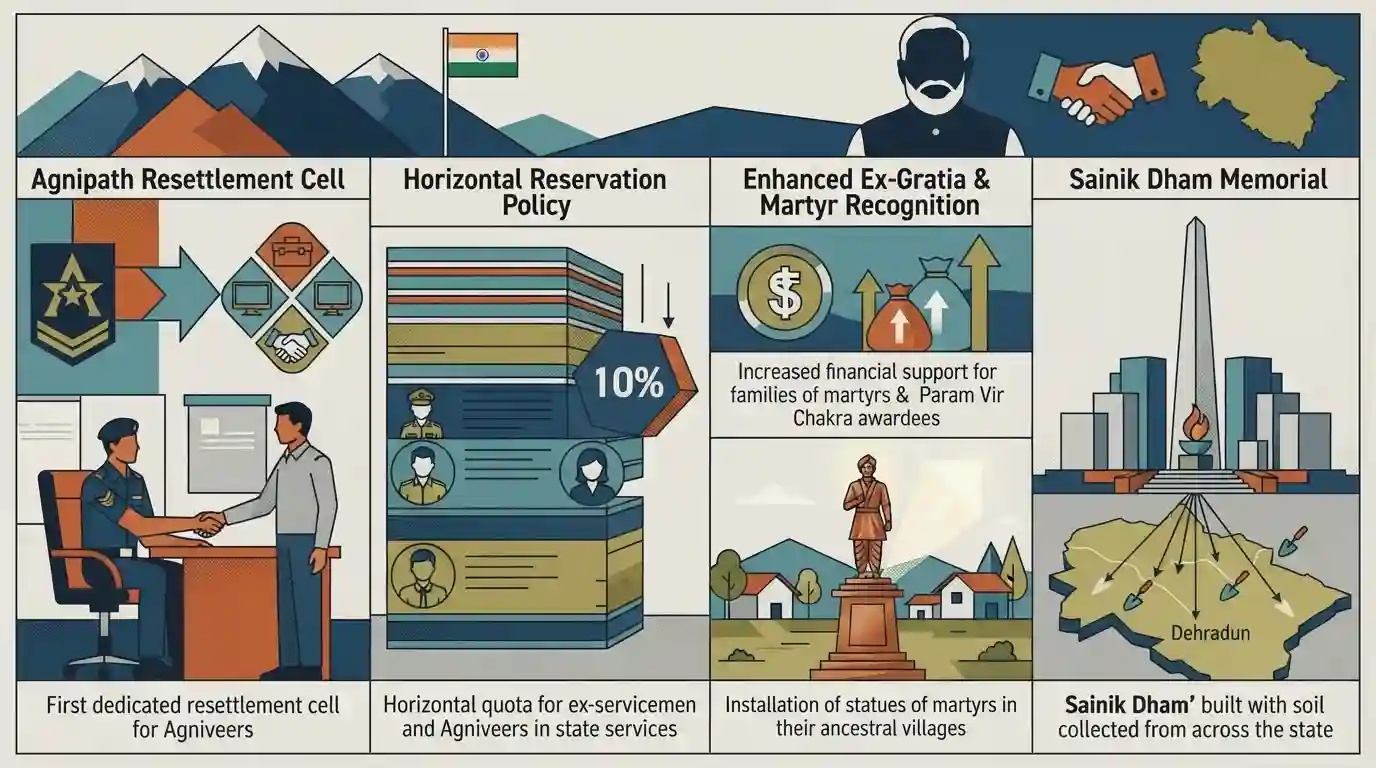
The Uttarakhand government, led by Chief Minister Pushkar Singh Dhami, has established the country's first dedicated resettlement cell for Agniveers to support their rehabilitation and employment after completing their service. To further support ex-servicemen, the state has enacted a 10% horizontal reservation for Agniveers in government services. Additionally, the government has substantially increased ex-gratia payments for the families of martyrs and Param Vir Chakra awardees, decided to install statues of martyrs in their ancestral villages, and is preparing to inaugurate the Sainik Dham memorial in Dehradun, built with soil from martyrs' homes across the state.
Key Points
- Uttarakhand has become the first state in India to establish a dedicated resettlement/employment cell for the rehabilitation of Agniveers who complete their four-year term in the armed forces.
- The state government approved a 10% horizontal reservation for Agniveers in Uttarakhand state government services to ease their transition into civilian employment.
- The ex-gratia compensation for the families of Param Vir Chakra recipients has been raised from ₹1.5 crore to ₹2 crore.
- For other martyred soldiers of the state, the ex-gratia amount was increased five times from ₹10 lakh to ₹50 lakh.
- Statues of martyred soldiers will be installed in their respective ancestral villages to honor their sacrifices.
- Sainik Dham, a grand military memorial in Dehradun, is nearing completion. It is built using soil collected from the courtyards of the homes of martyrs across all districts of Uttarakhand.
Important Terms
Agnipath Scheme

A military recruitment initiative introduced by the Indian government where youth (Agniveers) serve in the Armed Forces for a four-year period.
UPSC context
GS Paper III (Internal Security) and GS Paper II (Welfare Schemes).
Horizontal Reservation
An affirmative action mechanism that provides reservations to specific categories, such as women or veterans, cutting across vertical (caste-based) reservation categories.
UPSC context
GS Paper II (Indian Polity), focusing on constitutional reservation provisions and judiciary mandates.
Agniveer Rozgar Cell
A dedicated employment and rehabilitation platform set up by Uttarakhand to support returning Agniveers with post-service civilian jobs and training.
UPSC context
UKPSC Mains (Social Justice and Uttarakhand-specific welfare schemes).
Sainya Dham
A military memorial built in Dehradun, Uttarakhand, honoring state martyrs using soil collected from their respective ancestral homes.
UPSC context
UKPSC Prelims and Mains (State GK, military heritage, and soldier welfare).
Group C Services
Non-gazetted state government roles where Uttarakhand native former Agniveers are granted a 10% horizontal reservation under the state’s 2025 rules.
UPSC context
UKPSC Mains Paper II (Governance and state administration recruitment policies).
Prelims Trap
The 10% reservation for retired Agniveers is a vertical quota applicable to all Group A, B, and C state government services.
It is a horizontal reservation (adjusted within existing SC/ST/OBC/Gen quotas) and is restricted to Group 'C' uniformed services, not a general vertical quota for all state jobs.
Static Concepts Connected
How does horizontal reservation function under Indian Polity, particularly in Uttarakhand?
- Definition: It refers to reservation for special categories (women, PwDs, Agniveers) that cuts across vertical classifications (SC/ST/OBC/EWS) under Article 16(1).
- Indra Sawhney Rule: The Supreme Court in Indra Sawhney (1992) ruled that horizontal quotas must be adjusted within the respective vertical categories, not added as extra seats.
- Uttarakhand Context: Uttarakhand heavily utilizes this framework, having enacted 30% horizontal reservation for local women in 2023 and 10% for statehood activists.
Cross-Topic Patterns
Federalism + Defense Reform Integration
States creating localized welfare and reservation policies to cushion Union-level military reforms (Agnipath), illustrating functional policy alignment between central defense and state employment.
State Demographics + Veteran Welfare
The construction of Sainik Dham and steep ex-gratia hikes reflect Uttarakhand's high per-capita military enlistment, translating demographic reality into politically crucial state-funded welfare.

UKPSC is highly likely to test the specific mechanics of the Agniveer quota alongside the state's unique horizontal reservation laws.
Linked PYQs · 2
Linked PYQs · 2
- 2025UKPSC_PRELIMSGS1
Which programme was approved by the Union Cabinet in April, 2025 to develop border villages ?
- 2025UKPSC_PRELIMSGS1
Where was the first Asian Mayors' Conference held in Uttarakhand in 2006?
