Uttarakhand Emerges As India Sixth Fully Literate State Under Ullas
Source:drishtiias ↗
Why It Matters
Understanding state achievements under national development initiatives is critical for state public service commissions. This milestone directly updates the demographic and governance-related GK of Uttarakhand, which is a frequent theme in UKPSC GS-I Papers (especially questions related to literacy rates, districts, and comparative census data).
Summary
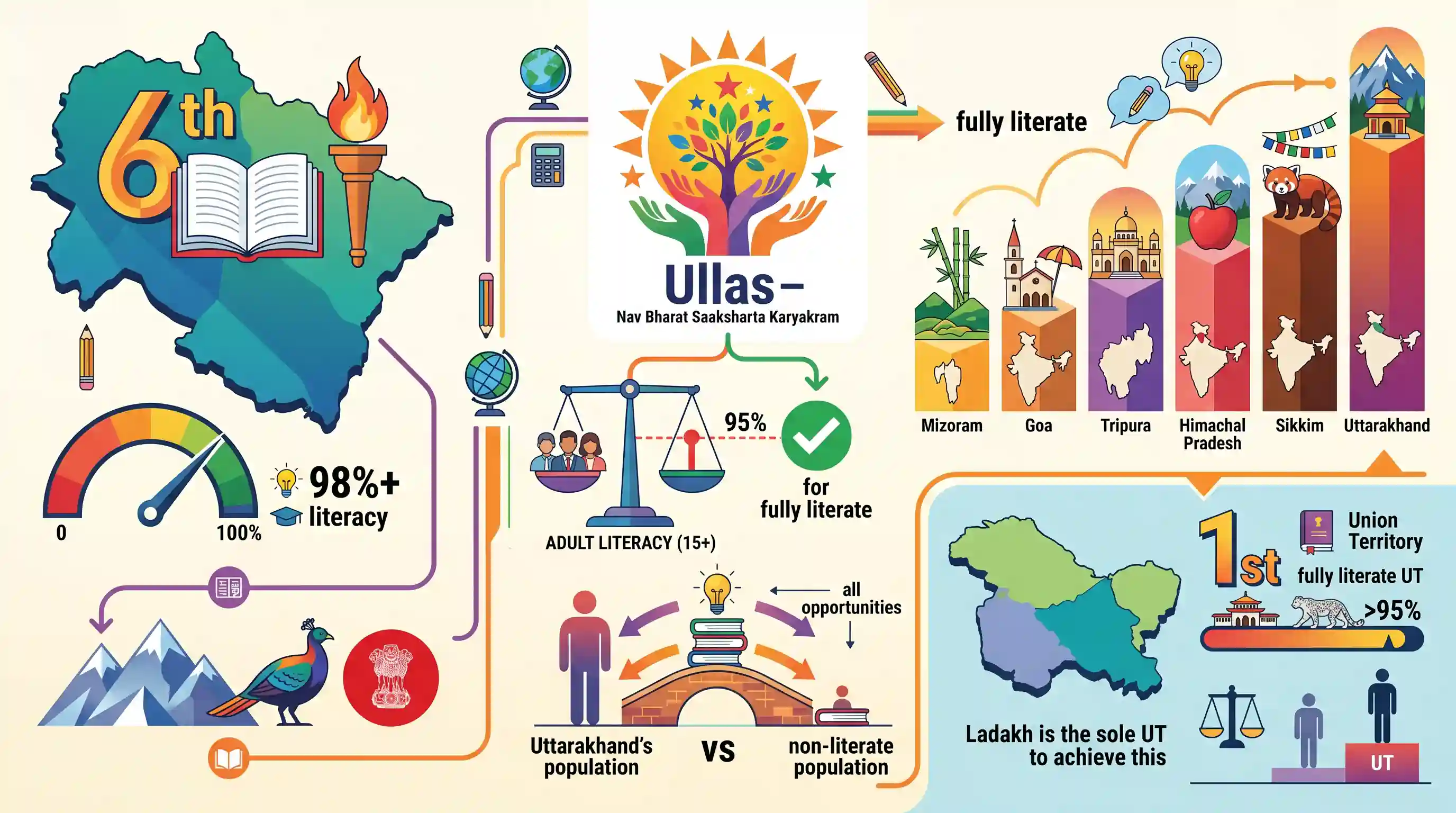
Uttarakhand has declared itself India's sixth fully literate state after achieving a literacy rate of 98% or above under the Union Government's 'Ullas – Nav Bharat Saaksharta Karyakram' (New India Literacy Programme). Under the guidelines of the programme, a state is classified as 'fully literate' once it registers a minimum of 95% adult literacy rate in the 15+ age demographic while providing basic literacy opportunities to all non-literate individuals. Uttarakhand joins Mizoram, Goa, Tripura, Himachal Pradesh, and Sikkim, while Ladakh holds the distinction of being the first Union Territory to achieve this certificate.
Key Points
- Uttarakhand has declared itself a fully literate state, achieving a literacy rate of 98% or above.
- With this achievement, Uttarakhand has become the sixth state in India to achieve full literacy under the Ullas scheme.
- The five other states declared fully literate prior to Uttarakhand are Mizoram, Goa, Tripura, Himachal Pradesh, and Sikkim.
- Ladakh became the first Union Territory to be fully certified under the Ullas – Nav Bharat Saaksharta Karyakram.
- Under the programme, a state attains 'fully literate' status upon achieving an adult literacy rate of at least 95% among individuals aged above 15 years, while ensuring education for all non-literate individuals.
- The campaign was successfully implemented through the collaborative efforts of local volunteers, educators, community organizations, and government agencies.
Important Terms
Ullas – Nav Bharat Saaksharta Karyakram

A Centrally Sponsored Scheme (2022–2027) under the Ministry of Education, aligned with NEP 2020, designed to provide foundational, digital, and financial literacy to non-literates aged 15 and above.
UPSC context
GS Paper II (Social Justice - Education); tests knowledge of social sector initiatives targeting adult literacy and lifelong learning.
New India Literacy Programme
The official name for ULLAS, a centrally sponsored initiative targeting five crore non-literates aged 15+ to transition from traditional adult education to a holistic 'Education for All' model.
UPSC context
GS Paper II (Government Policies); tests awareness of major structural policy shifts in primary and lifelong learning frameworks.
Functional Literacy
The practical capability to read, write, and compute with comprehension, enabling individuals to perform essential daily tasks, digital transactions, and engage effectively in society.
UPSC context
GS Paper II (Issues relating to Education); tests understanding of qualitative parameters measuring real-world literacy outcomes.
Foundational Literacy and Numeracy Assessment Test
The standardized national evaluation conducted under the NILP/ULLAS framework to assess and certify adult learners on foundational reading, writing, and arithmetic competencies.
UPSC context
GS Paper II (Education); tests knowledge of implementation tools, assessments, and quality control under central welfare schemes.
Full Literacy (under NILP)
A policy benchmark defined by the Ministry of Education, classifying a State or UT as 'fully literate' once it registers an adult literacy rate of 95% or above.
UPSC context
GS Paper I (Demography); tests understanding of demographic statistics, human capital development, and sub-national educational milestones.
Prelims Trap
A State/UT achieves 'fully literate' status under ULLAS only when it records a 100% literacy rate among its entire population.
ULLAS defines 'fully literate' at a 95% threshold specifically for the 15+ age demographic, acknowledging that absolute 100% literacy is structurally unfeasible.
Static Concepts Connected
How does Indian Census literacy differ from ULLAS literacy?
- Census Age: Targets population aged 7 years and above.
- ULLAS Age: Focuses on non-literates in the 15+ age group.
- Evaluation Metric: Census uses self-reporting, while ULLAS requires passing NIOS-certified FLNAT exams.
Cross-Topic Patterns
Demographic dividend + adult literacy
Targeting the 15+ age bracket under ULLAS directly builds functional skills required to absorb India's working-age population into formal service and digital economies.
Fiscal federalism + central schemes
ULLAS as a Centrally Sponsored Scheme demonstrates how hybrid digital-physical delivery models depend heavily on state-level volunteer mobilization for success.

ULLAS criteria (95% threshold, 15+ cohort, FLNAT) vs standard Census definitions likely to feature in 2026 welfare scheme questions.
Linked PYQs · 4
Linked PYQs · 4
- 2012UKPSC_PRELIMSGS1
As per 2011 Census, literacy rate of Uttarakhand State is:
- 2024UKPSC_PRELIMSGS1
As per census 2011, which of the following district of Uttarakhand had lowest female literacy rate ?
- 2012UKPSC_PRELIMSGS1
The state having highest literacy rate as per 2011 Census is
- 2024UKPSC_PRELIMSGS1
Districts are arranged in ascending order in terms of female literacy rate. Choose the correct option :
