Uttarakhand Officially Becomes India Sixth Fully Literate State
Source:livemint ↗
Why It Matters
This article is highly crucial for the UKPSC PCS Prelims. State-specific literacy rates, developmental milestones, and social indicators are frequently tested (e.g., past questions on Census 2011 literacy rates and district-wise rankings). Moreover, understanding central schemes like the ULLAS initiative and the broader provisions of the National Education Policy (NEP) 2020 forms a recurring theme in both state-level and national-level examinations.
Summary
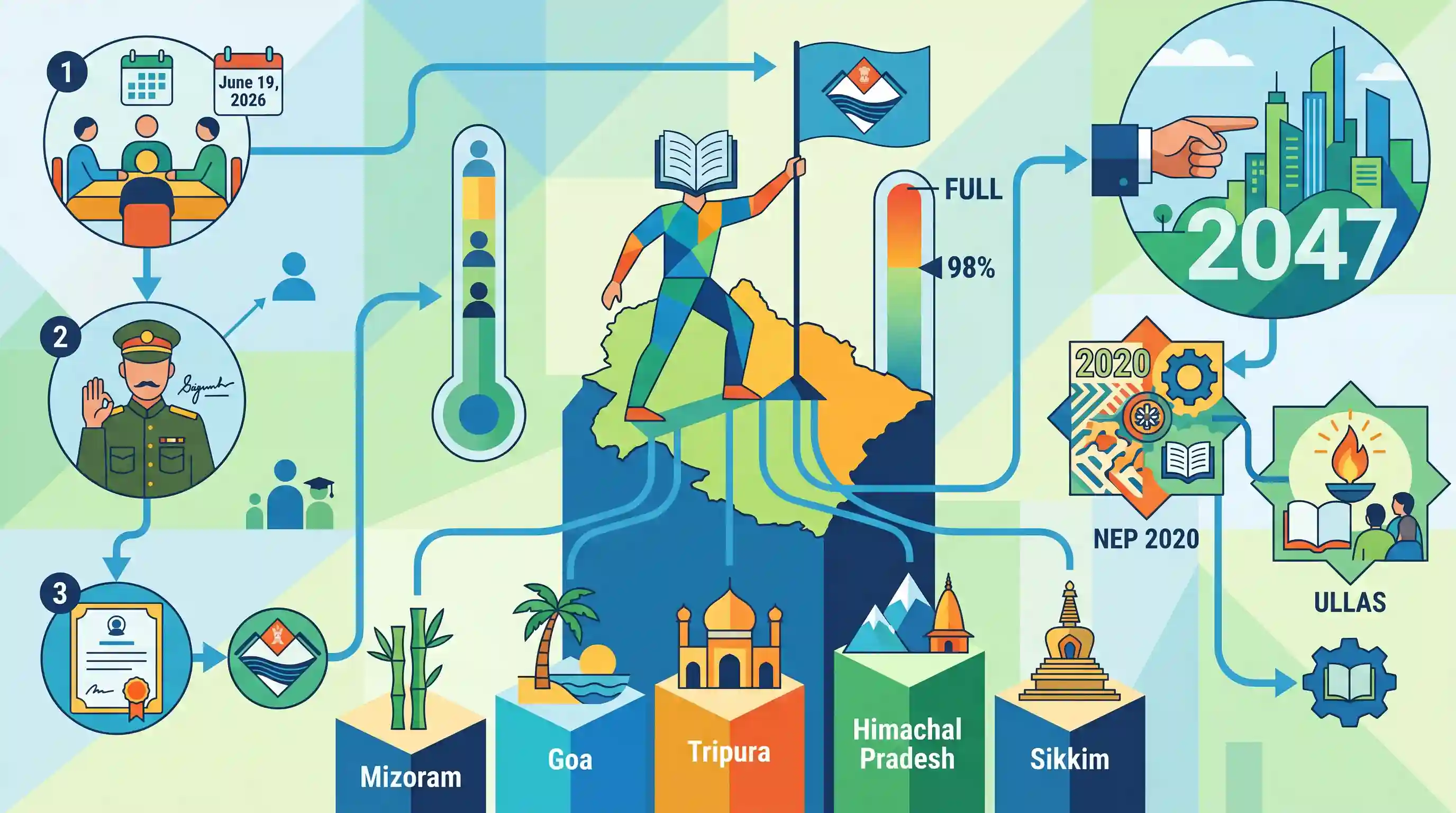
Uttarakhand has achieved the significant milestone of becoming the sixth fully literate state in India. Under the framework of the National Education Policy (NEP) 2020 and the ULLAS programme, the state met adult literacy benchmarks set by the Union Ministry of Education. Following state cabinet approval on June 19, 2026, the proposal was approved by Governor Lieutenant General (Retd.) Gurmeet Singh. With a literacy rate now exceeding 98%, Uttarakhand joins Mizoram, Goa, Tripura, Himachal Pradesh, and Sikkim in achieving full literacy status. Chief Minister Pushkar Singh Dhami highlighted this as a crucial step towards the 'Viksit Bharat 2047' vision.
Key Points
- Uttarakhand has officially achieved the status of being India's sixth fully literate state as of July 2026, with its current literacy rate standing at over 98%.
- The milestone was achieved under the aegis of the National Education Policy (NEP) 2020 and the central 'ULLAS' (Understanding Lifelong Learning for All in Society) programme.
- The state met the adult literacy benchmarks prescribed by the Department of School Education and Literacy under the Union Ministry of Education.
- The proposal was approved by the Uttarakhand State Cabinet on June 19, 2026, and subsequently formal approval was granted by Uttarakhand Governor Lieutenant General (Retd.) Gurmeet Singh.
- Prior to Uttarakhand, the five states that achieved full literacy status are Mizoram, Goa, Tripura, Himachal Pradesh, and Sikkim.
- Chief Minister Pushkar Singh Dhami emphasized that this development aligns with the national goal of 'Viksit Bharat' by 2047 and added that the government will continue to focus on financial literacy, digital literacy, and life skills.
Important Terms
National Education Policy (NEP) 2020

India’s comprehensive policy framework designed to reform and revitalize the education system, emphasizing equitable access, holistic learning, and integrating non-formal adult education with lifelong learning.
UPSC context
GS Paper II (Education) and Essay. Tests understanding of structural educational reforms and human development policies.
ULLAS programme
A Centrally Sponsored Scheme (2022–2027) under the Ministry of Education targeting non-literates aged 15 and above to provide foundational literacy, numeracy, digital literacy, and essential life skills.
UPSC context
GS Paper II (Social Justice/Government Schemes). Tests evaluation of adult education frameworks and inclusive social sector initiatives.
Department of School Education and Literacy
A dedicated department under India's Ministry of Education responsible for formulating and implementing national policies, schemes, and literacy standards for school education and adult literacy.
UPSC context
GS Paper II (Governance). Tests knowledge of administrative structures, program implementation, and policy execution within social services.
Union Ministry of Education
The nodal cabinet-level ministry of the Government of India responsible for formulating national policies on education, overseeing school education, literacy, and higher education.
UPSC context
GS Paper II (Institutional Frameworks). Tests understanding of ministerial governance, policy-making, and institutional roles in national development.
Prelims Trap
Kerala is one of the six states declared fully literate under the Ministry of Education's ULLAS guidelines.
While Kerala is historically India's most literate state, the specific 'fully literate' designation under the modern ULLAS (2022-27) framework applies to six other specific states.
Static Concepts Connected
How does India distinguish between literacy and functional literacy?
- Census Definition: A person aged seven or above who can read and write with understanding in any language is deemed literate.
- Functional Literacy: Under NEP 2020/ULLAS, it encompasses reading, writing, basic numeracy, digital literacy, financial literacy, and essential legal/civic life skills.
- Target Cohorts: Census tracks literacy for ages 7+, whereas adult education schemes like ULLAS target non-literate individuals aged 15 and above.
What are the fiscal mechanics of Centrally Sponsored Schemes (CSS)?
- Funding Split: CSS are cost-shared between Centre and States, typically in a 60:40 ratio, or 90:10 for Himalayan and North-Eastern states.
- Implementation Agency: Unlike Central Sector Schemes (100% centrally implemented), CSS are implemented entirely by State government administrations.
Cross-Topic Patterns
Digital Inclusion and Adult Literacy
ULLAS relies heavily on the DIKSHA portal and apps, directly linking adult literacy to India's broader Digital India and UPI-led financial inclusion ecosystems.
Himalayan States and Development Goals
With Uttarakhand, Sikkim, and Himachal on this list, Himalayan states showcase superior social-sector performance despite severe geographic and infrastructural bottlenecks.

UPSC may contrast the Census literacy definition (7+ years, simple read/write) with NEP 2020's 'functional literacy' (15+ years).
Linked PYQs · 3
Linked PYQs · 3
- 2012UKPSC_PRELIMSGS1
As per 2011 Census, literacy rate of Uttarakhand State is:
- 2024UKPSC_PRELIMSGS1
Districts are arranged in ascending order in terms of female literacy rate. Choose the correct option :
- 2025UKPSC_PRELIMSGS1
Consider the following statements about 'Right to Education' and choose the correct answer : 1. It try to achieve the aim of 'Education for All'. 2. Earlier a provision of free and compulsory education was provided in Part IV of the Constitution. 3. It became Fundamental Right after 91ˢᵗ Constitutional Amendment.
