Devidhura Celebrates Traditional Bagwal Fair with Fruits and Flowers
Source:the-print ↗
Why It Matters
The Devidhura Bagwal Mela is a highly significant cultural event in Uttarakhand. It has been repeatedly asked in UKPSC PCS exams (e.g., 2005 Prelims). Additionally, understanding the usage of local natural resources like 'ringal' bamboo relates to state handicrafts sold under the 'Himadri' brand (asked in 2025 Prelims).
Summary
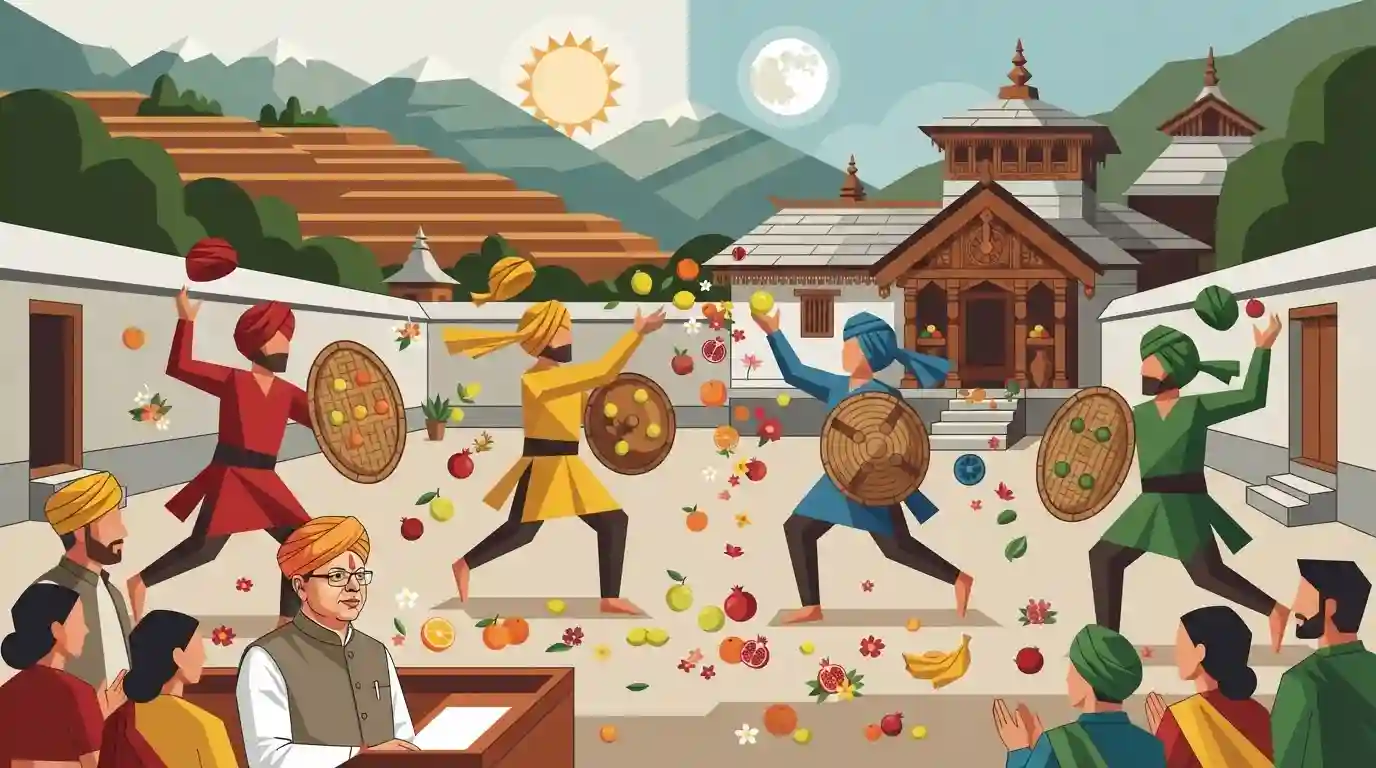
The traditional 'Bagwal' festival was celebrated on Raksha Bandhan at the Maa Varahi Dham Shaktipeeth in Devidhura, Champawat district, Uttarakhand. Attended by Chief Minister Pushkar Singh Dhami, the ritualistic battle was played using fruits and flowers instead of stones to avoid injuries. The battle involves four traditional clans (Khams)—Walik, Chamyal, Gahadwal, and Lamgadiya—clad in their respective clan-coloured turbans and wielding protective shields crafted from 'ringal' (hill bamboo). According to local belief, this ancient custom is conducted to offer the equivalent of one human life's worth of blood to appease Goddess Varahi.
Key Points
- The annual 'Bagwal' fair, a ritualistic battle of groups of devotees, was celebrated on Raksha Bandhan at the Maa Varahi Dham Shaktipeeth in Devidhura, Champawat district.
- The ritualistic battle involves four clans or 'Khams': Walik (associated with white turbans), Chamyal (pink), Gahadwal (saffron), and Lamgadiya (yellow).
- To prevent injuries, the traditional practice of throwing stones (stone-pelting) has evolved over the years into a symbolic battle using fruits and flowers.
- Participants carry protective shields made of bamboo and 'ringal' (a species of hill bamboo native to Uttarakhand, scientifically known as Chimnobambusa falcata).
- According to mythological legend, the battle is performed to appease Goddess Maa Varahi by offering blood equivalent to one human life to protect the region from demonic forces.
- Uttarakhand's traditional handicrafts, including items made from ringal bamboo, are marketed and sold under the state's official 'Himadri' brand name.
Prelims Trap
The Bagwal fair of Devidhura is officially and exclusively played using stones to satisfy the ancient blood-offering ritual.
Following High Court directives, the festival officially transitioned to using fruits and flowers since 2013, though symbolic blood-letting remains the spiritual goal.
Static Concepts Connected
What are the core features of Devidhura's Bagwal Fair?
- Location & Timing: Celebrated annually on Shravan Poornima (Raksha Bandhan) at Maa Varahi Temple in Devidhura, Champawat district.
- The Four Khams: Involves four clans: Walik (white turbans), Chamyal (pink), Gahadwal (saffron), and Lamgadiya (yellow).
- State Recognition: Declared an official 'State Fair' by the Uttarakhand government in July 2022.
What is Uttarakhand's Ringal Craft and its branding?
- GI Tag Status: Awarded a Geographical Indication (GI) tag in 2021; utilizes high-altitude dwarf hill bamboo (Chimnobambusa falcata).
- Commercial Branding: Finished products are promoted and sold under the state's official 'Himadri' brand managed by UHHDC.
Cross-Topic Patterns
GI crafts + Migration mitigation
Promoting GI-tagged Ringal crafts under the 'Himadri' brand creates local employment, directly addressing Uttarakhand’s severe hill-to-plain migration (Palyan) challenge.
Judicial intervention + Traditional rights
The High Court-mandated transition from stones to fruits in Bagwal reflects the delicate balance between Article 21 (right to safety) and Article 25 (religious freedom).

Match-the-following questions pairing the four traditional Khams of Champawat with their specific turban colors are highly likely in Prelims.
Linked PYQs · 2
Linked PYQs · 2
- 2005UKPSC_PRELIMSGS1
'Bagwal Mela' is organized at which place?
- 2025UKPSC_PRELIMSGS1
The craft products of the Uttarakhand state are sold by which brand name?
