Uttarakhand Allocates Industrial Land to Boost MSME Investments
Source:indianmasterminds ↗
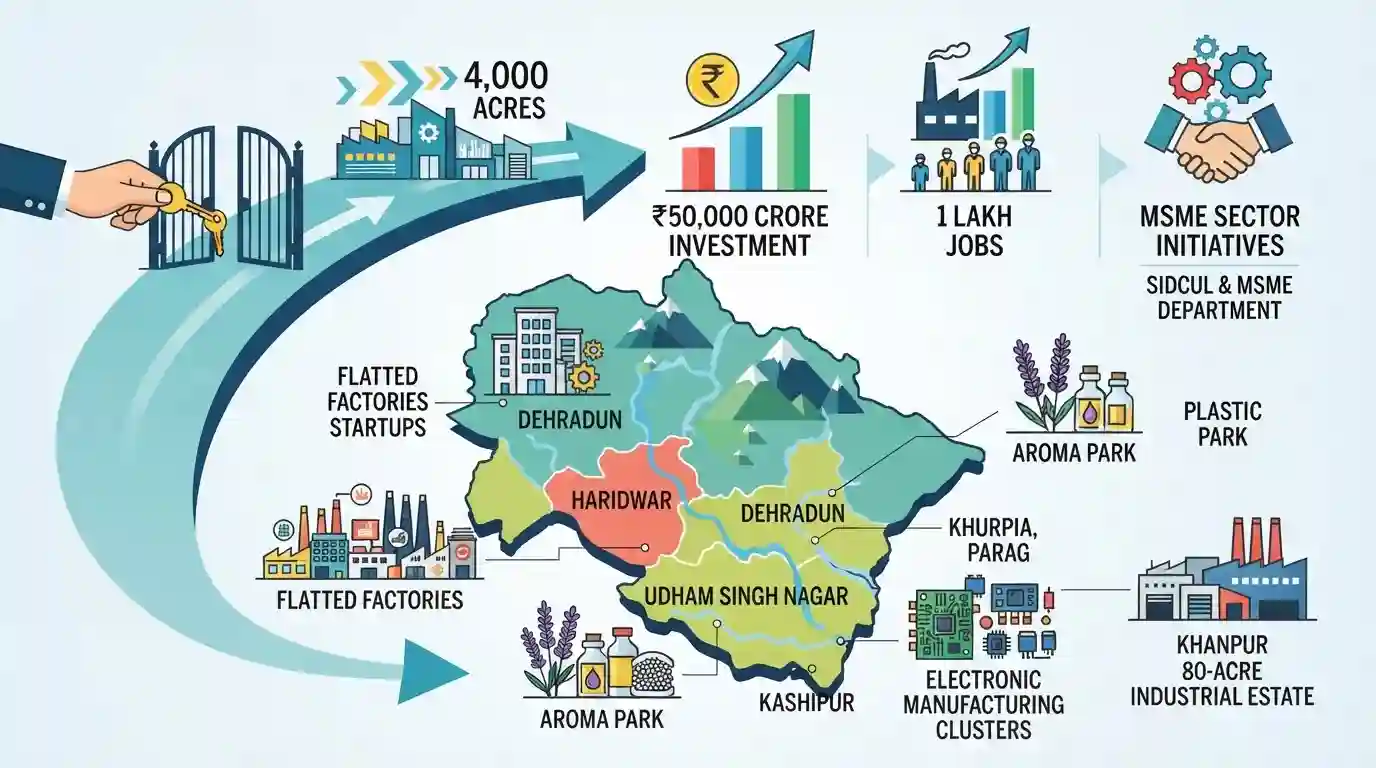
Why It Matters
This development relates directly to the state-specific economy and infrastructure syllabus for the UKPSC PCS Prelims. Knowing the locations of specialized industrial parks (e.g., Aroma Park in Kashipur, Plastic Park in Sitarganj) and the role of SIDCUL is crucial for objective questions on Uttarakhand's economic geography.
Summary
Uttarakhand is aiming to significantly boost its industrial sector by offering 4,000 acres of land to Micro, Small, and Medium Enterprises (MSMEs), targeting a ₹50,000 crore investment and the creation of 1 lakh jobs over the next two years. Coordinated by SIDCUL and the state's MSME Department, the initiative involves developing specialized infrastructure across Haridwar, Udham Singh Nagar, and Dehradun. Prominent projects include a 41-acre Aroma Park in Kashipur, a 40-acre Plastic Park in Sitarganj Phase-II, and Electronic Manufacturing Clusters in Khurpia, Parag, and Kashipur. Additionally, new flatted factories for startups will be built in Haridwar, Pantnagar, and Selaqui, and an 80-acre industrial estate is planned for Khanpur.
Key Points
- Uttarakhand government plans to allocate 4,000 acres of industrial land to MSMEs to generate 1 lakh jobs and attract ₹50,000 crore in investments over two years.
- SIDCUL is spearheading the development of specialized industrial zones across districts like Haridwar, Udham Singh Nagar, and Dehradun.
- Key projects include a 41-acre Aroma Park in Kashipur and a 40-acre Plastic Park in Sitarganj Phase-II.
- Electronic Manufacturing Clusters are slated for Khurpia, Parag, and Kashipur, alongside a new 80-acre industrial estate in Khanpur.
- The state will construct flatted factories in Haridwar, Pantnagar, and Selaqui to foster the growth of startups and small-scale industries.
Important Terms
SIDCUL

A state enterprise established in 2002 to promote industrial development, build infrastructure, and manage integrated industrial estates across Uttarakhand.
UPSC context
Crucial for GS-3 (Infrastructure & Industrial Policy). Illustrates state-level institutional mechanisms for driving investment and economic growth.
Flatted Factories
Multi-storey industrial buildings subdivided into separately occupied units, designed to house light manufacturing, assembly, and startups in land-scarce urban areas.
UPSC context
Important for GS-3 (Infrastructure & Urban Development). Demonstrates innovative land-use solutions for MSME growth and cluster-based urban industrialization.
Aroma Park
A specialized industrial cluster dedicated to aroma-based and perfumery industries, integrating aromatic crop farming with downstream processing to boost the local economy.
UPSC context
Relevant for GS-3 (Agriculture & Economy). Demonstrates cluster-based agro-industrial development and rural employment generation strategies.
Plastic Park
A dedicated industrial zone offering state-of-the-art infrastructure and common facilities to consolidate downstream plastic processing, manufacturing capacities, and recycling initiatives.
UPSC context
Relevant for GS-3 (Industrial Infrastructure). Ties into central schemes for petrochemical sector growth and organized plastic waste management.
Electronic Manufacturing Clusters (EMC) Scheme
A central scheme providing financial assistance for creating world-class shared infrastructure and common facilities to attract investment in the electronics manufacturing sector.
UPSC context
Central to GS-3 (Industrial Policy, Technology). Key to India's push for self-reliance in electronics and the Make in India initiative.
Prelims Trap
"The Plastic Park Scheme is an initiative administered by the Ministry of MSME to boost small industries."
The Plastic Park scheme is actually a central sector initiative administered by the Ministry of Chemicals and Fertilizers, not the MSME ministry.
Static Concepts Connected
What is the economic rationale behind "Flatted Factories"?
- Space Optimization: These multi-story industrial buildings maximize land usage, which is crucial in land-scarce geographical regions like Himalayan states or dense urban centers.
- MSME Support: They offer plug-and-play, ready-to-move infrastructure, significantly lowering the initial capital expenditure and land-acquisition hurdles for startups and micro-enterprises.
What are the key features of the Electronic Manufacturing Clusters (EMC) scheme?
- Nodal Ministry: Implemented by the Ministry of Electronics and IT (MeitY) to create world-class infrastructure for the Electronics System Design and Manufacturing (ESDM) sector.
- EMC 2.0 Focus: The EMC 2.0 scheme provides financial assistance to set up plug-and-play facilities, aiming to attract global anchor companies and their supply chains to India.
Cross-Topic Patterns
Hill state industrialization + Land constraints
The push for multi-story "flatted factories" reflects land scarcity in Himalayan states, linking physical geography constraints with urban industrial policy and MSME growth.
Agro-climatic zones + Industrial clustering
Uttarakhand's "Aroma Park" leverages its specific Himalayan agro-climatic conditions, linking regional agricultural geography directly to specialized secondary-sector manufacturing and export promotion.

Questions matching specialized industrial parks (Aroma, Plastic, Medical Device) to their nodal ministries or host states are highly probable.
Linked PYQs · 2
Linked PYQs · 2
- 2021UKPSC_PRELIMSGS1
Which of the following places is not associated with SIIDCUL ?
- 2025UKPSC_PRELIMSGS1
In Uttarakhand, where is the unit of Hindustan Machine Tools situated?
