Uttarakhand Observes Wildlife Week to Promote Conservation
Source:sarokarindia ↗
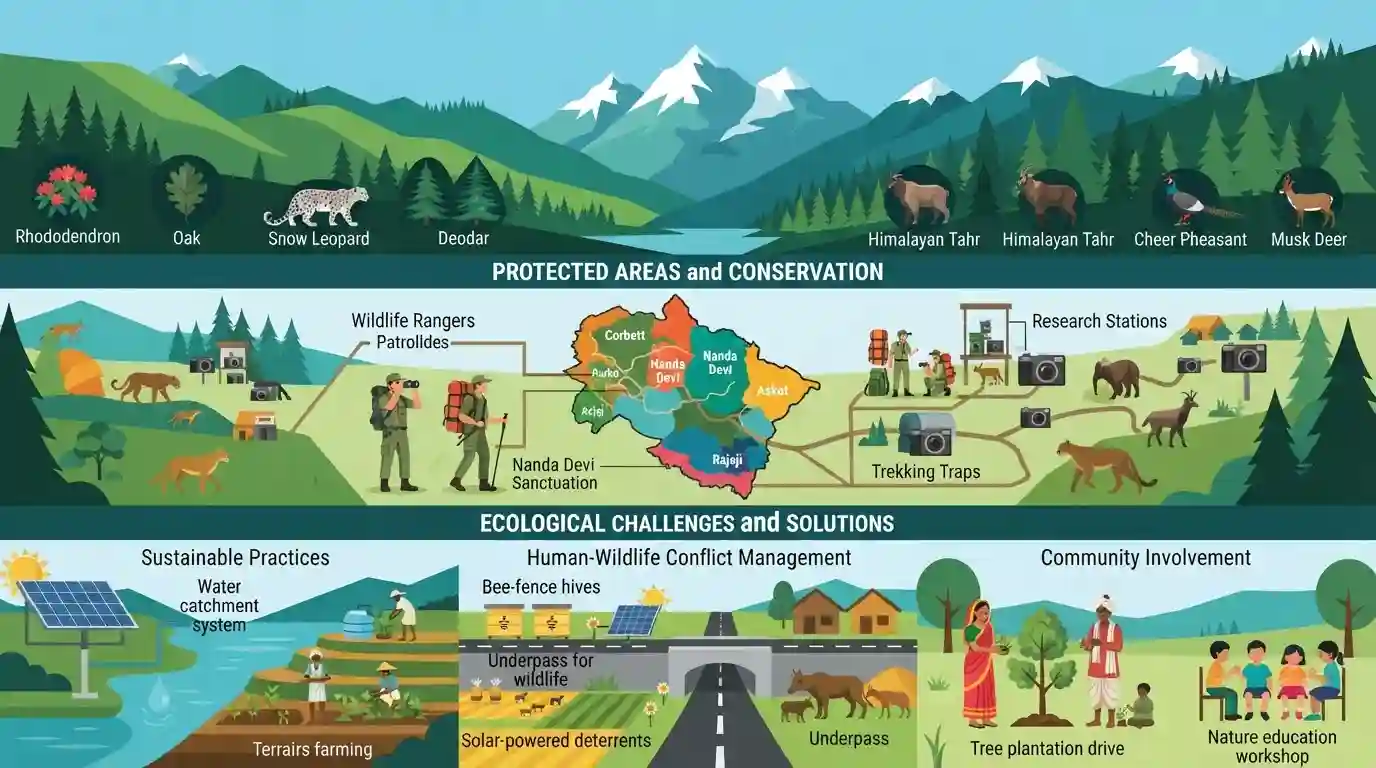
Why It Matters
Crucial for UKPSC PCS Prelims regarding state geography, wildlife sanctuaries, national parks, and environmental conservation frameworks in Uttarakhand.
Summary
The article discusses the observance of Wildlife Week in Uttarakhand, highlighting state-led conservation efforts, biodiversity protection of Himalayan flora and fauna, protected areas like wildlife sanctuaries, and strategies to address human-wildlife conflicts and ecological challenges in the region.
Key Points
- Wildlife Week is observed annually to raise awareness about wildlife conservation, habitat protection, and ecological balance.
- Uttarakhand hosts a rich biodiversity comprising several national parks, wildlife sanctuaries, and unique Himalayan flora and fauna.
- Key conservation challenges in the state include human-wildlife conflict, habitat degradation, and climate change vulnerabilities.
- State initiatives focus on community participation, anti-poaching operations, and strengthening protected area management.
Important Terms
Wildlife Protection Act 1972

A landmark Indian legislation enacted in 1972 that provides the legal framework for the protection of wild animals, birds, and plants, and establishes a network of protected areas across the country.
UPSC context
Crucial for GS Paper III (Environment & Ecology); tests statutory provisions, protected area networks, and wildlife conservation frameworks in India and Uttarakhand.
Uttarakhand Forest Department
The nodal state government agency responsible for managing forest resources, protecting wildlife sanctuaries and national parks, and executing conservation policies within Uttarakhand.
UPSC context
Important for UKPSC Uttarakhand Special GK and GS Paper III; tests state-level administrative implementation of environmental laws and wildlife management.
Static Concepts Connected
What are the key protected areas in Uttarakhand and their designated flagship conservation species?
- Askot Sanctuary: Askot Wildlife Sanctuary in Pithoragarh was established primarily for the protection and conservation of the endangered Himalayan musk deer.
- Govind Pashu Vihar: Govind Pashu Vihar National Park and Wildlife Sanctuary serves as a crucial high-altitude habitat zone for administering the Snow Leopard Project.
- Jim Corbett NP: Corbett National Park, established in 1936 as Hailey National Park, was the first national park in India and the birthplace of Project Tiger.
Cross-Topic Patterns
Bio-fencing and Human-Wildlife Conflict Mitigation
Uttarakhand's human-wildlife conflict mitigation strategies, such as bio-fencing and compensation schemes, intersect with GS Paper 3 Disaster Management and rural livelihoods under MGNREGA.
Terai Arc Landscape and Inter-state Corridors
The Terai Arc Landscape connects forest corridors across state boundaries, testing federal coordination between the Ministry of Environment, Forest and Climate Change and state forest departments.

UKPSC frequently tests specific high-altitude sanctuaries (e.g. Askot, Govind) alongside their flagship species like the Himalayan musk deer.
Linked PYQs · 4
Linked PYQs · 4
- 2024UKPSC_PRELIMSGS1
Which of the following pairs is not correctly matched ?
- 2024UKPSC_PRELIMSGS1
Which of the following pairs is not correctly matched ?
- 2025UKPSC_PRELIMSGS1
Match List - I with List - II and select the correct answer from the codes given below : | List - I (Wild Life Sanctuary) | List - II (Location) | |---|---| | A. Askot Wild Life Sanctuary | 1. Uttarkashi | | B. Binsar Wild Life Sanctuary | 2. Nainital | | C. Govind Wild Life Sanctuary | 3. Almora | | D. Nandhaur Wild Life Sanctuary | 4. Pithoragarh | Codes :
- 2025UKPSC_PRELIMSGS1
Consider the following statements and select the correct answer from the options given below : Statement 1 : Uttarakhand is highly vulnerable to climate change. Statement 2 : Climate change is causing water stress and depleting biodiversity in Uttarakhand.
