Inland fisheries sector drives rural economic growth in Uttar Pradesh
Source:times-of-india ↗
Why It Matters
The fisheries sector is a critical pillar of rural employment, doubling farmers' income, and boosting food security. For UPPSC, understanding state-specific agricultural and allied achievements, regional crop/fisheries contributions (like Eastern UP's dominance), and the technologies involved (Biofloc, RAS) is highly testable.
Summary
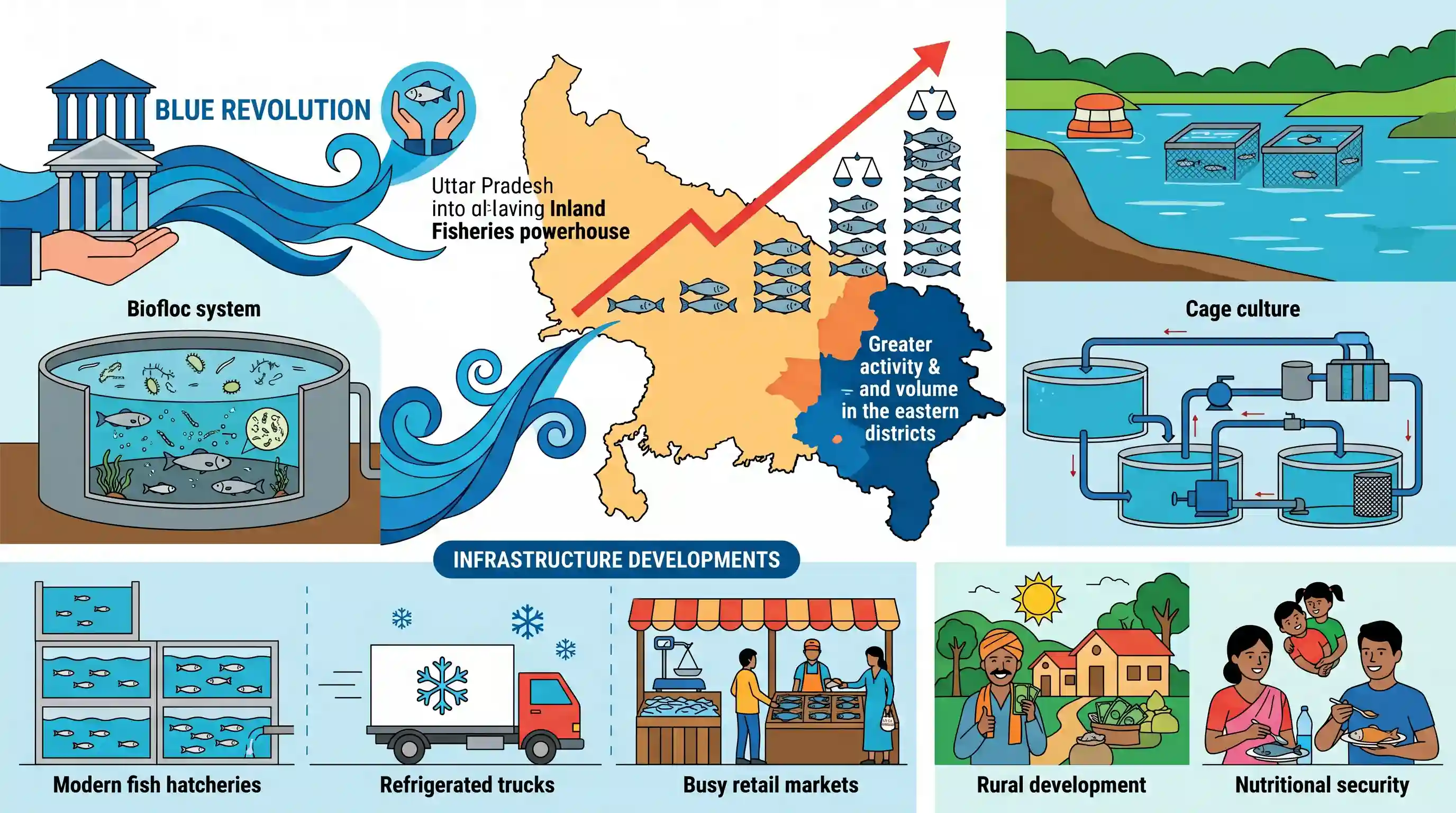
Over the past nine years, Uttar Pradesh has transformed into a leading inland fisheries powerhouse under the national Blue Revolution framework. Supported by the Pradhan Mantri Matsya Sampada Yojana (PMMSY) and the Fisheries and Aquaculture Infrastructure Development Fund (FIDF), the state\'s fish production rose to 746,000 metric tonnes in 2020-21—with eastern districts contributing nearly half—and has scaled further by 2025. This growth is underpinned by the deployment of scientific techniques like biofloc technology, cage culture, and Recirculatory Aquaculture Systems (RAS), combined with extensive infrastructure development across hatcheries, cold chains, and retail markets to drive rural development and nutritional security.
Key Points
- Uttar Pradesh has witnessed a significant boom in inland fisheries over the past nine years, driven by policy synergy between central and state initiatives.
- The state\'s fish production reached approximately 746,000 metric tonnes in 2020-21, with eastern districts of Uttar Pradesh contributing nearly half of this total volume, and production has further scaled up by 2025.
- Key central and state schemes driving this growth include the Blue Revolution Scheme, Pradhan Mantri Matsya Sampada Yojana (PMMSY), and the Fisheries and Aquaculture Infrastructure Development Fund (FIDF).
- To modernize aquaculture, UP has promoted advanced scientific practices such as cage culture in large water bodies, biofloc technology, Recirculatory Aquaculture Systems (RAS), and ornamental fisheries.
- Infrastructure development spans the entire value chain, including the establishment of modern fish hatcheries, feed mills, ice plants, cold storage, refrigerated transport vehicles, and upgraded landing centers.
Important Terms
Pradhan Mantri Matsya Sampada Yojana

A flagship central scheme launched in 2020 to bring about a Blue Revolution through sustainable and responsible development of India's fisheries sector.
UPSC context
GS Paper III: Agriculture, Allied Sectors (Fisheries), and Economics of Animal Rearing.
Blue Revolution Scheme
An integrated government initiative focusing on enhancing the production, productivity, and sustainable development of inland and marine fisheries and aquaculture to boost farmers' income.
UPSC context
GS Paper III: Technology Missions, Animal Rearing, and Agricultural Revolutions.
Fisheries and Aquaculture Infrastructure Development Fund
A dedicated infrastructure fund of Rs 7,522.48 crore established to provide concessional finance for developing both marine and inland fisheries infrastructure.
UPSC context
GS Paper III: Infrastructure, Investment Models, and Mobilization of Resources.
Biofloc Technology
A sustainable closed-tank aquaculture system that uses beneficial heterotrophic bacteria to convert organic waste into nutritious microbial protein for fish consumption.
UPSC context
GS Paper III: Science and Technology (Biotechnology) and Allied Agricultural Sectors.
Recirculating Aquaculture System
An advanced land-based, closed-loop fish farming technology that continuously filters, purifies, and reuses water to maintain high biosecurity with minimal water consumption.
UPSC context
GS Paper III: Sustainable Agriculture, Technology in Aid of Farmers, and Water Conservation.
Prelims Trap
Marine fisheries continue to contribute the majority share of India's total fish production due to its extensive coastline.
Inland aquaculture actually dominates India's fisheries sector, contributing over 70% to 75% of total fish production, making marine fisheries the minority contributor despite India's massive coastline.
Static Concepts Connected
What are Biofloc and Recirculating Aquaculture Systems (RAS)?
- Biofloc Technology: An innovative aquaculture technology where nitrogenous waste is converted by heterotrophic bacteria into nutrient-rich microbial protein (floc), which serves as fish feed.
- Recirculating Aquaculture System: A closed-loop system that filters, purifies, and recycles water continuously, allowing ultra-high-density fish farming with minimal water exchange and land footprint.
- Key Advantages: Both systems dramatically lower feed costs, mitigate disease transmission risks, and reduce environmental pollution compared to traditional open-pond aquaculture.
What is the institutional structure of the Fisheries and Aquaculture Infrastructure Development Fund (FIDF)?
- Core Objective: Set up to bridge infrastructure gaps across both marine and inland fisheries by offering concessional finance for modern cold chains, markets, and hatcheries.
- Implementing Agencies: The National Fisheries Development Board (NFDB) is the nodal implementing agency, while NABARD, NCDC, and scheduled banks act as Nodal Lending Entities.
- Financial Mechanism: The fund provides an interest subvention of up to 3% per annum to lower the borrowing cost for state governments, cooperatives, and private entrepreneurs.
Cross-Topic Patterns
Aquaculture as a climate-adaptation strategy
Promoting controlled-environment inland aquaculture (like RAS and biofloc) cushions farmers against erratic monsoons and agricultural crop failures, acting as an active climate-risk mitigation tool.
DPI and formalizing the unorganized economy
Using the National Fisheries Digital Platform (NFDP) to issue work-based IDs mirrors PM-SVANidhi, proving how sector-specific DPI solves the structural challenge of informal credit.

Inland vs marine production shares combined with biofloc and RAS technological mechanisms will likely feature in GS-3/Prelims 2026.
Linked PYQs · 3
Linked PYQs · 3
- 2014UPPSC_PRELIMSGS1
The number of agro-climate zones in Uttar Pradesh is
- 2015UPPSC_PRELIMSGS1
White revolution is related to
- 2015UPPSC_PRELIMSGS1
Green revolution is related to
