Uttar Pradesh Water Conservation Achievements and SDG-6 Targets
Source:drishtiias ↗
Why It Matters
Water conservation and SDG targets are frequent subjects in UPPSC Prelims (e.g., matching SDGs or tracking scheme chronology). Furthermore, UP-specific governance initiatives like Amrit Sarovar and Khet Talab Yojana are highly relevant for the state-specific segment of the syllabus.
Summary
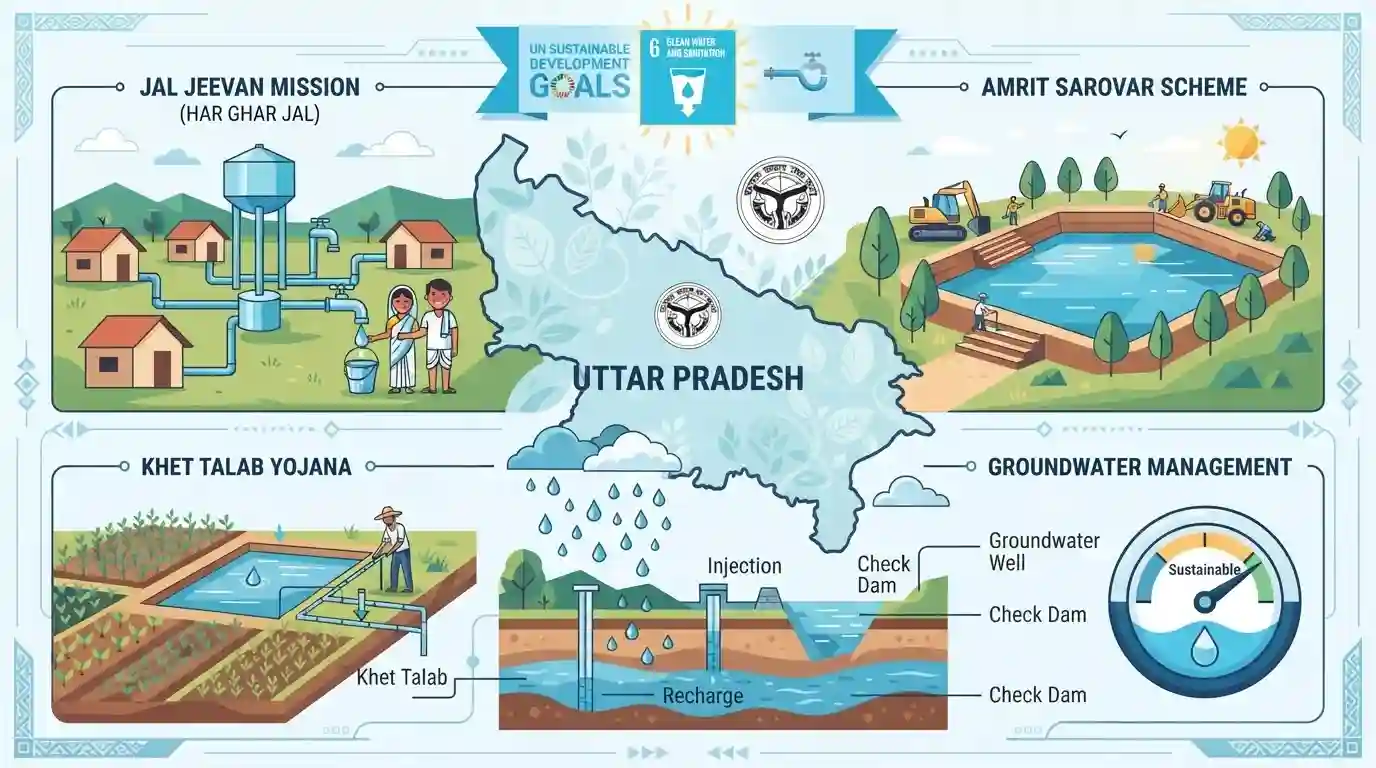
Uttar Pradesh has set a national benchmark in water conservation, effectively advancing towards the UN Sustainable Development Goal 6 (SDG-6) targets for clean water and sanitation. The state's multipronged strategy includes rapid expansion of rural tap water under the Jal Jeevan Mission (Har Ghar Jal), rejuvenation of village water bodies via the Amrit Sarovar scheme, and agricultural resilience through the Khet Talab Yojana. Additionally, rigorous enforcement of groundwater regulations ensures sustainable water harvesting and recharge.
Key Points
- Uttar Pradesh has successfully positioned itself as a benchmark in water conservation, aligning with UN Sustainable Development Goal 6 (Clean Water and Sanitation).
- The state has aggressively implemented the Jal Jeevan Mission, providing functional household tap connections through the 'Har Ghar Jal' initiative.
- Local water security has been enhanced via the 'Amrit Sarovar' scheme for village ponds and the 'Khet Talab Yojana' for agricultural farm ponds.
- Stringent enforcement of the Groundwater Act, including mandates for rooftop rainwater harvesting, has been critical in improving ground water recharge across the state.
Important Terms
Jal Jeevan Mission

A Centrally Sponsored Scheme under the Ministry of Jal Shakti launched in 2019 to provide Functional Household Tap Connections (FHTC) to every rural household in India.
UPSC context
GS Paper II (Government Policies) and GS Paper III (Water Resource Management); tests execution of basic public services.
Har Ghar Jal
A targeted sub-initiative under the Jal Jeevan Mission aiming to deliver 55 litres of safe, potable tap water per capita daily to all rural households.
UPSC context
GS Paper II and III; tests rural development, social welfare, and indicators of household standard of living.
Mission Amrit Sarovar
A nationwide water conservation initiative launched in 2022 to construct or rejuvenate at least 75 local water bodies (ponds) in each district of India.
UPSC context
GS Paper III (Conservation); tests sustainable community-driven water harvesting models and local climate resilience.
Khet Talab Yojana
A farm-pond subsidy scheme in Uttar Pradesh under Rashtriya Krishi Vikas Yojana that assists farmers in harvesting rainwater and implementing micro-irrigation.
UPSC context
GS Paper III (Agriculture/Irrigation); tests knowledge of state-level interventions for dryland agriculture and rainwater harvesting.
UN Sustainable Development Goal 6 (SDG-6)
A global target set by the United Nations to ensure universal access to clean water and sanitation and sustainable management of water resources by 2030.
UPSC context
GS Paper III (Sustainable Development) and GS Paper II; tests global indices and target-based policy planning.
Uttar Pradesh Ground Water (Management and Regulation) Act, 2019
A legislative framework enacted to protect, regulate, and sustainably manage groundwater extraction through block and gram panchayat-level committees.
UPSC context
GS Paper III (Environment); tests decentralized governance and legislative controls on critical resource depletion.
Prelims Trap
The Central Ground Water Authority (CGWA) is a statutory body constituted under the Water Act of 1974.
Aspirants often assume that the CGWA, which regulates groundwater across India, was created under the Water (Prevention and Control of Pollution) Act, 1974. It was actually established under the Environment (Protection) Act, 1986.
Static Concepts Connected
What is the constitutional framework governing water resources in India?
- State List Entry 17: Entry 17 of the State List places water supplies, irrigation, canals, drainage, embankments, and water storage under state jurisdiction.
- Union List Entry 56: Entry 56 of the Union List allows the Central government to regulate and develop interstate rivers and river valleys as declared by Parliament.
- Article 262 Adjudication: Article 262 provides for parliamentary adjudication of disputes relating to the waters of interstate rivers, bypassing ordinary court jurisdictions.
How is groundwater regulated at the central level in India?
- CGWA Statutory Basis: The Central Ground Water Authority (CGWA) was established under Section 3(3) of the Environment (Protection) Act, 1986.
- Regulatory Powers: It regulates nationwide extraction, issues No Objection Certificates (NOCs) for industrial/commercial use, and identifies over-exploited assessment units.
Cross-Topic Patterns
Localism in SDG-6 implementation
Linking the 11th Schedule (Panchayat powers) with grassroots water conservation schemes like Amrit Sarovar shows how local body devolution is essential for achieving global UN SDGs.
Water-Energy-Food Nexus in Agriculture
State-subsidized farm ponds reduce agricultural groundwater draft, directly decreasing the power subsidy burden on state discoms and breaking the intensive-irrigation feedback loop.

UPSC may contrast state groundwater legislation with CGWA's central mandate under the Environment Protection Act 1986 in 2026.
Linked PYQs · 5
Linked PYQs · 5
- 2019UPPSC_PRELIMSGS1
Which of the following Sustainable Development Goal (SDG) will target to water availability for all and its permanent management upto 2030 in India?
- 2025UPPSC_PRELIMSGS1
Match List-I (Sustainable Development Goal): (A) Goal 1 (B) Goal 3 (C) Goal 4 (D) Goal 6 List-II (Area of Goal): 1. Clean water and sanitation 2. Quality education 3. End poverty in all its forms 4. Good health and well-being
- 2025UPPSC_PRELIMSGS1
Consider the following and arrange them in the correct chronological order. 1. Atal Mission for Rejuvenation and Urban Transformation 2. Jawaharlal Nehru National Urban Renewal Mission 3. Jal Jeevan Mission 4. National Urban Housing and Habitat Policy Select the correct answer from the code given below :
- 2022UPPSC_PRELIMSGS1
Which one of the following Watershed Development Projects sponsored by the Central Government of India which aims at enabling the rural population to conserve the water ?
- 2023UPPSC_PRELIMSGS1
A geographical unit that collects, stores and release water is called -
