UP Board of Revenue special benches for land disputes
Source:opindia ↗
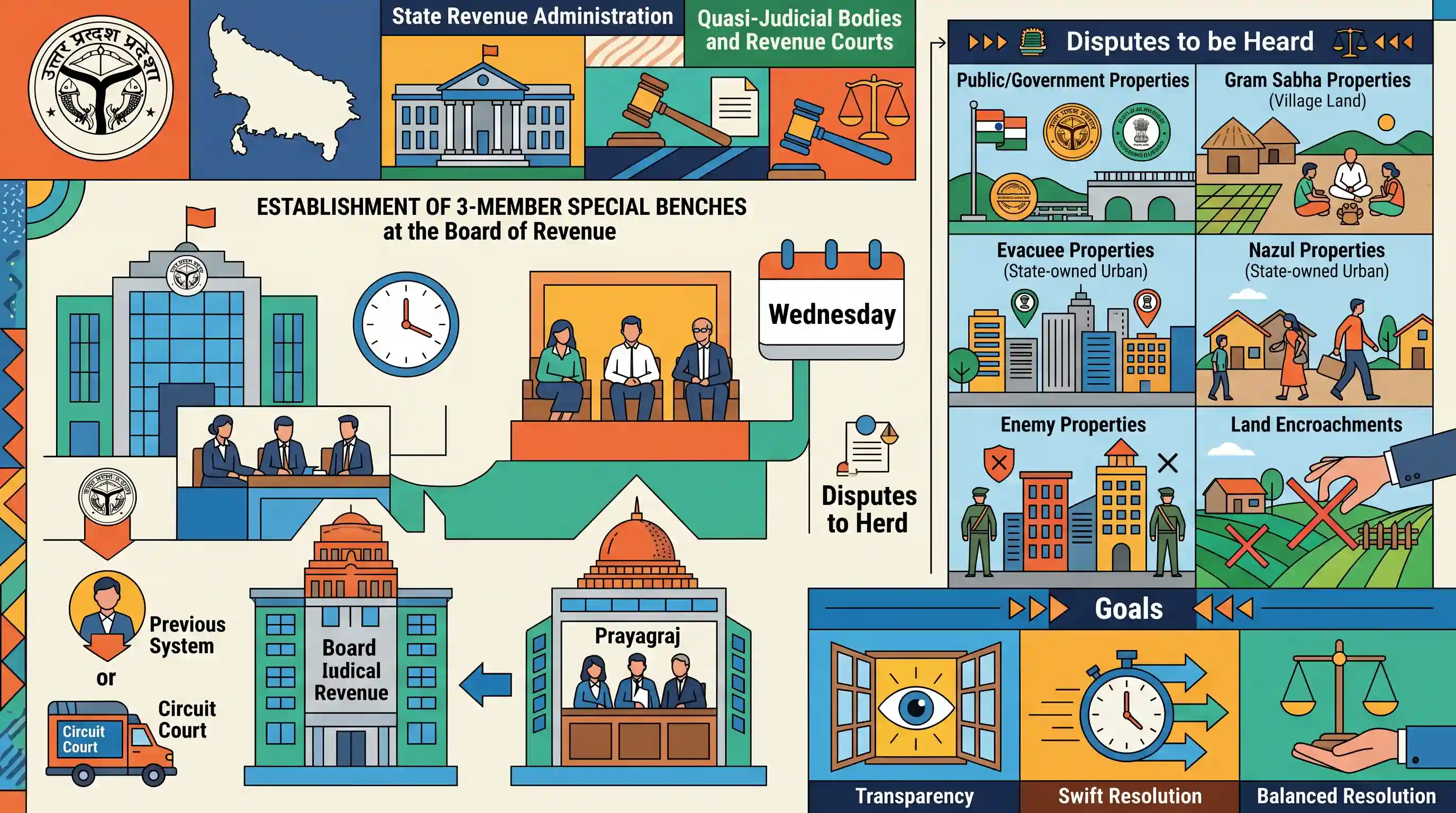
Why It Matters
Understanding the administration of land revenue, the structure of the Board of Revenue, and statutory provisions under the Uttar Pradesh Revenue Code is crucial for UPPSC Prelims (state-specific polity/governance) and Mains (GS Paper 5 & 6, focusing on UP-specific administrative and land reforms).
Summary
The Uttar Pradesh government, led by CM Yogi Adityanath, has established 3-member special benches at the Board of Revenue in Lucknow and Prayagraj under Section 9 of the Uttar Pradesh Revenue Code. These benches will hear disputes regarding public, government, Gram Sabha, Nazul, evacuee, and enemy properties every Wednesday, replacing the single-member bench/Circuit Court system to ensure transparency and swift, balanced resolution of land encroachments.
Key Points
- The Uttar Pradesh government has established 3-member special benches at the Board of Revenue to resolve disputes involving public and government land quickly.
- These special benches will replace the previous system of single-member benches or Circuit Courts for specific land categories.
- The land categories covered include reserved category land, government land, Gram Sabha land, Nazul land, evacuee property, and enemy property.
- The special benches will be stationed at Lucknow and Prayagraj and will hold dedicated hearings every Wednesday.
- This reform has been introduced under Section 9 of the Uttar Pradesh Revenue Code, following directives to clear encroachments and modernize the revenue justice system.
- The multi-member bench setup is aimed at ensuring greater transparency, consistency, and multi-perspective balanced decision-making.
Important Terms
Uttar Pradesh Revenue Code

A state legislative act consolidating and simplifying laws related to land tenures, land revenue, and revenue courts in Uttar Pradesh, replacing obsolete colonial-era regulations to modernize agrarian land administration.
UPSC context
GS Paper III (Land Reforms); tests state-level legislative measures, land tenure systems, and agricultural governance frameworks.
Board of Revenue, Uttar Pradesh
The chief controlling authority in Uttar Pradesh responsible for revenue administration, supervising land records, and acting as the highest court of appeal and revision for land revenue disputes.
UPSC context
GS Paper II (Quasi-Judicial Bodies) & GS Paper III (Land Reforms); tests state administrative mechanisms and judicial dispute resolution.
Gram Sabha Land
Communal or public land vested in village-level local bodies (Gram Sabhas) to be managed, preserved, or distributed for collective community benefit and rural public infrastructure.
UPSC context
GS Paper II (Panchayati Raj) & GS Paper III (Land Reforms); tests decentralized land governance and rural local self-government.
Nazul Land
Government-owned land, historically confiscated during British rule, that is typically not administered directly as state property but leased out to entities or individuals for public or residential use.
UPSC context
GS Paper II (Governance) & GS Paper III (Land Reforms); tests public land management, historical tenure systems, and urban governance.
Evacuee Property
Immovable assets and properties abandoned or left behind by individuals who migrated to Pakistan during the Partition of India in 1947, managed by government-appointed custodians.
UPSC context
GS Paper I (Post-Independence Consolidation) & GS Paper II (Governance); tests legal administration of partition-era assets and resettlement policies.
Enemy Property
Assets left behind in India by individuals who migrated and took citizenship of hostile countries (like Pakistan and China) after wars, managed permanently under the Custodian of Enemy Property.
UPSC context
GS Paper II (Government Acts) & GS Paper III (Security); tests regulation of sovereign assets, internal security, and legislative controls.
Prelims Trap
State Board of Revenue benches hold final statutory authority to permanently alienate, sell, or clear titles of Enemy Properties.
Enemy properties vest with the Custodian of Enemy Property for India (CEPI) under the Union Ministry of Home Affairs. State revenue courts can adjudicate local land disputes but cannot unilaterally alter or dispose of federal custodial rights.
Static Concepts Connected
What is 'Nazul Land' and how is it legally managed in India?
- Origin and Nature: Government-owned land confiscated during the British regime that escheated to the State post-independence due to lack of legal heirs.
- Regulatory Framework: Governed by state-specific Nazul Rules/Manuals and typically leased for public utilities, rather than being owned by local Gram Sabhas or municipal bodies.
What is the Custodian of Enemy Property for India (CEPI)?
- Nodal Authority: A statutory authority under the Ministry of Home Affairs established under the Enemy Property Act, 1968.
- Mandate and Scope: Vests and manages properties belonging to citizens of Pakistan and China who migrated during or after the wars of 1962, 1965, and 1971.
- Legal Status: Amendments in 2017 ensured that the law of succession does not apply to enemy properties, preventing claims by legal heirs of migrated citizens.
Cross-Topic Patterns
Land administration vs Central custody
While land is a State Subject (List II), Enemy Property is governed by Union legislation. State revenue benches must carefully coordinate with the Central Custodian (CEPI) to resolve multi-jurisdictional land title disputes.
Revenue reforms and ease of business
Replacing single-member revenue circuits with multi-member benches acts as a vital judicial reform, reducing pending land litigation to unlock blocked capital and accelerate infrastructure projects.

Prelims 2026 may test the jurisdictional division between state revenue courts and the central Custodian of Enemy Property over disputed lands.
Linked PYQs · 2
Linked PYQs · 2
- 2018UPPSC_PRELIMSGS1
Which of the following taxes is levied by the Gram Panchayats?
- 2004UPPSC_PRELIMSGS1
The largest share of Revenue receipt of the Uttar Pradesh Government comes from:
