Uttar Pradesh introduces one-time registration for state recruitment
Source:freepressjournal ↗
Why It Matters
UPPSC Prelims regularly tests candidates on Uttar Pradesh state-specific schemes, digital portals, governance initiatives, and administrative policies (such as the UPSSSC PET reform and validity changes).
Summary
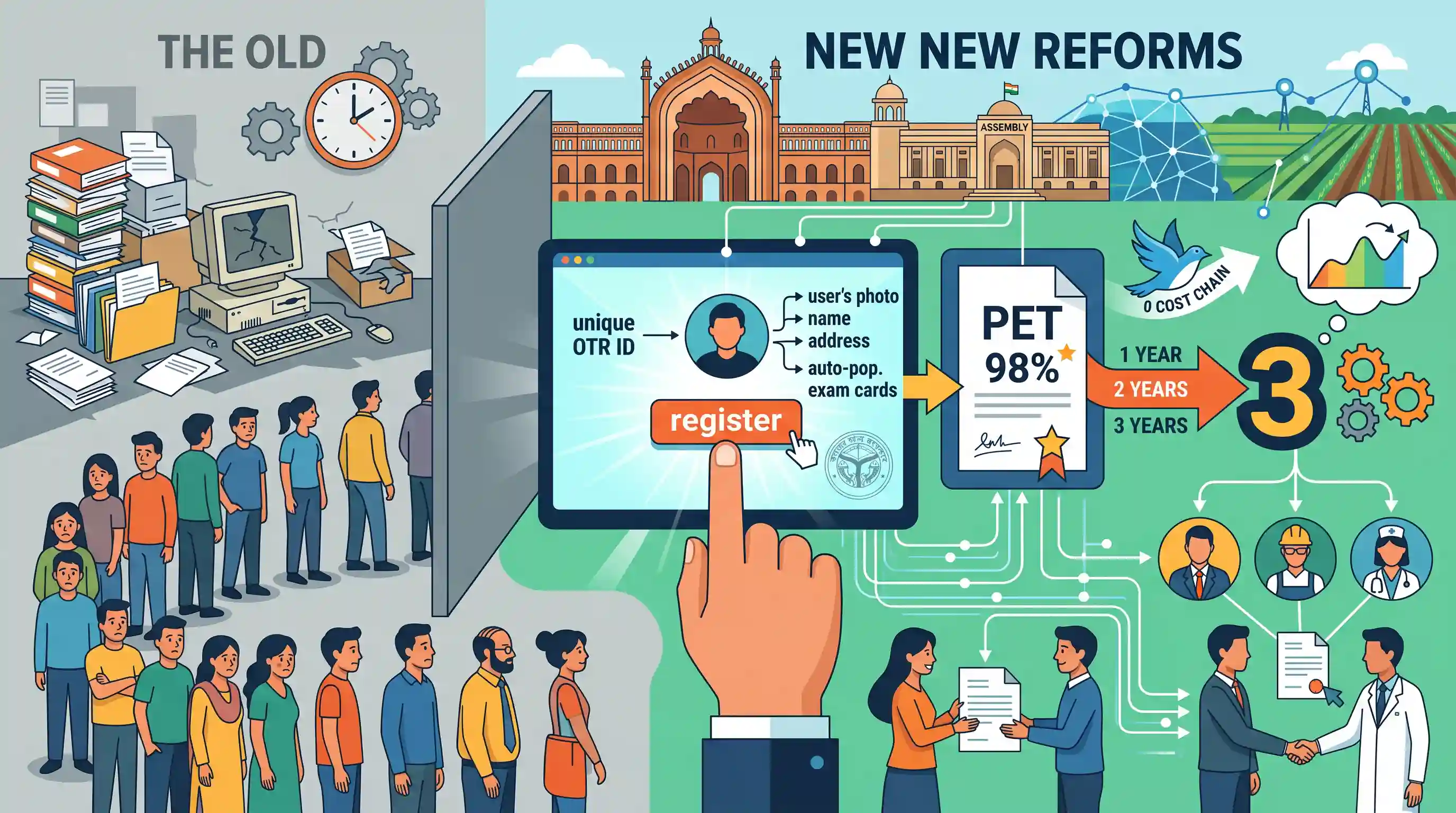
On July 14, 2026, the Government of Uttar Pradesh launched the One-Time Registration (OTR) system for recruitment through the Uttar Pradesh Subordinate Services Selection Commission (UPSSSC). This free facility auto-populates candidate details for future exams. Notably, the validity of the Preliminary Eligibility Test (PET) score has been extended to three years, allowing aspirants to use their highest scores for future applications. This initiative marks a major step in the state's administrative reforms and digital governance.
Key Points
- The Yogi Adityanath government in Uttar Pradesh launched a free One-Time Registration (OTR) system through the Uttar Pradesh Subordinate Services Selection Commission (UPSSSC) on July 14, 2026.
- The OTR system aims to make recruitment applications simpler, more transparent, and faster by requiring candidates to fill in personal and educational details only once.
- A major policy update is that the Preliminary Eligibility Test (PET) score's validity has been extended to three years, and candidates with multiple valid scores can utilize their highest score for recruitment.
- Candidates must verify their OTR profile via mobile and email and upload a color photograph (taken within the last six months) and a signature.
- Once an OTR number is issued, candidates will not be permitted to modify the submitted details, ensuring authenticity.
- The initiative is a significant step towards digital good governance and youth-centric administrative reform in Uttar Pradesh.
Important Terms
One-Time Registration (OTR) system

A digital facilitation system that allows job aspirants to register their personal and educational details once on a portal, eliminating the need to re-enter details for future applications.
UPSC context
GS Paper II: Governance, e-governance applications, and administrative reforms simplifying recruitment and enhancing transparency.
Preliminary Eligibility Test (PET)
A mandatory state-level preliminary screening exam in Uttar Pradesh used to shortlist candidates for Group B and Group C government posts.
UPSC context
GS Paper II: State-level administrative bodies and public sector recruitment processes.
Uttar Pradesh Subordinate Services Selection Commission (UPSSSC)
The state-level statutory recruiting agency in Uttar Pradesh responsible for conducting competitive exams and hiring for Group C administrative posts.
UPSC context
GS Paper II: Statutory, regulatory, and various quasi-judicial bodies in state administration.
e-Governance
The application of information and communication technology to deliver government services, exchange information, and integrate systems to improve administrative efficiency and transparency.
UPSC context
GS Paper II: E-governance applications, models, successes, limitations, and potential for administrative transparency.
Administrative Reforms
Systematic structural and procedural changes made to public administration to improve operational efficiency, transparency, and accountability in public services.
UPSC context
GS Paper II: Civil services in a democracy, institutional measures, and recruitment commission reforms.
Prelims Trap
Members of subordinate state recruitment boards share the same constitutional removal safeguards as members of the State Public Service Commission.
Only constitutional SPSC members (Article 315) are protected by Article 317 (requiring Presidential removal). Statutory subordinate board members are governed by state-level acts.
Static Concepts Connected
How do SPSC constitutional safeguards compare to state subordinate recruitment boards?
- Constitutional Status: SPSCs are established under Article 315, whereas subordinate selection boards are statutory bodies created by state legislative acts.
- Removal Power: SPSC members are appointed by the Governor but removed only by the President. Subordinate board members are typically removed by the State Government.
- Consultative Safeguards: SPSCs must be consulted on disciplinary actions under Article 320, a protection not constitutionally extended to statutory subordinate boards.
Cross-Topic Patterns
E-Governance in Federal Recruitment
The transition of UPSC and various state boards to OTR platforms reflects a coordinated, national push toward paperless, digital-first administrative governance.
Administrative Autonomy vs. Control
Comparing SPSC constitutional safeguards against statutory board vulnerability highlights legislative design choices balancing state executive control with institutional recruitment integrity.

UPSC may contrast constitutional SPSCs with statutory state recruitment boards on appointment, removal, and e-governance standards in 2026.
Linked PYQs · 1
Linked PYQs · 1
- 2021UPPSC_PRELIMSGS1
The functions of the State Public Service Commission of Uttar Pradesh can be extended by
