Uttar Pradesh Infrastructure and Expressway Growth Roadmap
Source:business-standard ↗
Why It Matters
UP-specific infrastructure projects (expressways, their geographical alignments, districts covered, and eco-friendly technologies like solar roads and fly ash utilization) are highly recurring and crucial topics in both UPPSC Prelims and Mains.
Summary
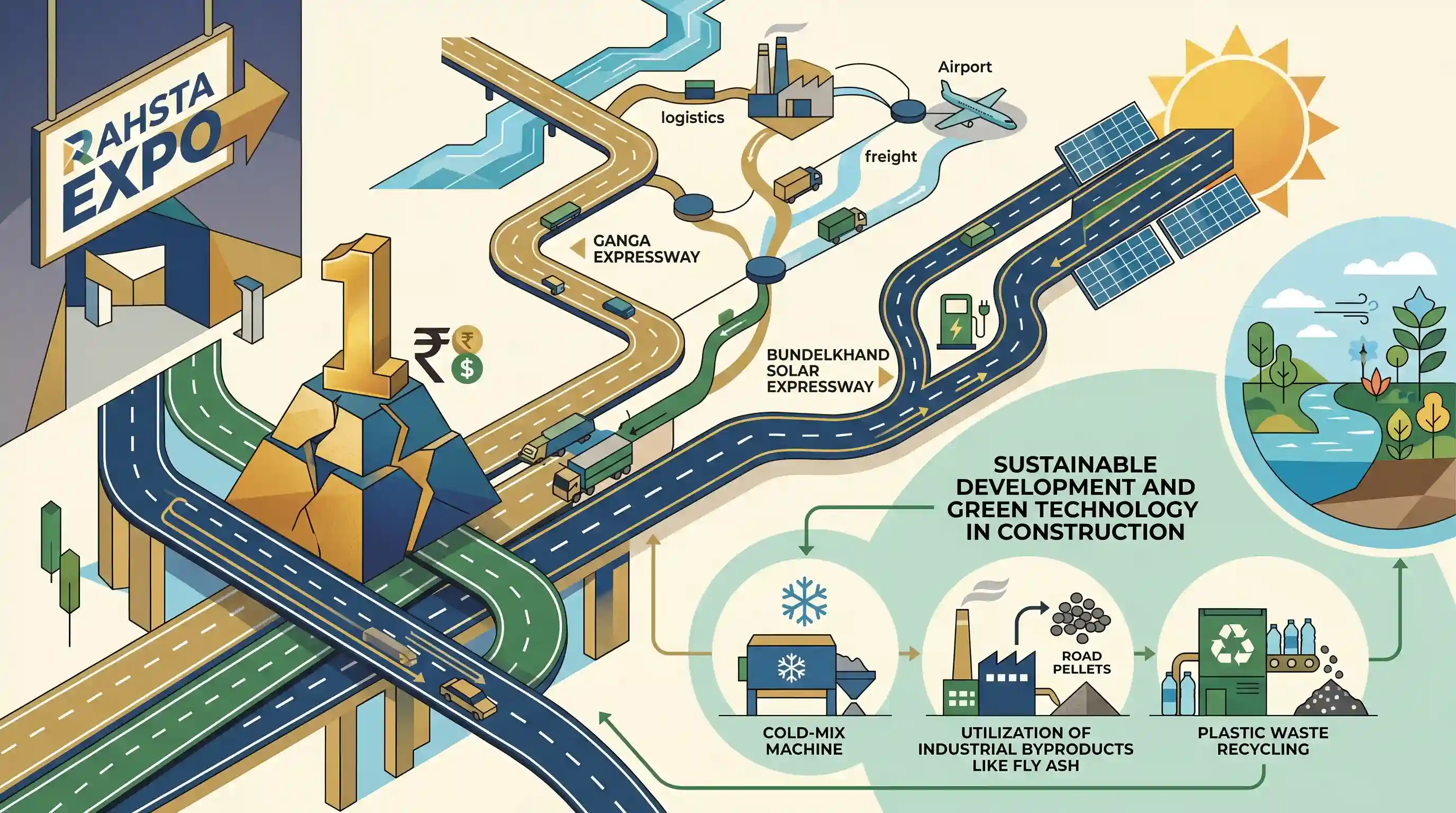
At the RAHSTA Expo, Uttar Pradesh showcased its infrastructure-led growth roadmap, highlighting how its massive expressway network is serving as the backbone for its $1 trillion economy target. The state is emphasizing green and sustainable road construction techniques, including cold-mix technology, the utilization of industrial byproducts like fly ash, and plastic waste recycling. Key state-led initiatives like the Ganga Expressway and the Bundelkhand Solar Expressway were showcased as pioneering examples of integrated, eco-friendly logistics corridors.
Key Points
- Roadmap Unveiling: Uttar Pradesh presented its infrastructure-led development model at the RAHSTA (Roads and Highways Sustainable Technologies & Advancements) Expo, aligning with its goal to achieve a $1 trillion economy.
- Expressway Leadership: Known as India's 'Expressway State', UP is capitalizing on its massive expressway network (e.g., Ganga, Purvanchal, Bundelkhand, and Agra-Lucknow Expressways) as the primary engine for industrial growth and connectivity.
- Ganga Expressway Flagship: The upcoming 594-km six-lane greenfield Ganga Expressway connecting Meerut to Prayagraj was highlighted as a major corridor traversing 12 districts, enhancing western-eastern connectivity and logistics.
- Sustainable Road Construction: The state is aggressively adopting green technologies, including the use of recycled plastic waste, fly ash (industrial byproduct), municipal waste, and cold-mix technology to reduce carbon emissions and environmental footprint in road building.
- Solar Expressways & Green Energy: The Bundelkhand Expressway is being pioneered as India's first 'Solar Expressway', installing solar panels along its pathways to generate green energy.
- Multimodal & Industrial Integration: Plans focus on connecting expressways with major transport gateways like the Noida (Jewar) International Airport, Ayodhya Airport, and National Waterway-1 (Ganga River), as well as developing dedicated industrial clusters along highway corridors through UPEIDA.
Important Terms
Uttar Pradesh Expressways Industrial Development Authority (UPEIDA)

A state government authority established in 2007 to plan, acquire land, construct, and manage access-controlled expressways and develop industrial corridors across Uttar Pradesh.
UPSC context
GS Paper 3: Infrastructure; tests understanding of state-level statutory bodies driving infrastructure growth.
Ganga Expressway Project
A 594 km access-controlled expressway currently under construction in Uttar Pradesh, connecting Meerut to Prayagraj to serve as a high-speed logistics and connectivity corridor across the state.
UPSC context
GS Paper 3: Infrastructure; tests knowledge of mega-infrastructure projects and their regional economic impacts.
Bundelkhand Expressway Project
An operational 296 km-long, four-lane access-controlled greenfield expressway in Uttar Pradesh connecting Chitrakoot with the Agra-Lucknow Expressway to promote development in the backward Bundelkhand region.
UPSC context
GS Paper 3: Infrastructure; tests understanding of regional corridors in mitigating regional developmental imbalances.
Purvanchal Expressway Project
An operational 340.8 km-long, six-lane access-controlled expressway connecting Lucknow to Ghazipur, aimed at boosting economic growth, industrial development, and regional integration in eastern Uttar Pradesh.
UPSC context
GS Paper 3: Infrastructure; tests knowledge of expressways and their integration with industrial clusters.
National Highways Authority of India (NHAI)
An autonomous statutory agency under the Ministry of Road Transport and Highways, established in 1988 to develop, maintain, and manage India's extensive National Highways network.
UPSC context
GS Paper 3: Infrastructure; tests familiarity with institutional bodies managing core national transportation networks.
Pradhan Mantri Gram Sadak Yojana (PMGSY)
A centrally sponsored scheme launched in 2000 to provide all-weather, single road connectivity to eligible unconnected habitations in rural India to reduce poverty and foster economic integration.
UPSC context
GS Paper 2 & 3: Schemes and Infrastructure; tests comprehension of rural connectivity and welfare governance.
Prelims Trap
Fly ash is legally classified as a hazardous waste under India's Hazardous Waste Management Rules due to its heavy metal content.
Despite containing toxic heavy metals, fly ash is classified as non-hazardous waste in India, regulated under dedicated Fly Ash Utilization Notifications rather than Hazardous Waste Rules.
Static Concepts Connected
What is Cold Mix Asphalt (CMA) technology and its ecological benefits?
- Ambient Processing: Processes aggregates and bituminous binders entirely at ambient temperatures (20°C–25°C), eliminating the fuel-intensive heating required for traditional Hot Mix Asphalt.
- Emission Reduction: Reduces carbon dioxide and greenhouse gas emissions by up to 50–60% during construction and eliminates toxic bitumen fumes, improving worker safety.
- Resource Efficiency: Particularly suitable for remote, forest-adjacent, or high-altitude areas where maintaining hot mix temperatures is logistically and economically unfeasible.
What are the regulatory mandates for Fly Ash utilization in India?
- Mandatory Utilization: MoEFCC notifications mandate 100% utilization of fly ash by coal-fired thermal power plants within a specified radius (typically 300 km) for construction activities.
- Permitted Sectors: Extensively used in manufacturing Portland Pozzolana Cement (PPC), fly ash bricks, structural fills, and road embankments, reducing topsoil excavation.
- Nodal Authority: The Central Electricity Authority (CEA) serves as the nodal body to monitor fly ash generation and utilization data across India's thermal power utilities.
Cross-Topic Patterns
Infrastructure PPPs and Renewable Integration
The transition of transport corridors like the Bundelkhand Expressway into solar hubs reflects a shift towards hybrid Public-Private Partnerships (PPPs), blending infrastructure development with utility-scale clean energy generation.
Fly ash utilization and environmental law
Scaling fly ash use in highway construction aligns with the National Green Tribunal's mandates on thermal plant waste, demonstrating circular economy links between industrial waste management and infrastructure growth.

Multi-statement questions in 2026 may test green road technologies (cold-mix, plastic waste) alongside national fly-ash utilization norms.
Linked PYQs · 4
Linked PYQs · 4
- 2023UPPSC_PRELIMSGS1
Which of the following Scheme/Programme is not the Central Government Programme and it is Uttar Pradesh Government's Programme?
- 2018UPPSC_PRELIMSGS1
'Purvanchal Express Way' in Uttar Pradesh will not pass through which of the following cities?
- 2021UPPSC_PRELIMSGS1
Flyash pollution is caused by
- 2023UPPSC_PRELIMSGS1
What do we call balancing the need to use resources and also conserve them for the future?
