Uttar Pradesh to train ten thousand Gau Mitras for cow welfare
Source:The Hindu ↗
Why It Matters
Highlights state-level policy integration (Uttar Pradesh Special), linking animal welfare with broader socioeconomic and environmental goals like green energy and rural employment.
Summary
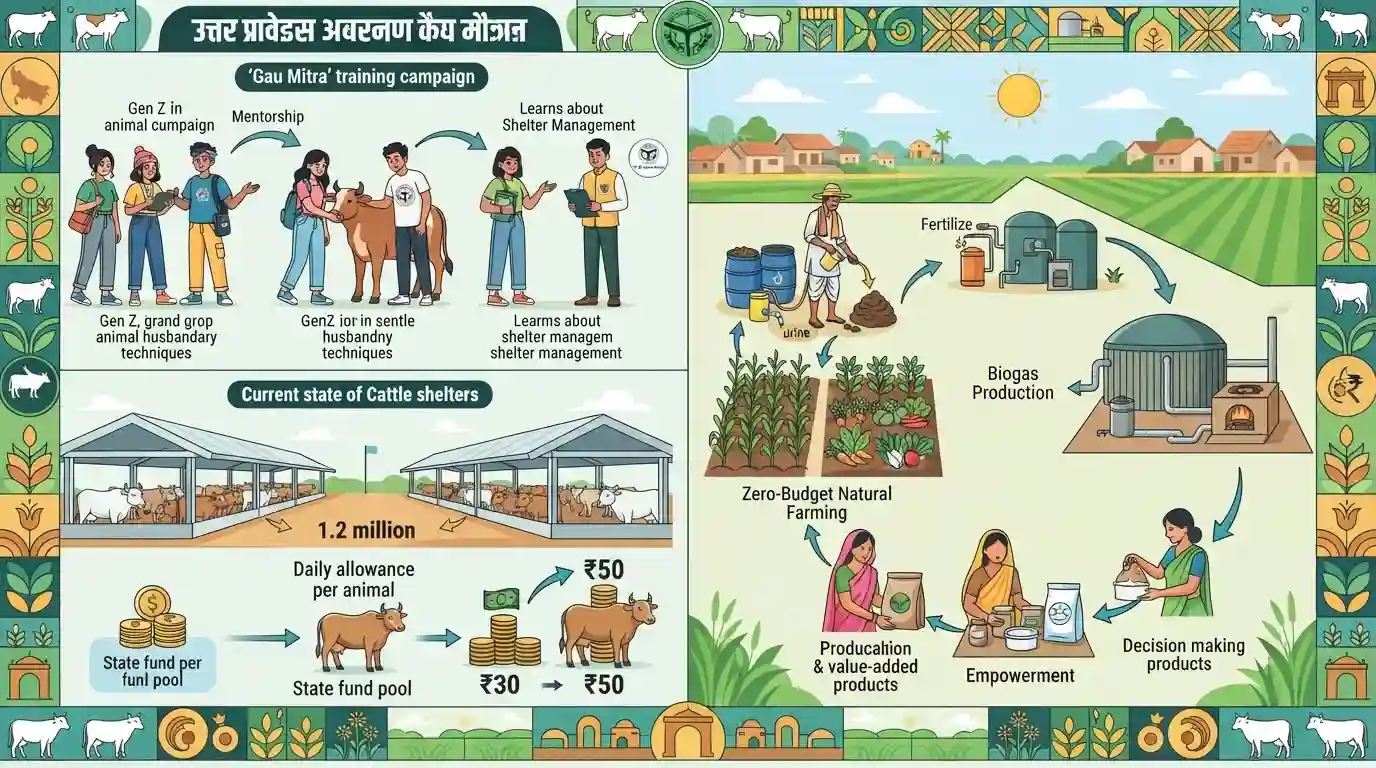
The Uttar Pradesh government has launched a campaign to train 10,000 'Gau Mitras' (cow protectors), aiming to sensitise the younger generation (Gen Z) toward cow protection. Led by the UP Go Seva Aayog, the initiative seeks to develop a self-reliance model by integrating cow protection with the rural economy, zero-budget natural farming, green energy (biogas), and women's empowerment. Currently, the state operates over 7,500 shelters for roughly 1.2 million cattle and has recently increased the daily upkeep allowance per animal from ₹30 to ₹50.
Key Points
- The Uttar Pradesh government announced plans to train 10,000 'Gau Mitras' to engage the younger generation in cow protection.
- The initiative connects cow welfare with the rural economy, natural farming, biogas, women's empowerment, and green energy.
- UP has over 7,500 cow shelters housing roughly 1.2 million cattle.
- Financial assistance under the cow participation scheme was increased from ₹30 to ₹50 per animal per day.
Important Terms
Uttar Pradesh Go Seva Aayog

A statutory state body responsible for cow welfare, protection, and preservation. It manages gaushalas, oversees the ₹50 daily upkeep allowance, and leads initiatives like the 'Gau Mitra' program to integrate cattle with rural economic self-reliance.
UPSC context
Important for UPPSC GS Paper 5 (UP Special). Tests knowledge of state institutions managing animal husbandry, agriculture, and rural economy.
Gau Mitras
Trained volunteers engaged by the Uttar Pradesh government to sensitise youth toward cow protection. The state is training 10,000 Gau Mitras to link cattle welfare with natural farming, biogas generation, and rural employment.
UPSC context
Relevant for UPPSC GS Paper 5 (UP-specific schemes). Highlights community participation in state-led rural economic and cultural initiatives.
Zero-Budget Natural Farming (ZBNF)
A chemical-free agricultural model emphasizing natural inputs like cow dung and urine (Jeevamrutha) to eliminate reliance on market fertilizers. It is integrated into UP’s cow shelter schemes to promote sustainable, low-cost farming.
UPSC context
Highly relevant for UPPSC GS Paper 3 (Agriculture) and GS Paper 5. Tests ecological farming techniques and farmer income strategies.
Mukhyamantri Nirashrit Govansh Sahbhagita Yojana
A UP government scheme addressing the stray cattle issue by encouraging citizens to adopt destitute cows. Caretakers receive direct financial assistance, which was recently increased from ₹30 to ₹50 per day per animal.
UPSC context
Crucial for UPPSC GS Paper 5. Tests knowledge of state solutions for stray cattle management, animal husbandry, and rural welfare.
Prelims Trap
Gau Mitras are officially deputed for law enforcement and anti-cattle smuggling operations.
Aspirants may confuse 'Gau Mitra' with vigilantes or police auxiliaries. The initiative actually focuses on rural economy integration—natural farming, biogas, and 'cow tourism'—not policing.
Static Concepts Connected
What are the 4 pillars of Zero Budget Natural Farming (ZBNF)?
- Jivamrita: A microbial mixture of cow dung, cow urine, jaggery, and pulse flour applied to enhance soil microbiome.
- Bijamrita: A seed treatment mixture utilizing local cow dung and urine to protect young roots from diseases.
- Acchadana (Mulching): Covering topsoil with cover crops or crop residues to conserve soil moisture and suppress weeds.
- Whapasa (Moisture): Maintaining optimal soil aeration and water vapor, reducing the need for heavy irrigation.
What is the Mukhyamantri Besahara Govansh Sahbaghita Yojana?
- Core Objective: A state scheme to solve the stray cattle menace by transferring them from government shelters to willing local farmers and herdsmen.
- Financial Aid: The government provides a daily allowance per animal via Direct Benefit Transfer (DBT), which was recently increased from ₹30 to ₹50.
Cross-Topic Patterns
Biogas and GOBARdhan scheme synergy
Linking UP's 7,500 gaushalas with biogas aligns with the central GOBARdhan initiative, transforming cattle waste into green energy and reducing rural fossil fuel dependence.
Women's SHGs and Rural Micro-enterprises
Tasking women's SHGs to manufacture eco-friendly cow-dung products links animal husbandry directly with rural livelihood missions, driving rural women's economic empowerment.

Integration of cow shelters with SHGs, biogas, and natural farming makes it a prime candidate for UPPSC GS 5 and Prelims scheme questions.
Linked PYQs · 5
Linked PYQs · 5
- 2021UPPSC_PRELIMSGS1
The functions of the State Public Service Commission of Uttar Pradesh can be extended by
- 2017UPPSC_PRELIMSGS1
With effect from 1 April, 2017 the minimum wage for unskilled labour in Uttar Pradesh has been fixed at:
- 2014UPPSC_PRELIMSGS1
The number of agro-climate zones in Uttar Pradesh is
- 2020UPPSC_PRELIMSGS1
According to the Report released by NITI Aayog in December 2019 on 'Sustainable Development Goals India Index 2019-20', the Uttar Pradesh is grouped under which of the following categories ?
- 2023UPPSC_PRELIMSGS1
Which of the following scheme/s is/are related to Uttar Pradesh? (1) Anuthee Uphar Scheme (2) Matra Shakti Udyamita Scheme (3) Kaushalya Matritva Scheme (4) Stree Nidhi Scheme Select the 'correct' answer using the code given below -
