UP to host India first large scale biopolymer plant
Source:ibef ↗
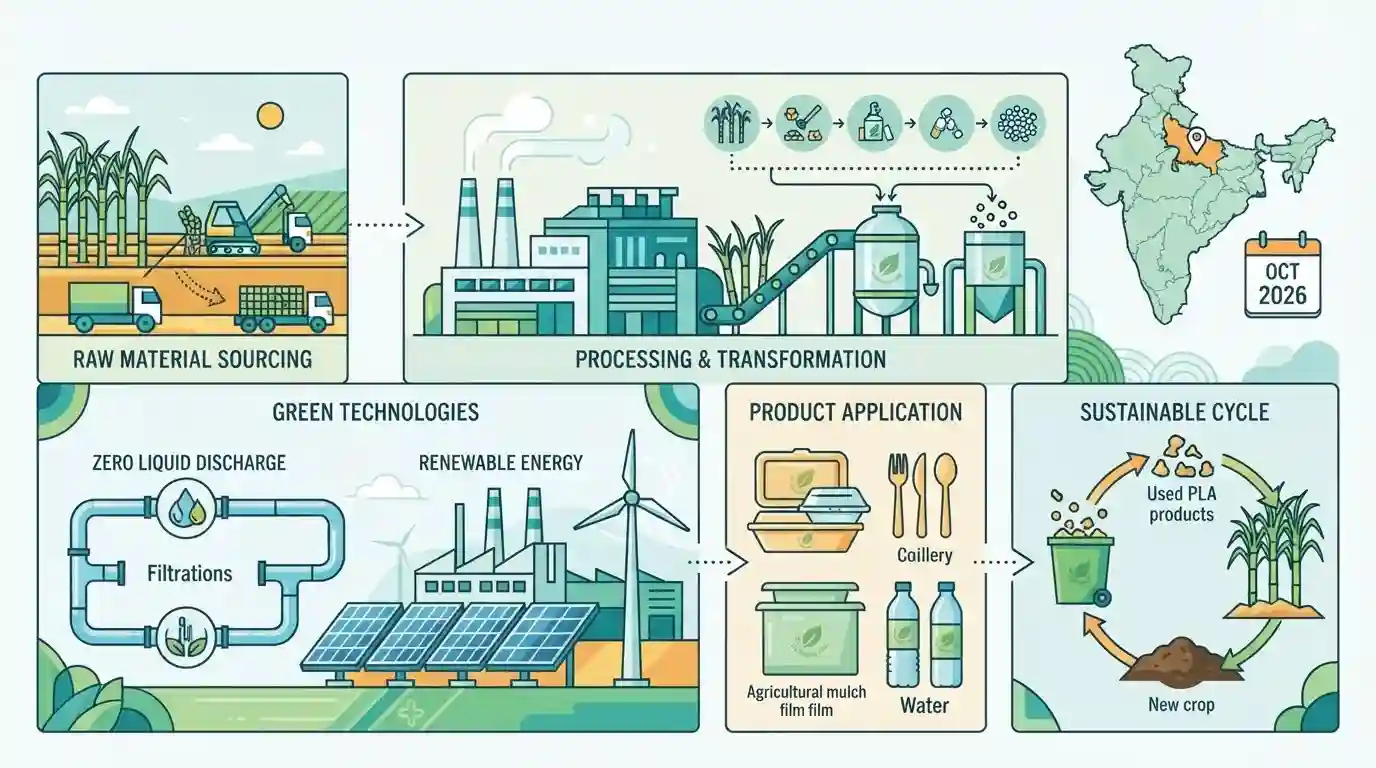
Why It Matters
This development is highly relevant for both GS3 (Environment/Industrial Economy) and UP-specific sections, as it highlights India's transition to a circular bio-economy through a pioneering, large-scale sugarcane-to-bioplastic (PLA) plant in Uttar Pradesh, addressing single-use plastic pollution using sustainable green technologies.
Summary
Uttar Pradesh is set to host India's first large-scale biopolymer manufacturing plant in Lakhimpur Kheri, led by Balrampur Chini Mills Limited with a Rs. 3,080 crore investment. The facility will convert sugarcane into Polylactic Acid (PLA), a 100% biodegradable bioplastic, replacing conventional plastics. Utilizing green technologies like a Zero Liquid Discharge system and renewable energy, the plant bolsters India's transition toward a circular bio-economy and is slated to commence operations by October 2026.
Key Points
- India’s first large-scale biopolymer facility, branded 'Balrampur Bioyug', is being established at the Kumbhi sugar unit in Lakhimpur Kheri, Uttar Pradesh.
- The plant represents an investment of Rs. 3,080 crore (US$ 324.21 million) by Balrampur Chini Mills Limited and will produce 80,000 tonnes of Polylactic Acid (PLA) annually.
- The facility will convert locally sourced sugarcane into a 100% biodegradable bioplastic to serve as a sustainable alternative to conventional single-use plastics.
- Emphasizing green manufacturing, the plant will feature a Zero Liquid Discharge (ZLD) system and rely on renewable energy sources, with operations expected to begin by October 2026.
Important Terms
Polylactic Acid (PLA)

A 100% biodegradable, bio-based thermoplastic derived from renewable agricultural resources like sugarcane. It decomposes naturally within months, offering a highly sustainable alternative to conventional petroleum-based plastics.
UPSC context
Crucial for GS Paper 3 (Science & Tech, Environment) regarding sustainable materials and solutions to plastic pollution.
Zero Liquid Discharge (ZLD)
An advanced industrial wastewater management method that recovers and reuses all process water, ensuring absolutely no harmful liquid effluent is released outside the facility into local water bodies.
UPSC context
Highly relevant for GS Paper 3 (Environment) and UP Special papers highlighting eco-friendly industrial growth and water conservation.
Balrampur Chini Mills Limited
A major Indian sugar company developing the nation's first large-scale biopolymer plant in UP. Operating under the "Balrampur Bioyug" brand, it transforms locally sourced sugarcane into biodegradable plastics.
UPSC context
Important for UP Economy (GS Papers 5 & 6) and current affairs involving major private investments and green manufacturing.
Circular Bio-Economy
An economic model that sustainably utilizes renewable biological resources—such as agricultural biomass—to produce energy, food, and industrial goods while systematically minimizing waste and environmental impact.
UPSC context
A key theme for GS Paper 3 (Economy, Sustainable Development) and essay topics focused on green transitions.
Lakhimpur Kheri
The UP district hosting India’s pioneering ₹3,080 crore large-scale biopolymer plant. The project seamlessly integrates local sugarcane agriculture with advanced, eco-friendly manufacturing on a single campus.
UPSC context
Essential for UP Special (GS Papers 5 & 6) concerning regional development, geography, and agro-based industrialization in the state.
Prelims Trap
"India's first large-scale biopolymer plant relies on bamboo as its primary raw material."
The plant uses locally sourced sugarcane (UP's main commercial crop), not bamboo or corn, to produce Polylactic Acid (PLA).
Static Concepts Connected
What are bioplastics and how does Polylactic Acid (PLA) function?
- Biomass Source: Derived from renewable biomass sources like sugarcane or corn starch rather than petroleum-based petrochemicals.
- Chemical Properties: PLA is a thermoplastic aliphatic polyester that is fully biodegradable under commercial composting conditions.
- Environmental Significance: It serves as a sustainable alternative to conventional single-use plastics, significantly reducing carbon footprints.
What is the geographic and economic significance of sugarcane in Uttar Pradesh?
- Production Hub: UP is India's leading sugarcane producer, with cultivation heavily concentrated in the Terai and Doab regions (including Lakhimpur Kheri).
- Economic Backbone: It is the state's primary commercial cash crop, supporting millions of farmers and driving agro-based industrial development.
- Industrial Diversification: The industry is transitioning from just sugar and molasses to ethanol blending and now advanced biorefineries for bioplastics.
Cross-Topic Patterns
Sugarcane diversification into the bio-economy
UP’s sugar industry is shifting from traditional sugar and ethanol production toward advanced biorefineries, directly linking agricultural output to high-tech circular economy and green manufacturing goals.
ZLD systems and river conservation mandates
ZLD technology prevents untreated effluent discharge. Expect questions linking ZLD adoption in UP’s sugar/distilleries to river conservation efforts like Namami Gange and groundwater protection.

Expect a multi-statement question combining UP's sugarcane geography, PLA bioplastic properties, and India's first biopolymer plant.
Linked PYQs · 5
Linked PYQs · 5
- 2022UPPSC_PRELIMSGS1
Dudhwa National Park is located in which of the following districts of Uttar Pradesh?
- 2016UPPSC_PRELIMSGS1
The largest Sugar Mill of Asia is located at which of the following place in Uttar Pradesh?
- 2008UPPSC_PRELIMSGS1
The main commercially produced crop of Uttar Pradesh is
- 2022UPPSC_PRELIMSGS1
Which of the following material is bio-degradable ?
- 2023UPPSC_PRELIMSGS1
Which of the following is not a biodegradable polluter?
