Uttar Pradesh to Raise Specialized Rescue Group for Disasters
Source:hindustantimes ↗
Why It Matters
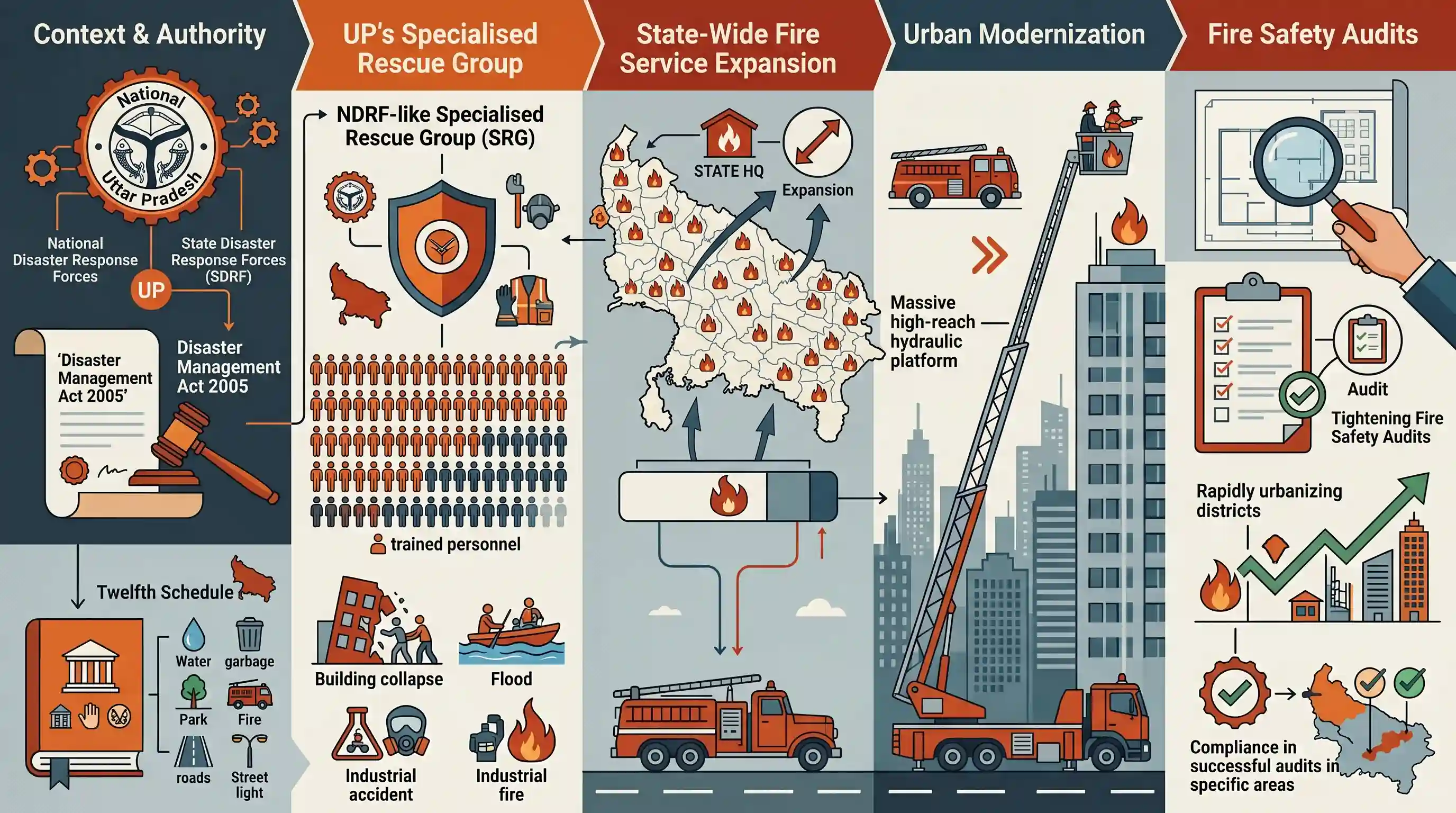
The development shows structural changes in state disaster response capabilities, integrating national-level training with local-level rescue operations. Under UPPSC, municipal responsibilities (like fire services under the 12th Schedule) and the statutory provisions of the Disaster Management Act, 2005 are core syllabus topics.
Summary
The Uttar Pradesh government is setting up an NDRF-like Specialised Rescue Group (SRG) with 240 trained personnel to handle complex disasters. In addition, the state is expanding fire services to every tehsil, modernizing its firefighting fleet with high-reach hydraulic platforms for urban high-rises, and tightening fire safety audits in rapidly urbanizing districts.
Key Points
- The Uttar Pradesh government is establishing a Specialised Rescue Group (SRG) within the state fire and emergency services department, modeled on the National Disaster Response Force (NDRF).
- A cohort of 240 personnel will undergo advanced training at premier national institutions including the NDRF, BSF, ITBP, and CISF to manage complex disasters like floods, building collapses, and chemical accidents.
- The SRG will be established in 10 districts in its first phase of deployment.
- The state aims to cover all 350 tehsils with fire services. Currently, 326 permanent fire stations are active across 296 tehsils, with 26 ready for inauguration, 25 under construction, and DPRs prepared for 47 more.
- To handle high-rise emergencies in major urban hubs like Noida and Ghaziabad, the state is procuring advanced hydraulic platforms (ranging up to 102 meters in reach) and 14 advanced firefighting vehicles for up to 100-storey buildings.
- Chief Minister Yogi Adityanath directed regular fire audits of hospitals, schools, and high-rises and requested the simplification of the fire NOC (No Objection Certificate) process.
Important Terms
Disaster Management Act 2005

A central legislation in India that provides a statutory framework for proactive disaster risk reduction, mitigation, and response, establishing authorities at national, state, and district levels.
UPSC context
GS Paper III (Disaster Management); tests legislative frameworks, executive emergency powers, and statutory bodies like the NDMA.
74th Constitutional Amendment Act 1992
A landmark constitutional amendment that granted constitutional status to Urban Local Bodies (ULBs), introducing Part IXA to decentralize urban governance and planning.
UPSC context
GS Paper II (Polity and Governance); tests democratic decentralization, devolution of powers, and local self-government structures.
Twelfth Schedule of the Indian Constitution
A schedule containing 18 functional items devolved to municipal local bodies, covering municipal matters like urban planning, public health, sanitation, and fire services.
UPSC context
GS Paper II (Polity); tests knowledge of municipal powers, federal distribution of subjects, and local governance scope.
National Disaster Response Force (NDRF)
A specialized, multi-skilled central force raised under the Disaster Management Act, 2005, dedicated to rapid search, rescue, and mitigation during disasters.
UPSC context
GS Paper III (Disaster Management); tests administrative emergency responses, command structures, and national crisis response agencies.
Specialised Rescue Group (SRG)
A state-level specialized disaster response unit raised within Uttar Pradesh's Fire and Emergency Services to tackle complex urban, high-rise, and industrial emergencies.
UPSC context
GS Paper III (Disaster Management); tests state-level initiatives, decentralization of rescue capabilities, and urban safety infrastructure.
Prelims Trap
Fire services must be under the exclusive administrative control of urban local bodies as mandated by the Twelfth Schedule.
Aspirants often assume constitutional listing forces direct local control, overlooking that states retain executive control over fire departments, keeping them centralized in 21 states.
Static Concepts Connected
What is the statutory disaster management governance hierarchy in India?
- National level (NDMA): Chaired by the Prime Minister; serves as the apex policy-formulating body for disaster response.
- State level (SDMA): Chaired by the respective Chief Minister, directing state-level mitigation and preparation plans.
- District level (DDMA): Co-chaired by the District Magistrate and the chairperson of the local authority.
- Urban level (UDMA): Introduced by the 2025 Amendment for metropolitan cities, headed by the Municipal Commissioner.
How are fire services constitutionally classified in India?
- Twelfth Schedule: Listed under Entry 7 of the Twelfth Schedule (Article 243W) as a municipal function.
- State jurisdiction: Governed primarily by state laws, falling under the broader public safety mandate of the State List.
- Centralization gap: In 21 states, fire services are run directly by the state government rather than devolved to local municipal bodies.
Cross-Topic Patterns
Urbanization and safety infrastructure
Vertical growth in Tier-2 and Tier-3 cities outpaces municipal capacity, necessitating central-state policy interventions like the 2025 DM Amendment's Urban Disaster Management Authorities (UDMAs).
Fiscal federalism in disaster financing
State disaster mitigation and response rely on Central shares (75% general, 90% special category), making local resilience heavily dependent on Finance Commission devolution frameworks.

The 2025 DM Amendment's statutory backing for SDRFs and UDMAs, paired with Twelfth Schedule devolution gaps, is prime for a 2026 GS-2/GS-3 mix.
Linked PYQs · 2
Linked PYQs · 2
- 2021UPPSC_PRELIMSGS1
The National Disaster Management Division in India is the nodal division in the Ministry of Home Affairs for disaster management. Who is the Ex-officio Chairman of the National Disaster Management Authority?
- 2020UPPSC_PRELIMSGS1
During the 'lockdown', the extraordinary powers used by the Government of India received legal basis from which of the following laws? 1. Mental Health Care Act, 2017 2. Disaster Management Act, 2005 3. Enemy Property Act, 1968 4. Epidemic Diseases Act, 1897 Select the correct answer using the codes given below.
