UP highway projects expand regional connectivity and economic growth
Source:indiatvnews ↗
Why It Matters
The UPPSC Prelims frequently tests facts regarding major infrastructure developments in the state, such as specific districts traversed by expressways and highways (similar to previous questions on the Ganga and Purvanchal Expressways), as well as geographical/conceptual definitions like greenfield projects.
Summary
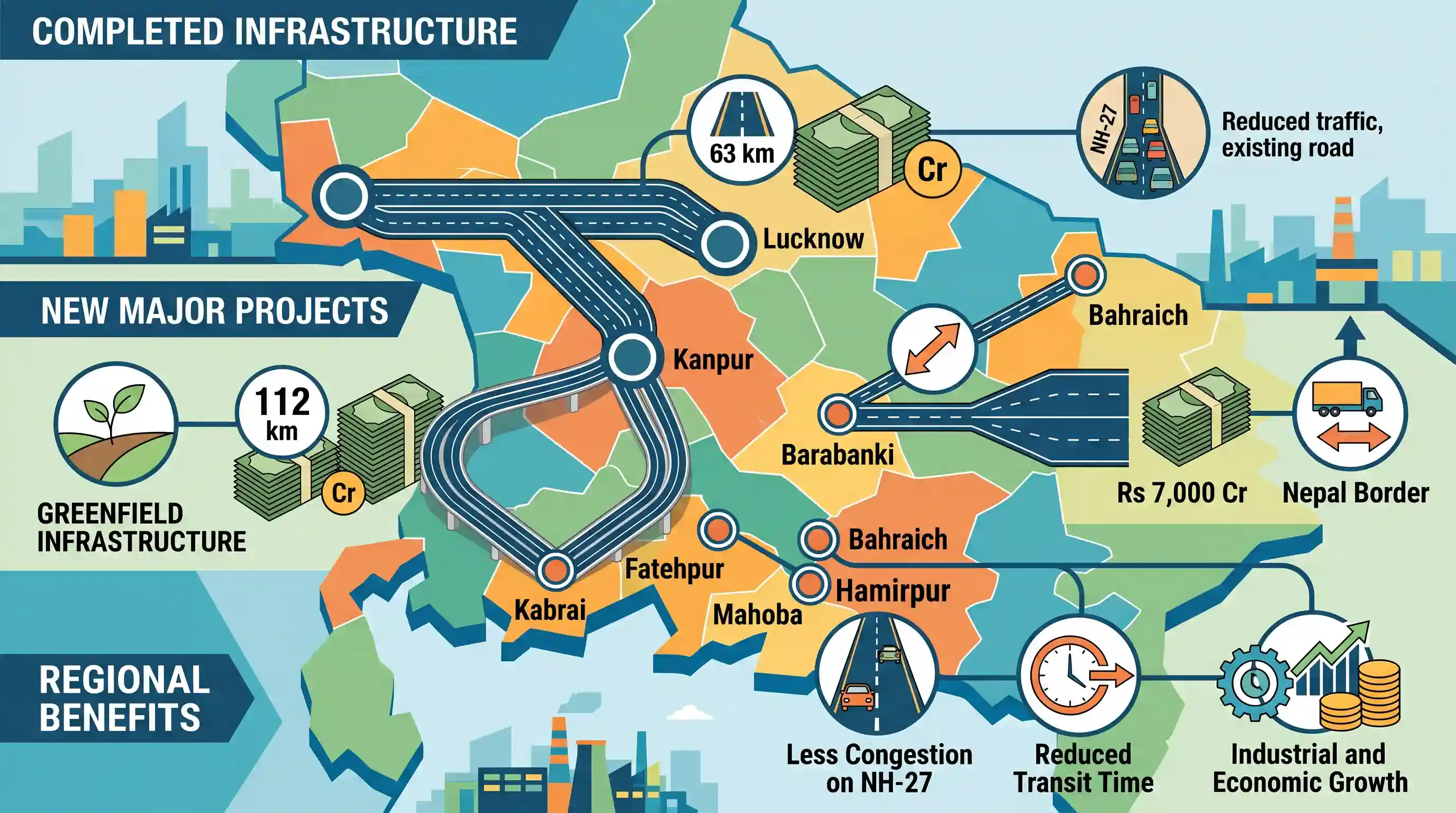
Uttar Pradesh is expanding its transport infrastructure with the completion of the 63-km Lucknow-Kanpur Expressway (built at a cost of Rs 4,700 crore) and the development of two new major projects approved by the Union Cabinet: the 112-km Kanpur-Kabrai greenfield highway (costing over Rs 3,000 crore) and the widening of the Barabanki-Bahraich highway to four lanes (costing Rs 7,000 crore). These projects aim to cut transit times, reduce congestion on NH-27, and promote industrial and economic growth across multiple districts including Kanpur, Barabanki, Bahraich, Fatehpur, and Hamirpur.
Key Points
- The Union Cabinet has approved and funded two new highway projects in Uttar Pradesh, which will benefit around eight districts including Kanpur, Barabanki, Bahraich, Fatehpur, and Hamirpur.
- The 63-km-long Lucknow-Kanpur Expressway, built at Rs 4,700 crore, features a 42-km greenfield section and will slash travel time between the two major cities from 2.5–3 hours to 30–45 minutes.
- The newly approved Kanpur-Kabrai road is a 112-km greenfield highway costing over Rs 3,000 crore, passing through Kanpur, Fatehpur, and Hamirpur.
- The Barabanki-Bahraich road is being upgraded from a 2-lane road to a 4-lane highway at an estimated cost of Rs 7,000 crore, involving land acquisitions of 140 acres in Bahraich and 110 acres in Barabanki.
- A greenfield highway is defined as a road built from scratch along an entirely new alignment where no roads or residential structures previously existed, featuring extensive tree plantations on both sides to mitigate pollution.
Important Terms
Greenfield Infrastructure Projects

Infrastructure projects built from scratch on previously undeveloped land, offering complete planning flexibility without existing-structure constraints.
UPSC context
GS Paper III (Infrastructure); tests understanding of development types and asset creation.
Lucknow-Kanpur Expressway Project
A 63-km, 6-lane access-controlled highway (National Expressway 6) connecting Lucknow and Kanpur, designed to reduce transit times and boost regional economic connectivity.
UPSC context
GS Paper III (Infrastructure: Roads); tests knowledge of key connectivity corridors and regional development.
Kanpur-Kabrai Greenfield Highway Project
A 117.7-km access-controlled greenfield corridor on NH-34 forming a key segment of the Bhopal-Kanpur Economic Corridor to improve regional freight and mineral logistics.
UPSC context
GS Paper III (Infrastructure); tests knowledge of economic corridors and the PM GatiShakti framework.
Barabanki-Bahraich Highway Expansion Project
A 101-km four-lane widening project of NH-927 in UP, developed under the Hybrid Annuity Mode, aimed at improving connectivity toward the Nepal border.
UPSC context
GS Paper III (Infrastructure) & GS II (Bilateral Relations); tests understanding of cross-border trade connectivity.
Hybrid Annuity Mode (HAM)
An infrastructure financing model where the government pays 40% of the cost during construction, and the remaining 60% as annuities over a fixed period.
UPSC context
GS Paper III (Investment Models); tests command of public-private partnership frameworks.
Build-Operate-Transfer (BOT) model
A project delivery mechanism where a private entity finances, constructs, and operates a facility, recovering costs via user tolls before transferring ownership back to the government.
UPSC context
GS Paper III (Investment Models); tests comprehension of private sector participation in infrastructure.
Prelims Trap
The Lucknow-Kanpur National Expressway (NE-6) physically traverses the districts of Lucknow, Unnao, and Kanpur.
NE-6 physically runs only through Lucknow and Unnao districts. It terminates before crossing the Ganges into Kanpur district proper, making Unnao its physical terminus despite its name.
Static Concepts Connected
What is the Hybrid Annuity Model (HAM) in Indian infrastructure?
- Risk Allocation: The government (NHAI) bears the commercial traffic/demand risk, shielding the private developer from fluctuations in toll revenues.
- Funding Split: NHAI funds 40% of the project cost during construction, while the developer finances the remaining 60% through debt and equity.
- Annuity Payments: The private developer recovers their 60% investment through guaranteed semi-annual annuity payments from the government over a fixed concession period.
How does BOT-Toll differ from EPC in public-private partnerships?
- EPC Model: The government funds the entire project, and the private player is paid to construct it, bearing no long-term operations or traffic risk.
- BOT-Toll Model: The private developer builds, operates, and eventually transfers the asset, bearing 100% of the financial, construction, and toll-collection risks.
Cross-Topic Patterns
Cross-Border Trade + Land Ports
Upgrading NH-927 to Rupaidiha links GS3 infrastructure to GS2 neighborhood diplomacy, showcasing how domestic highway development directly facilitates bilateral trade with landlocked Nepal.
PPP Models + Fiscal Consolidation
The deliberate policy shift from EPC to HAM and BOT models reflects the government's strategy to crowd-in private capital while managing fiscal deficit targets.

Expect questions contrasting BOT vs HAM risk-sharing models alongside physical transit corridors linking land ports to neighboring countries.
Linked PYQs · 2
Linked PYQs · 2
- 2023UPPSC_PRELIMSGS1
Which of the following Scheme/Programme is not the Central Government Programme and it is Uttar Pradesh Government's Programme?
- 2018UPPSC_PRELIMSGS1
'Purvanchal Express Way' in Uttar Pradesh will not pass through which of the following cities?
