Jewar Electronics Hub and Semiconductor Manufacturing in UP
Source:indiatv ↗
Why It Matters
This article covers high-priority UPPSC Prelims areas, specifically major state infrastructure (Jewar manufacturing hub, Delhi-Siliguri High-Speed Rail Corridor) and economic initiatives promoting 'Make in India'. UP-specific mega projects and transport corridors frequently feature in regional economic and geography questions.
Summary
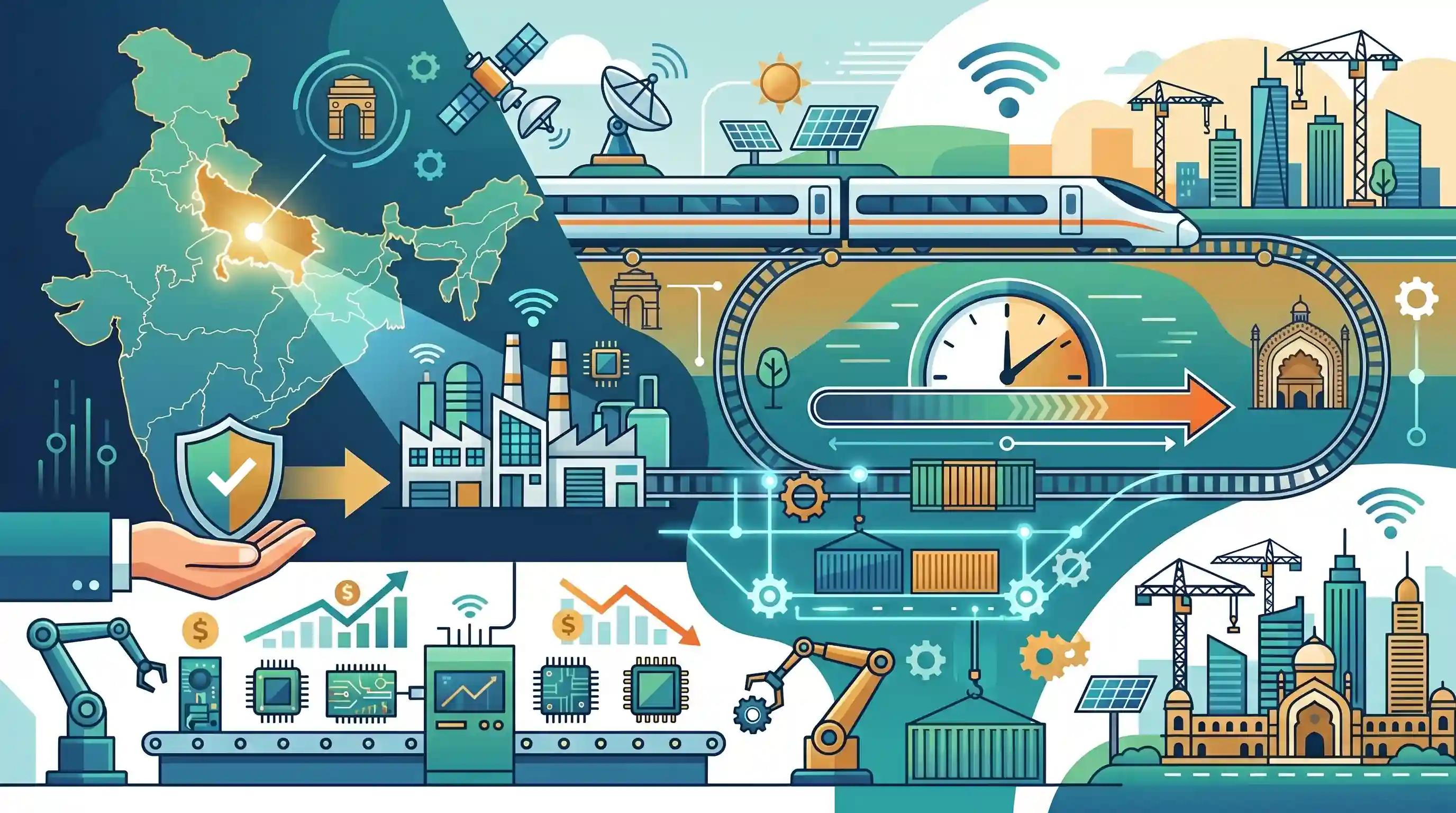
Uttar Pradesh is rapidly emerging as a leading electronics and semiconductor manufacturing hub, accelerated by the launch of a major electronics project in Jewar, Gautam Buddha Nagar. Supported by the Central Government, the project will manufacture high-tech electronics worth ₹40,000 crore domestically, reducing reliance on imports. Additionally, the Central Government's approval of the Delhi-Siliguri Bullet Train Corridor will slash transit times from Jewar to Lucknow to 1 hour and 40 minutes, providing a massive logistical boost to the region's electronics and semiconductor supply chains.
Key Points
- Uttar Pradesh is developing a major electronics manufacturing and semiconductor hub in the Jewar region of Gautam Buddha Nagar, aimed at boosting domestic manufacturing.
- The project is estimated to substitute electronic imports worth approximately ₹40,000 crore by enabling local production of these high-value components.
- South Korean multinational company Korea Circuits (headed by CEO Yang Ho Cho) is setting up a facility to manufacture advanced High-Density Interconnect (HDI) printed circuit boards (PCBs) for smartphones, memory modules, and IT hardware.
- The Union Government has approved the Delhi–Siliguri Bullet Train Corridor, which will cut travel time from Delhi to Lucknow to a little over 2 hours, and Jewar to Lucknow to 1 hour and 40 minutes, boosting local industrial logistics.
- UP's political stability, investor-friendly policies, skilled workforce, and fast-track clearance mechanisms were cited as key factors drawing global semiconductor supply chain players.
Important Terms
Make in India

A flagship national initiative launched in 2014 to facilitate investment, foster innovation, enhance skill development, and build best-in-class manufacturing infrastructure across key focus sectors.
UPSC context
GS Paper III: Indian Economy and Industrial Policy. Tests knowledge of manufacturing reforms, FDI, and national growth strategies.
Aatmanirbhar Bharat
An umbrella national campaign launched in 2020 promoting self-reliance across key strategic sectors to reduce import dependence and boost domestic manufacturing capabilities.
UPSC context
GS Paper III: Indian Economy. Tests understanding of self-reliance, import substitution, and industrial development policies.
Delhi-Siliguri Bullet Train Corridor
A proposed high-speed rail corridor connecting Delhi to Siliguri via Jewar, Lucknow, Varanasi, and Patna, aimed at dramatically reducing travel times and enhancing regional logistics.
UPSC context
GS Paper III: Infrastructure (Railways). Tests knowledge of high-speed transit-oriented development and economic corridors.
Ministry of Electronics and Information Technology
The Union ministry responsible for formulating policies regarding information technology, digital public infrastructure, electronics manufacturing schemes, and promoting India's semiconductor and tech ecosystems.
UPSC context
GS Paper II: Government Policies. Tests understanding of state-led technology schemes and digital governance frameworks.
Amber Enterprises
A leading Indian original equipment and electronics manufacturing services company actively expanding into domestic printed circuit board (PCB) fabrication through global partnerships.
UPSC context
GS Paper III: Science and Technology/Economy. Tests understanding of private sector contributions to the domestic hardware supply chain.
Korea Circuits
A prominent South Korean technology company specializing in high-density interconnect (HDI) and advanced printed circuit board (PCB) manufacturing.
UPSC context
GS Paper II/III: Bilateral Relations. Tests understanding of foreign direct investment (FDI) and global tech transfers.
Prelims Trap
The Uttar Pradesh Semiconductor Policy 2024 offers an additional 50% capital subsidy on total project cost, rendering units 100% subsidized.
The UP policy offers 50% of the central subsidy (which is 50% of project cost), resulting in a combined total subsidy of 75% of the project cost, not 100%.
Static Concepts Connected
What is the India Semiconductor Mission (ISM)?
- Nodal Agency: Launched under the Digital India Corporation to drive India's long-term semiconductor and display manufacturing strategies.
- Fiscal Support: Provides uniform 50% fiscal support of the project cost for semiconductor and display fabrication units.
- Key Components: Encompasses schemes for Fabs, Compound Semiconductors, Silicon Photonics, Sensor Fabs, and Design Linked Incentives (DLI).
What are High-Density Interconnect (HDI) PCBs?
- Definition: Printed circuit boards featuring higher wiring density per unit area, utilizing microvias, blind/buried vias, and thin lines.
- Applications: Enables severe miniaturization and higher performance, essential for smartphones, aerospace electronics, and memory modules.
Cross-Topic Patterns
Competitive federalism in deep-tech
States are offering massive fiscal top-ups (like UP's policy) on top of central incentives to bypass geographic disadvantages and attract deep-tech capital.
Logistics-led industrial clustering
Linking high-speed rail corridors to manufacturing hubs enables rapid transit of high-value, low-weight electronic components, reducing reliance on coastal port proximity.

2026 Prelims may test the structural and financial limits of the India Semiconductor Mission alongside state-level top-up schemes.
Linked PYQs · 2
Linked PYQs · 2
- 2003UPPSC_PRELIMSGS1
Railway ministry of India proposes to introduce Bullet train between:
- 2023UPPSC_PRELIMSGS1
Which of the following Scheme/Programme is not the Central Government Programme and it is Uttar Pradesh Government's Programme?
