Sardar Vallabhbhai Patel Industrial Zone scheme launched in UP
Source:indian-masterminds ↗
Why It Matters
Understanding state-specific industrial policies like SVPEIZ is critical for the UP Special component of the UPPSC Prelims. It highlights the structural shifts in regional economic planning, SPV-led governance models, and infrastructure initiatives designed to attract investment and tackle unemployment.
Summary
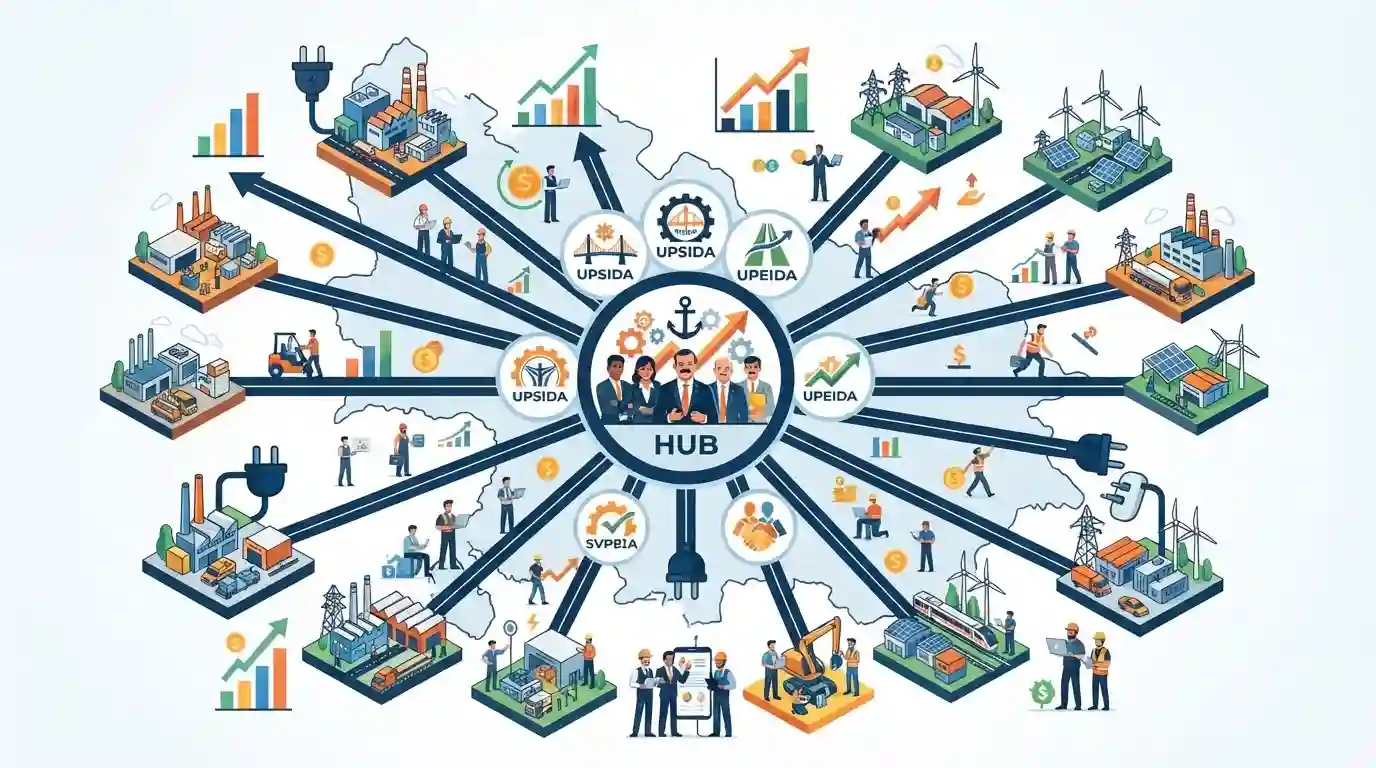
The Uttar Pradesh government is launching 16 industrial zones under the Sardar Vallabhbhai Patel Employment and Industrial Zone (SVPEIZ) scheme to stimulate economic growth and employment. Operated under a 'Hub and Spoke' model, the initiative involves major state agencies like UPSIDA and UPEIDA. These zones will feature 'plug-and-play' infrastructure to accelerate business setup and will be managed through Special Purpose Vehicles (SPVs) led by anchor investors, significantly enhancing the state's investment climate.
Key Points
- The Uttar Pradesh government will establish 16 new industrial zones under the Sardar Vallabhbhai Patel Employment and Industrial Zone (SVPEIZ) scheme.
- The scheme aims to create a comprehensive industrial and employment ecosystem utilizing a 'Hub and Spoke' model across the state.
- State authorities including MSME Department, UPSIDA, UPEIDA, YEIDA, GIDA, and Greater Noida Authority will oversee these zones.
- Each zone will offer 'plug-and-play' facilities—pre-installed electricity, water, and road access—to expedite business operations.
- The zones will be managed by a Special Purpose Vehicle (SPV), with an anchor investor acting as the SPV's chairman.
Important Terms
Sardar Vallabhbhai Patel Employment and Industrial Zone (SVPEIZ) scheme

A UP government initiative establishing integrated "hub and spoke" industrial zones across districts. Featuring plug-and-play infrastructure on 50+ acre campuses, these hubs combine MSME manufacturing, ODOP displays, skill training, and employment services in one location.
UPSC context
GS-III (Economy, Employment). Tests knowledge of decentralized industrial development, MSME promotion, and integrated employment generation models.
Uttar Pradesh State Industrial Development Authority (UPSIDA)
The nodal state agency managing industrial land banks and infrastructure in Uttar Pradesh. It facilitates single-window clearances, develops industrial areas, and promotes investments to accelerate manufacturing and commercial growth across the state.
UPSC context
GS-III (Infrastructure, Investment Models). Relevant for examples of state-level institutional mechanisms driving ease of doing business and industrialization.
Uttar Pradesh Expressways Industrial Development Authority (UPEIDA)
A UP government body overseeing the construction of access-controlled expressways (like Ganga and Purvanchal) and developing adjacent industrial corridors, including the UP Defence Industrial Corridor, to spur regional economic integration.
UPSC context
GS-III (Infrastructure, Connectivity). Important for illustrating how transport networks are leveraged to create manufacturing and logistics clusters.
Yamuna Expressway Industrial Development Authority (YEIDA)
A statutory body managing planned industrial and urban development along the Yamuna Expressway. It coordinates major regional infrastructure projects, including the Noida International Airport, multi-modal logistics hubs, and dedicated foreign investment zones.
UPSC context
GS-III (Infrastructure, Urbanization). Exemplifies integrated regional planning, combining aviation, road connectivity, and specialized industrial hubs.
Gorakhpur Industrial Development Authority (GIDA)
An authority established to drive planned industrial growth in Eastern UP's Purvanchal region. It provides infrastructure, land allotments, and thematic parks to attract manufacturing investments and boost regional employment.
UPSC context
GS-III (Regional Development). Demonstrates state intervention aimed at industrializing historically underdeveloped regions to reduce geographic economic disparities.
Prelims Trap
"SVPEIZ is a Centrally Sponsored Scheme where the managing SPV is headed by a designated civil servant."
SVPEIZ is strictly a Uttar Pradesh state scheme, and uniquely, its managing SPV is chaired by a private anchor investor, not a government bureaucrat.
Static Concepts Connected
What is a Special Purpose Vehicle (SPV) in infrastructure projects?
- Legal Entity: A legal entity (subsidiary) created by a parent company or government to manage a specific project and isolate financial risk.
- Ring-fencing: The SPV's operations and assets are legally isolated; if the project goes bankrupt, the parent entity's broader assets remain protected.
- UPSC Context: Widely used in India's Smart Cities Mission, InvITs, and Public-Private Partnership (PPP) infrastructure corridors.
How does the 'Hub and Spoke' model function in industrial development?
- Central Hub: A major centralized zone acting as the focal point for heavy processing, final assembly, or major logistics.
- Feeder Spokes: Smaller nodes or ancillary industrial zones that supply raw materials, intermediate goods, or specific skills to the main hub.
- Economic Efficiency: Optimizes transport networks, creates economies of scale, and aligns with the multimodal connectivity goals of PM Gati Shakti.
Cross-Topic Patterns
Evolution of SEZs to Plug-and-Play
The shift from tax-holiday-driven SEZs to infrastructure-driven "plug-and-play" zones reflects a national policy pivot to reduce business gestation periods and bypass land-acquisition hurdles.
State-level PPPs & Anchor Investors
Allowing private anchor investors to chair SPVs marks a departure from traditional bureaucrat-led infrastructure bodies (like Smart City SPVs), testing a new governance template for GS3 Investment Models.

Expect a GS3 question evaluating plug-and-play infra and private-led SPVs as the new alternative to stalling SEZ models for manufacturing.
Linked PYQs · 2
Linked PYQs · 2
- 2006UPPSC_PRELIMSGS1
Special Economic Zones are being set up in U.P. at
- 2010UPPSC_PRELIMSGS1
Special Economic Zone (SEZ) Act became effective in
