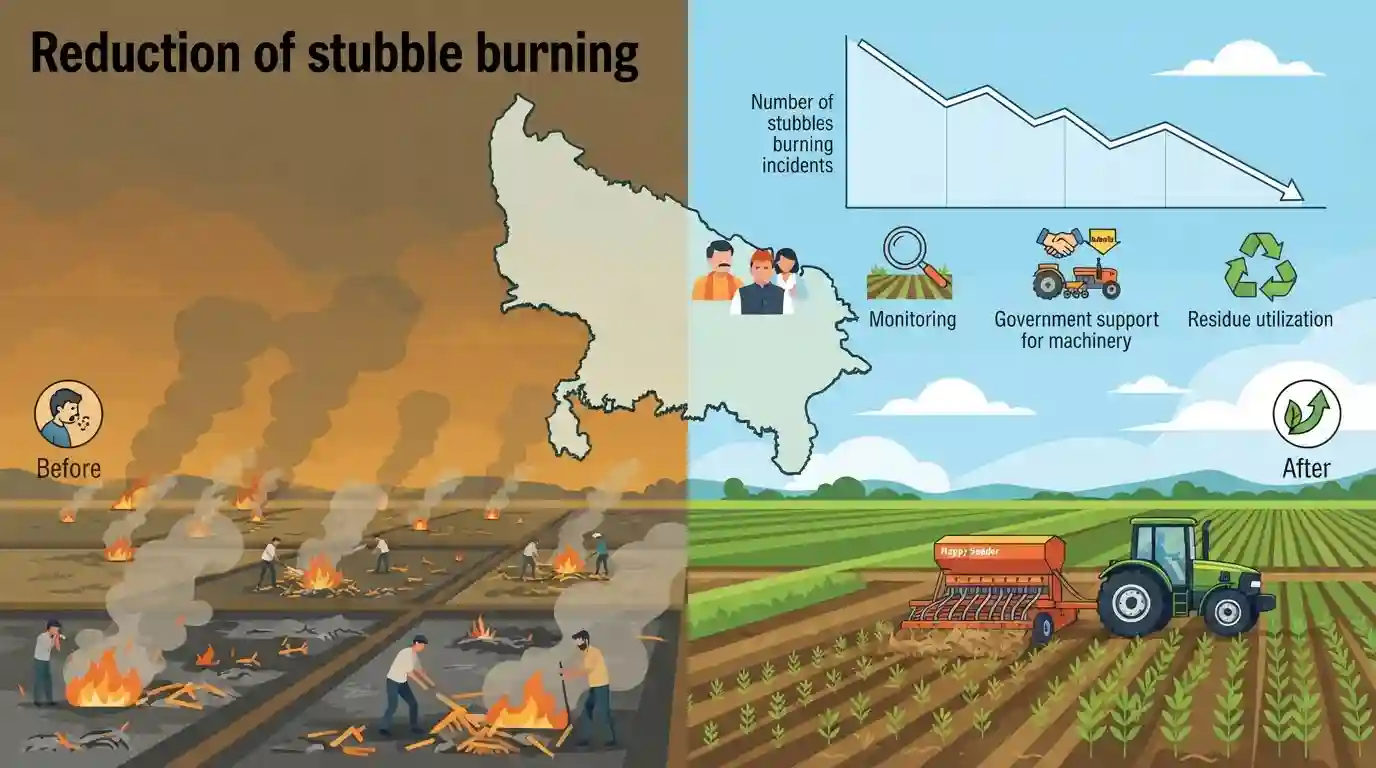
Uttar Pradesh Reports Significant Drop in Stubble Burning Incidents
Source:indianmasterminds ↗
Why It Matters
Crucial for UPPSC aspirants tracking state-specific environmental initiatives, agricultural policy updates, and measures addressing air pollution and stubble burning in Uttar Pradesh.
Summary
The article highlights the notable drop in stubble burning incidents across Uttar Pradesh, attributed to the sustainable farming initiatives and strict monitoring enforced by the Yogi Adityanath government. These measures aim at effective crop residue management and environmental conservation in the state.
Key Points
- Uttar Pradesh has witnessed a significant reduction in stubble burning incidents due to proactive governance and sustainable farming initiatives under Chief Minister Yogi Adityanath.
- The state government implemented effective crop residue management strategies, offering alternatives and promoting in-situ management techniques.
- Enhanced monitoring and awareness campaigns among farmers contributed to improving air quality and environmental health in the region.
Important Terms
Stubble Burning

The practice of setting fire to leftover crop residue after harvesting, causing severe air pollution and soil degradation in northern India.
UPSC context
Important for UPPSC GS Paper 3 (Environment, Pollution, and Agriculture). Tests knowledge of causes, environmental impacts, and mitigation strategies.
Crop Residue Management
Practices and technologies like in-situ incorporation, balers, mulchers, and bio-decomposers used to manage agricultural residue without burning.
UPSC context
Relevant to UPPSC GS Paper 3 under Agriculture and Sustainable Development. Tests measures and subsidies to curb stubble burning.
Sustainable Farming
Farming practices that integrate environmental conservation, economic viability, and social equity, ensuring long-term agricultural productivity without depleting natural resources.
UPSC context
Appears in UPPSC GS Paper 3 (Agriculture and Environment). Evaluates policies promoting eco-friendly agricultural practices and resource efficiency.
Static Concepts Connected
What are the core differences between In-Situ and Ex-Situ Crop Residue Management?
- In-Situ Technique: In-situ management involves incorporating crop residue back into the soil using machinery like super seeders, happy seeders, and mulchers without burning or removing it.
- Ex-Situ Technique: Ex-situ management involves transporting residue away from the field for industrial uses such as biomass power, ethanol production, and compressed biogas (CBG).
Cross-Topic Patterns
CRM Funding Meets Space-Borne Satellite Tracking
Central funding under CRM is matched with state-level administrative penalties and space-borne satellite tracking under disaster and environmental governance.

UPPSC often tests specific central scheme allocations (e.g., ₹868.67 Cr CRM fund) and subsidy patterns for stubble management in UP.
Linked PYQs · 2
Linked PYQs · 2
- 2025UPPSC_PRELIMSGS1
With reference to 'Delhi Government's Bio-decomposer and Spray Programme', which of the following statements is/are correct? 1. The Bio-decomposer solution is provided free of cost to farmers to help convert stubble into manure. 2. The Bio-decomposer solution is prepared using a mix of several fungi. Select the correct answer using the code given below:
- 2024UPPSC_PRELIMSGS1
Consider the following statements with reference to Upper Gangetic agro-climatic region: 1. This region encompasses central and western Uttar Pradesh. 2. This region has more than 130% irrigation intensity and 140% cropping intensity. Which of the above statements is/are correct?
