Pre-Monsoon Thunderstorms and Disaster Management Gaps
Source:Indian Express ↗
Why It Matters
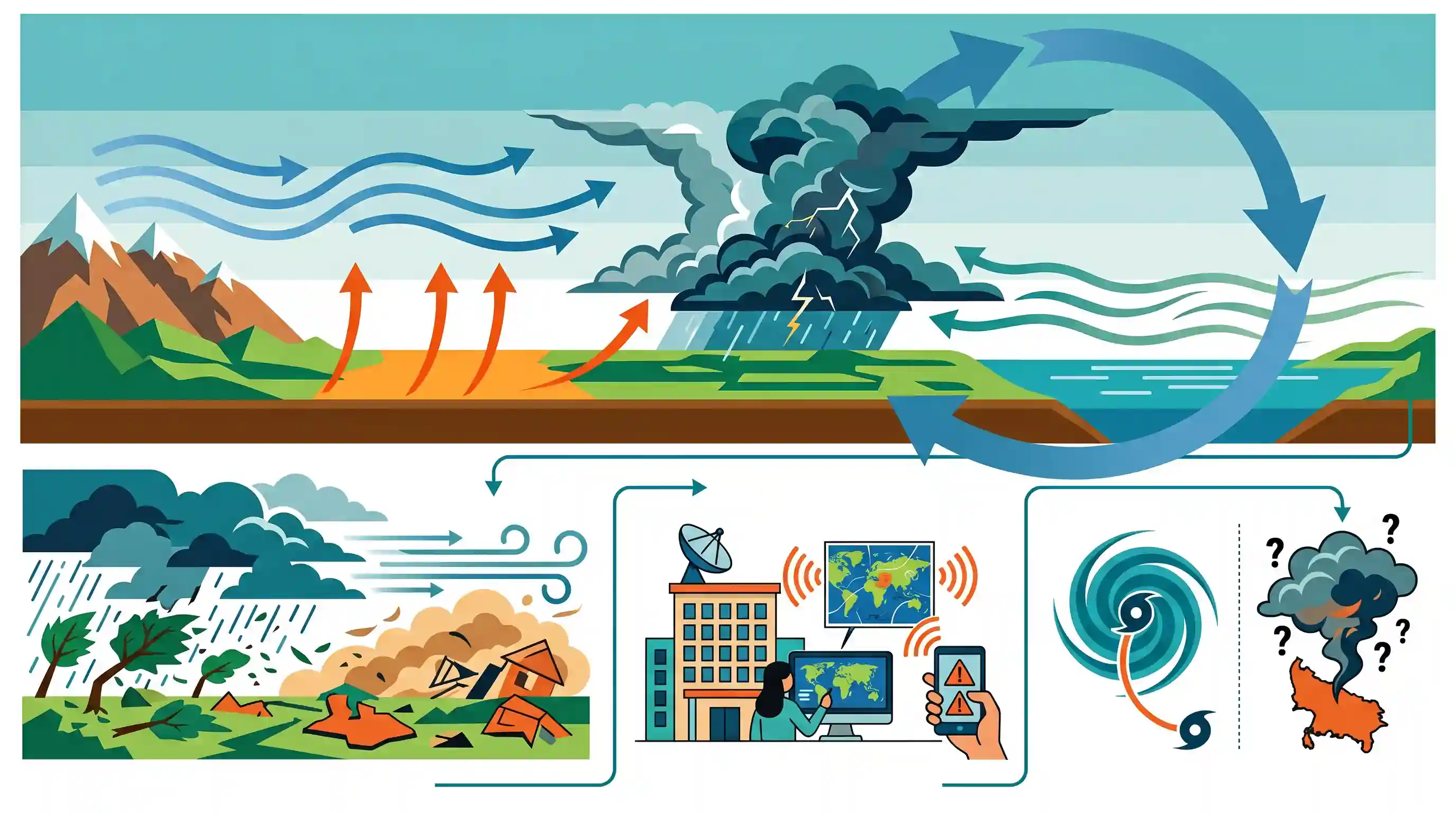
Understanding the complex interplay of Western Disturbances, local heating, and moisture currents is crucial for UPSC Geography (Climatology). Additionally, the difficulty in forecasting and evacuating for localized thunderstorms contrasts with cyclone management, representing a key concept in GS3 Disaster Management and early warning systems.
Summary
Severe pre-monsoon thunderstorms in Uttar Pradesh in May 2026, locally known as 'Andhi', resulted in significant fatalities, highlighting the destructive potential of local atmospheric instabilities. The storms were generated by a volatile combination of intense surface heating creating strong updrafts, moisture incursion from the Bay of Bengal, and the intrusion of cool, dry air from Western Disturbances in the upper troposphere. This thermal contrast fostered rapid cumulonimbus cloud formation and violent downdrafts. The event underscored the limitations of current disaster management paradigms for localized, rapid-onset weather events; while the IMD issued early warnings, predicting the precise intensity and location of such storms remains challenging compared to tracking large-scale tropical cyclones.
Key Points
- Intense surface heating in May creates strong thermal convection in North India, acting as the primary trigger for pre-monsoon thunderstorms (Andhi).
- The convergence of low-level moisture-laden southeasterly winds from the Bay of Bengal and upper-level cool, dry air from Western Disturbances created severe atmospheric instability.
- Rapid upward movement of warm, moist air under these unstable conditions led to the formation of towering cumulonimbus clouds, culminating in deadly thunderstorms with wind speeds of 100-130 kmph.
- While the IMD issued an 'orange' alert, it underestimated the peak wind speeds, highlighting the challenge of pinpoint forecasting for highly localized and rapid-onset meteorological events.
- Unlike tropical cyclones which offer lead time for mass evacuations, thunderstorms are hyper-local and develop quickly, necessitating structural resilience and real-time public advisories rather than evacuations.
Important Terms
India Meteorological Department (IMD)

India's principal agency for meteorological observations and weather forecasting under the Ministry of Earth Sciences. It provides critical warnings for natural disasters like cyclones, storms, and heatwaves.
UPSC context
GS Paper II/III: Governance and Disaster Management; role of institutional frameworks in climate risk mitigation.
Western Disturbances
Extra-tropical storms originating in the Mediterranean region that bring winter rain to Northern India. During summer, they can trigger severe atmospheric instability, leading to pre-monsoon thunderstorms.
UPSC context
GS Paper I: Geography; factors influencing Indian climate and their impact on Rabi crops.
Andhi (Dust Storms)
Localized, convective dust storms or thunderstorms common in Northern India during April-June. They are caused by intense surface heating and bring high-velocity winds, reducing visibility significantly.
UPSC context
GS Paper I: Geography; knowledge of regional weather phenomena and local winds of the Indo-Gangetic plains.
Pre-monsoon Showers
Localized rainfall occurring between March and May due to thermal convection. While vital for crops like mangoes and coffee, they can be accompanied by destructive squalls.
UPSC context
GS Paper I: Geography; understanding seasonal transitions and their socio-economic impacts on Indian agriculture.
Early Warning Systems (EWS)
Integrated systems of hazard monitoring, forecasting, and communication. They are designed to provide timely alerts to vulnerable communities, a key priority under the Sendai Framework.
UPSC context
GS Paper III: Disaster Management; technological interventions for disaster risk reduction and community preparedness.
Cumulonimbus Clouds
Dense, towering vertical clouds associated with thunderstorms and atmospheric instability. They can produce heavy precipitation, lightning, and powerful downdrafts or squalls.
UPSC context
GS Paper I: Physical Geography; processes of cloud formation and thermodynamic instability in the atmosphere.
Prelims Trap
"Western Disturbances exclusively influence the Indian subcontinent during winter months."
Aspirants assume WDs only bring winter rain. In pre-monsoon months, upper-air WDs interacting with intense surface heating and moisture trigger violent thunderstorms.
Static Concepts Connected
What are the regional variations of pre-monsoon showers in India?
- Andhi (Dust storms): Blinding dust storms in Northwestern India and UP. They temporarily lower temperatures but can cause severe destruction.
- Kalbaisakhi (Nor'westers): Violent thunderstorms in Bengal and Assam, notoriously destructive but helpful for tea, jute, and rice crops.
- Mango Showers: Pre-monsoon showers in Kerala and Karnataka that help in the early ripening of mangoes.
What do IMD's color-coded weather warnings signify?
- Yellow (Be updated): Indicates severely bad weather spanning across several days. Advises authorities and public to stay updated.
- Orange (Be prepared): Alert for extremely bad weather with potential for power outages, disruption, and damage. Preparation is required.
- Red (Take action): Highest alert for extreme weather posing a high risk to life and property, requiring immediate action.
Cross-Topic Patterns
Disaster Mgmt: Cyclones vs. Local storms
While cyclones allow for multi-day evacuation planning, rapid-onset thunderstorms require Doppler-radar 'nowcasting' and immediate shelter-in-place protocols, shifting DM strategies.
Western Disturbances beyond winter precipitation
Western Disturbances aren't just for winter Rabi crops. Their intrusion into the upper troposphere during summer creates thermal contrast, fueling extreme convection and thunderstorms.

Expect prelims statements contrasting the destructive nature of Northern 'Andhi' with agriculturally beneficial 'Mango showers' in the South.
Linked PYQs · 3
Linked PYQs · 3
- 2022MainsGS1
Discuss the meaning of colour-coded weather warnings for cyclone prone areas given by India Meteorological Department.
- 2020MainsGS3
Discuss the recent measures initiated in disaster management by the Government of India departing from the earlier reactive approach.
- 2025PrelimsGS1
Consider the following statements : Statement I: In January, in the Northern Hemisphere, the isotherms bend equatorward while crossing the landmasses, and poleward while crossing the oceans. Statement II: In January, the air over the oceans is warmer than that over the landmasses in the Northern Hemisphere. Which one of the following is correct in respect of the above statements?
