Uttar Pradesh showcases textile hub vision at Bharat Tex 2026
Source:organiser ↗
Why It Matters
The article contains high-yield, UP-specific factual data on industrial policies (Textile Policy 2022), weaver welfare schemes, and the mapping of traditional handicrafts to their respective districts (e.g., Baghpat for home textiles, Bhadohi for carpets). UPPSC Prelims frequently tests candidates on ODOP mappings and state-level economic initiatives.
Summary
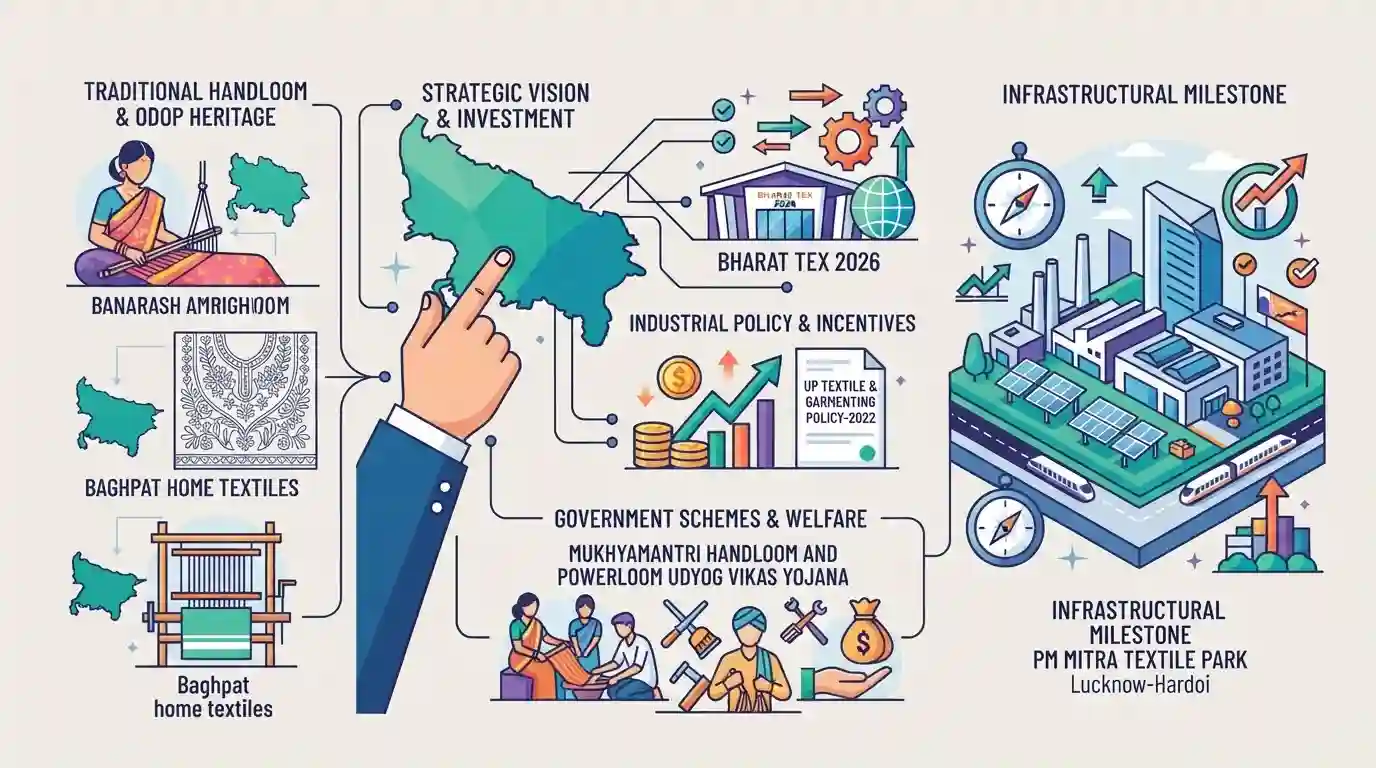
The Uttar Pradesh government showcased its strategic vision to transform the state into a premier global textile hub at Bharat Tex 2026. Emphasizing its robust traditional handloom ecosystem and rich One District One Product (ODOP) heritage—such as Banarasi sarees, Chikankari, and Baghpat home textiles—the state highlighted key policies to attract investors. The UP Textile and Garmenting Policy-2022 offers comprehensive financial incentives, while welfare programs like the Mukhyamantri Handloom and Powerloom Udyog Vikas Yojana support local weavers. Additionally, the development of the mega PM MITRA Textile Park in the Lucknow-Hardoi region is positioned as a major infrastructural milestone for the sector.
Key Points
- UP Minister Rakesh Sachan highlighted the state's vision to become a global textile hub at Bharat Tex 2026.
- Uttar Pradesh has a significant traditional handloom base with nearly 1.91 lakh weavers and iconic ODOP items like Banarasi sarees, Lucknow Chikankari, Bhadohi carpets, and Baghpat home textiles.
- The UP Textile and Garmenting Policy-2022 aims to attract investors by offering robust incentives, including capital and interest subsidies, land cost concessions, and stamp duty exemptions.
- State welfare measures for weavers include electricity subsidies, scholarships, the Sant Kabir Handloom Award, and the Mukhyamantri Handloom and Powerloom Udyog Vikas Yojana.
- The upcoming PM MITRA Textile Park across Lucknow and Hardoi is projected to be a major catalyst for textile manufacturing and job creation in the state.
Important Terms
UP Textile and Garmenting Policy-2022

A state policy offering financial incentives like capital subsidies, stamp duty exemptions, and employment grants to attract investment, establish textile parks, and transform Uttar Pradesh into a global textile manufacturing hub.
UPSC context
Relevant for GS Paper 3 (Industrial Policy). Highlights state-level interventions to boost labor-intensive manufacturing sectors and attract investment.
Mukhyamantri Handloom and Powerloom Udyog Vikas Yojana
A welfare scheme by the Uttar Pradesh government providing financial assistance and technological upgrades to handloom and powerloom artisans, with special provisions aimed at uplifting Scheduled Caste weavers.
UPSC context
Important for GS Paper 2 (Welfare Schemes) and GS Paper 3 (Employment). Tests knowledge of state efforts to sustain traditional crafts.
PM MITRA Scheme
The PM Mega Integrated Textile Regions and Apparel scheme builds world-class textile infrastructure based on the 5F vision. In UP, a 1,000-acre mega park is being developed across Lucknow and Hardoi.
UPSC context
Relevant for GS Paper 3 (Infrastructure). Demonstrates central-state collaboration in establishing large-scale, export-driven manufacturing clusters to boost textile competitiveness.
One District One Product (ODOP)
A flagship Uttar Pradesh initiative launched in 2018 to identify, brand, and promote one signature traditional craft from each of its 75 districts, boosting local employment, artisan incomes, and exports.
UPSC context
Crucial for GS Paper 3 (Inclusive Growth) and GS Paper 2 (Government Policies). An excellent model of decentralized economic and rural development.
Sant Kabir Handloom Award
A prestigious award honoring outstanding handloom weavers for significant contributions to preserving weaving traditions, showcasing exceptional craftsmanship, and promoting community welfare and the overall growth of the handloom sector.
UPSC context
Relevant for GS Paper 1 (Indian Culture) and Prelims. Highlights institutional efforts to recognize, preserve, and incentivize India's traditional artisan heritage.
Prelims Trap
PM MITRA Parks are entirely owned and funded by the Central Government with no financial or equity stake from state governments.
PM MITRA parks are established via SPVs with joint equity (typically 51% State, 49% Centre), not solely by the Centre.
Static Concepts Connected
What is the PM MITRA scheme's institutional and funding framework?
- SPV Structure: Implemented through Special Purpose Vehicles jointly owned by State (51% equity) and Central (49% equity) governments to ensure cooperative federalism.
- Development Capital Support: The Centre provides up to ₹500 crore for Greenfield parks and ₹200 crore for Brownfield parks to develop core infrastructure.
- Competitive Incentive: Provides up to ₹300 crore per park as Competitiveness Incentive Support (CIS) to incentivize early manufacturing units.
Cross-Topic Patterns
Inland Logistics & Export Competitiveness
Shows how land-locked states use freight subsidies to offset transit costs to coastal ports, linking state industrial policy with the National Logistics Policy.
Fiscal Federalism in Industrial Parks
The 51:49 SPV equity split in PM MITRA illustrates co-operative federalism, balancing central financial backing with state-level land and administrative execution.

Expect questions testing the federal SPV equity split (51:49) and logistics mitigation strategies for land-locked PM MITRA parks in 2026.
Linked PYQs · 2
Linked PYQs · 2
- 2022UPPSC_PRELIMSGS1
On the basis of 'one district one product' programme in Uttar Pradesh, which one of the following pairs is NOT correctly matched ?
- 2025UPPSC_PRELIMSGS1
As per the One District One Product (ODOP) scheme of Uttar Pradesh, Moonj products are associated with which of the following districts? 1. Amethi 2. Sultanpur 3. Sant Kabir Nagar Select the correct answer from the code given below:
