UP Renewable Energy Target and Solar Manufacturing Expansion
Source:bioenergytimes ↗
Why It Matters
Uttar Pradesh's renewable energy and biofuel strategies are essential case studies for energy security, state-level environmental initiatives, and agricultural waste management. The detailed figures on capacities, projects, and national production share make this extremely valuable for UPPSC PCS GS and economy sections.
Summary
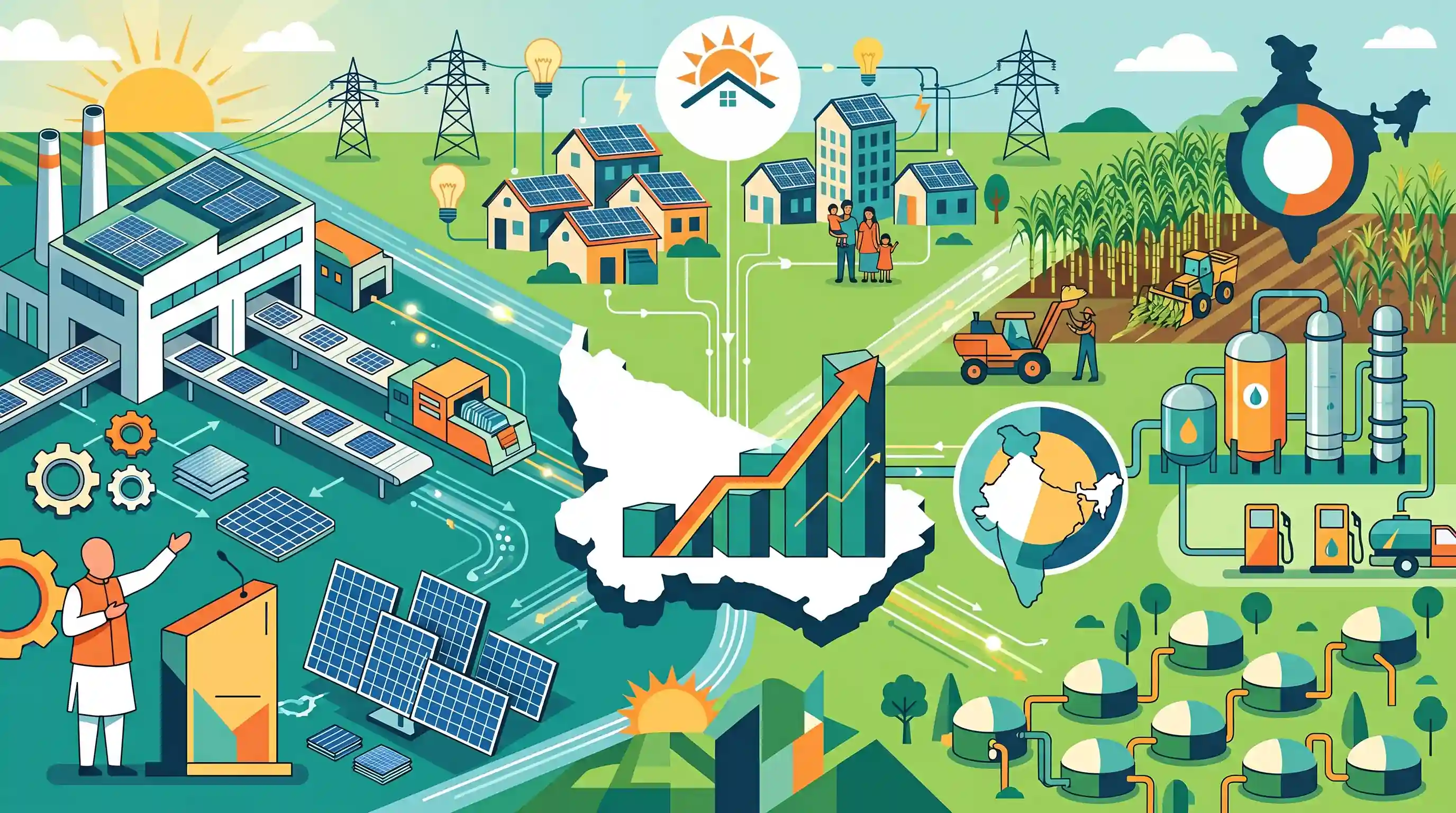
Uttar Pradesh has announced an ambitious target to reach 20,000 MW (20 GW) of renewable energy capacity within the next two to three years, expanding from its current 6,000 MW base. Announced by Chief Minister Yogi Adityanath at the foundation stone laying of SAEL Industries' ₹8,200 crore manufacturing unit in Jewar, the state's clean energy push integrates large-scale solar manufacturing (6 GW cells, 5 GW modules) with rooftop solar under the PM Surya Ghar Yojana. Furthermore, UP continues to lead India in biofuels, contributing 55% of the national ethanol production and championing compressed biogas (CBG) expansion with 100 new plants planned.
Key Points
- Uttar Pradesh has set a target of increasing its renewable energy capacity to 20,000 MW (20 GW) within the next two to three years, up from its current generation of approximately 6,000 MW.
- SAEL Industries is investing ₹8,200 crore to set up a manufacturing facility in Jewar (Gautam Buddha Nagar) with an annual capacity of 6 GW of solar cells and 5 GW of solar modules.
- More than 6 lakh households in UP have installed rooftop solar under the PM Surya Ghar Yojana, collectively generating over 2,000 MW of power and reducing household electricity bills by 50% to 60%.
- Uttar Pradesh is India's leading ethanol producer under the ethanol blending program, with its sugar industry contributing nearly 55% of national ethanol production.
- The state leads the country in Compressed Biogas (CBG) plants and plans to establish 100 additional facilities in the coming year, utilizing agricultural residue to prevent crop residue burning and boost farmer incomes.
- CM Yogi Adityanath highlighted that global supply chain threats, such as disruptions through the Strait of Hormuz in West Asia, underscore the necessity of strong domestic clean energy initiatives.
Important Terms
PM Surya Ghar Muft Bijli Yojana

A central government scheme launched in 2024 to provide up to 300 units of free monthly electricity to one crore households in India by installing subsidised rooftop solar systems.
UPSC context
GS Paper III (Infrastructure/Energy); tests government initiatives for clean energy transition and climate change commitments.
Ethanol Blending Programme
A national initiative promoting the blending of biological ethanol with petrol to reduce crude oil import dependency, lower vehicular emissions, and bolster the rural/agricultural economy.
UPSC context
GS Paper III (Environment/Energy); tests energy security, National Biofuels Policy, and agricultural diversification.
Compressed Biogas (CBG)
A purified, methane-rich renewable fuel produced by anaerobic decomposition of organic wastes, chemically identical to conventional natural gas and used as a green alternative to CNG.
UPSC context
GS Paper III (Environment/Energy); tests waste-to-wealth technologies, circular economy, and pollution control.
SATAT Scheme
Sustainable Alternative Towards Affordable Transportation: A central initiative supporting private entrepreneurs to establish Compressed Biogas plants and integrate green fuel into India’s transport sector.
UPSC context
GS Paper III (Infrastructure/Energy); tests policy frameworks for alternative fuels and waste management.
SAEL Industries
A prominent Indian clean energy developer establishing a major integrated solar cell and module manufacturing facility in Uttar Pradesh to strengthen domestic solar supply chains.
UPSC context
GS Paper III (Industrial Growth/Energy); tests private investments in building self-reliant renewable manufacturing infrastructure.
Prelims Trap
The National Policy on Biofuels targets 20% ethanol blending in petrol (E20) to be achieved by the year 2030.
The 2022 amendment to the National Policy on Biofuels officially advanced the E20 (20% blending) target year from 2030 to 2025-26.
Static Concepts Connected
What are the chemical properties of Compressed Biogas (CBG) and how is it produced?
- Anaerobic Digestion: Produced through the biological breakdown of organic waste in the absence of oxygen.
- Methane Enrichment: Raw biogas (50-70% methane) is purified to exceed 90% methane, matching natural gas standards.
- SATAT Initiative: Promotes CBG production to replace commercial CNG in automotive and industrial sectors.
What is the strategic geography of the Strait of Hormuz?
- Geographic Borders: Separates Iran to the north from Oman (Musandam Peninsula) and UAE to the south.
- Waterway Connectivity: Links the Persian Gulf with the Gulf of Oman and the Arabian Sea.
- Global Chokepoint: Handles one-fifth of global oil consumption, making it vital for India's crude import security.
Cross-Topic Patterns
Solar Manufacturing + WTO Rules
India's solar cell production push must navigate WTO domestic content rules, which historically led to disputes over protectionist subsidies under the National Solar Mission.
Geopolitics + Clean Energy Transition
Supply chain vulnerabilities at West Asian maritime chokepoints like Hormuz act as direct catalysts accelerating India's domestic decentralized solar and bioenergy targets.

SATAT's biogas composition and the advanced E20 biofuel targets are highly likely to be tested as statement-based Prelims questions.
Linked PYQs · 4
Linked PYQs · 4
- 2025UPPSC_PRELIMSGS1
Which of the following two are the major constituent of Bio-gas ? 1. Methane 2. Butane 3. Carbon dioxide 4. Carbon monoxide Select the correct answer from the code given below :
- 2016UPPSC_PRELIMSGS1
Which one of the following gases, released from bio-gas plant is used as a fuel gas?
- 2022UPPSC_PRELIMSGS1
Compressed Natural Gas (CNG) is mainly composed of
- 2022UPPSC_PRELIMSGS1
Solar energy is converted into electric energy through
