UP attracts 45000 crore investment in electronics and green energy
Source:indian-masterminds ↗
Why It Matters
Demonstrates the practical impact of state-level industrial and sector-specific policies (like the UP Semiconductor Policy 2024) in attracting FDI and domestic investment. It serves as an excellent case study for UP Specific questions in GS papers and highlights India's broader push towards self-reliance in semiconductors and renewable energy.
Summary
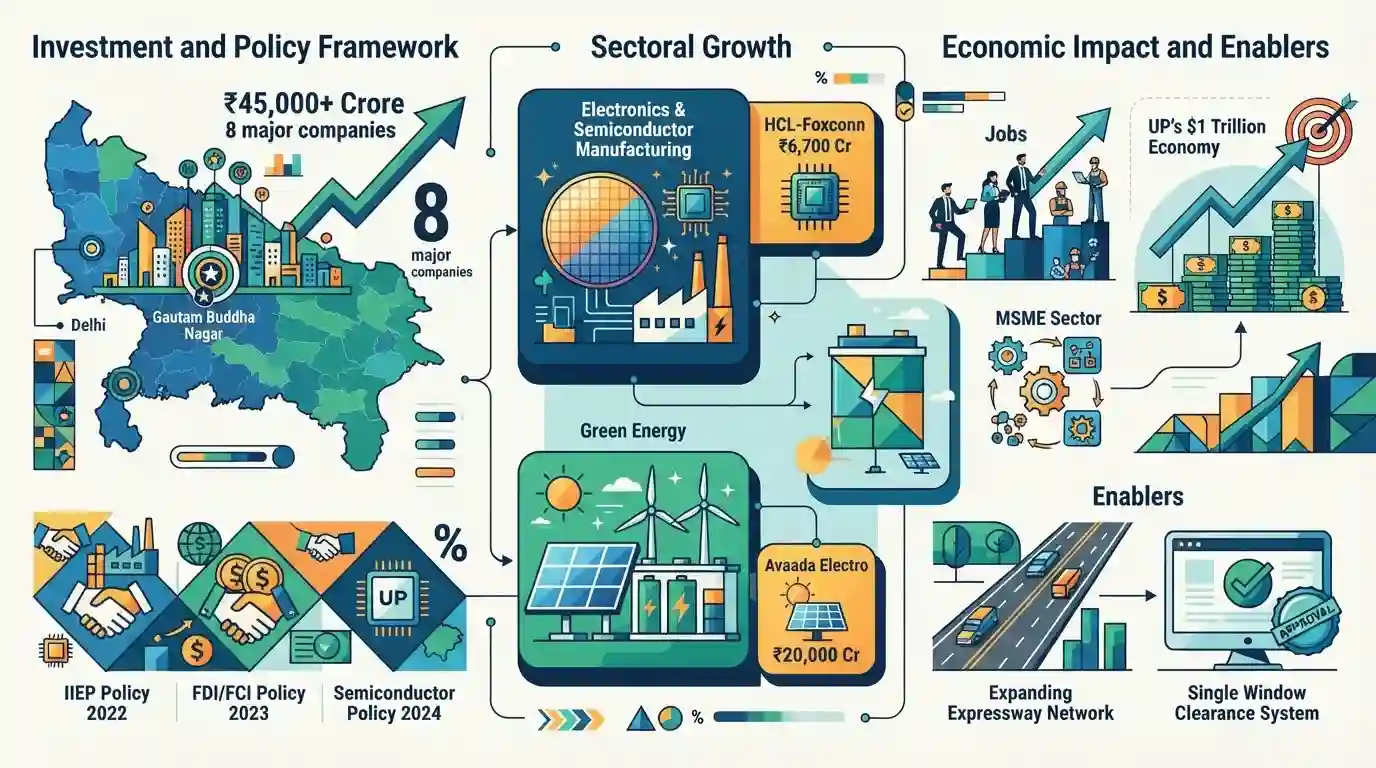
Uttar Pradesh has attracted over ₹45,000 crore in investments from eight major companies, primarily concentrated in Gautam Buddha Nagar. Propelled by progressive frameworks like the Industrial Investment and Employment Promotion (IIEP) Policy 2022, FDI/FCI Policy 2023, and Semiconductor Policy 2024, the state is becoming a preferred destination for the semiconductor, electronics, and green energy sectors. Major commitments include HCL-Foxconn's ₹6,700 crore in semiconductors and Avada Electro's ₹20,000 crore in solar manufacturing. These mega investments are poised to accelerate employment, bolster the MSME sector, and drive UP's ambition of becoming a $1 trillion economy, supported by an expanding expressway network and single-window clearance systems.
Key Points
- Uttar Pradesh is slated to receive over ₹45,000 crore in investments from eight major conglomerates, focusing on Gautam Buddha Nagar.
- The investments span critical emerging sectors, including semiconductors, electronics manufacturing, and green energy (solar power).
- Key initiatives driving this growth include the state's Industrial Investment and Employment Promotion (IIEP) Policy 2022, FDI/FCI Policy 2023, and the dedicated Semiconductor Policy 2024.
- Prominent projects include HCL-Foxconn's ₹6,700 crore semiconductor investment and Avada Electro's ₹20,000 crore solar equipment manufacturing facility.
- The influx of mega projects is expected to significantly boost the local MSME ecosystem, create massive employment, and advance the state's target of becoming a $1 trillion economy.
Important Terms
Industrial Investment and Employment Promotion (IIEP) Policy 2022

A framework by Uttar Pradesh offering flexible incentives like capital subsidies, net SGST reimbursement, and PLI top-ups to categorize and attract Large, Mega, and Super-Mega industrial investments.
UPSC context
GS-3 (Industrial Growth). Showcases state-led structural reforms and competitive federalism driving job creation and trillion-dollar economy goals.
UP FDI/FCI Policy 2023
UP's Foreign Direct and Capital Investment policy allowing companies securing funds via equity, external commercial borrowing, or debt to qualify for state subsidies with a ₹100 crore minimum investment.
UPSC context
GS-3 (Investment Models). Illustrates innovative state strategies to broaden foreign investment definitions and attract Fortune 500 capital.
UP Semiconductor Policy 2024
A proactive state policy offering an additional 50% capital subsidy over central grants, land rebates, and a 5% interest subvention to establish semiconductor fabrication and ATMP/OSAT hubs.
UPSC context
GS-3 (Indigenization of Technology). Crucial for answers on India's Semiconductor Mission and building a localized electronics ecosystem.
HCL-Foxconn Joint Venture
A ₹3,706 crore collaborative venture establishing an Outsourced Semiconductor Assembly and Test (OSAT) facility in Jewar, UP to manufacture display driver chips for electronics.
UPSC context
GS-3 (Science & Tech). Highlights critical corporate partnerships driving the domestic packaging and testing phases of the semiconductor supply chain.
Avaada Electro
A major solar PV module manufacturer committing over ₹16,000 crore to build a 5.1 GW integrated high-efficiency solar cell and module manufacturing facility in Uttar Pradesh.
UPSC context
GS-3 (Renewable Energy). Exemplifies private sector capital flowing into green infrastructure, advancing India's renewable energy capacity targets.
SAEL Solar
A renewable energy firm investing ₹8,200 crore to set up an integrated facility in Greater Noida capable of manufacturing 5 GW of high-efficiency TOPCon solar cells and modules annually.
UPSC context
GS-3 (Infrastructure/Energy). Represents efforts to strengthen backward integration in India's solar supply chain and reduce import dependency.
Amber Enterprises
A major electronics manufacturer investing ₹6,000 crore near the upcoming Noida Airport for a massive printed circuit board (PCB) assembly and consumer appliances manufacturing plant.
UPSC context
GS-3 (Industrial Growth). Key example of import substitution in the domestic electronics component sector, specifically for PCBs.
Prelims Trap
"Recent joint ventures like HCL-Foxconn in UP are establishing India's first end-to-end silicon wafer fabrication plants."
Most current large-scale semiconductor investments in India (including UP's HCL-Foxconn plant) are OSAT/ATMP (Assembly and Testing) units, not full silicon wafer fabrication foundries.
Static Concepts Connected
What is the difference between a Semiconductor Fab and an OSAT facility?
- Semiconductor Fab: Manufactures the actual silicon wafers and prints the microscopic integrated circuits (ICs) onto them. Highly capital and water-intensive.
- OSAT (Assembly/Test): Takes manufactured wafers, cuts them into individual chips, packages them to prevent damage, and tests them before integrating them into electronic devices.
How do state-level PLI top-ups function under competitive federalism?
- Central Incentives: The Union government offers production-linked or capital-linked incentives to boost domestic manufacturing in strategic sectors (e.g., India Semiconductor Mission).
- State Top-ups: States offer additional matching subsidies (e.g., 50% top-up on Central capital subsidy), net SGST reimbursement, and land rebates to attract these specific industries to their jurisdiction.
Cross-Topic Patterns
Competitive federalism in high-tech supply chains
States (Gujarat, UP, Assam) are aggressively competing using tailored policies (land rebates, PLI top-ups) to capture the high-tech supply chain relocation driven by the global 'China-Plus-One' strategy.
Solar deployment vs. solar manufacturing
Massive investments by SAEL and Avaada highlight India's shift from merely installing solar capacity (historically reliant on Chinese imports) to backward integration into domestic solar equipment manufacturing.

Expect a Prelims question distinguishing OSAT/ATMP units from full fabs, alongside the India Semiconductor Mission's funding structure.
Linked PYQs · 2
Linked PYQs · 2
- 2023UPPSC_PRELIMSGS1
Which of the following Scheme/Programme is not the Central Government Programme and it is Uttar Pradesh Government's Programme?
- 2020UPPSC_PRELIMSGS1
Which of the following Indian States/Union Territories launched Electric Vehicle Policy on 7th August, 2020 ?
