UP MYUVA scheme offers interest-free loans for young entrepreneurs
Source:india-today ↗
Why It Matters
UPPSC Prelims frequently tests state-sponsored social security, livelihood, and self-employment schemes, often focusing on precise eligibility details such as minimum age (21-40 years for MYUVA vs 18-40 for Swarojgar Yojana), educational cut-offs (Class 8 pass vs High School), and financial provisions like margin money and interest subventions.
Summary
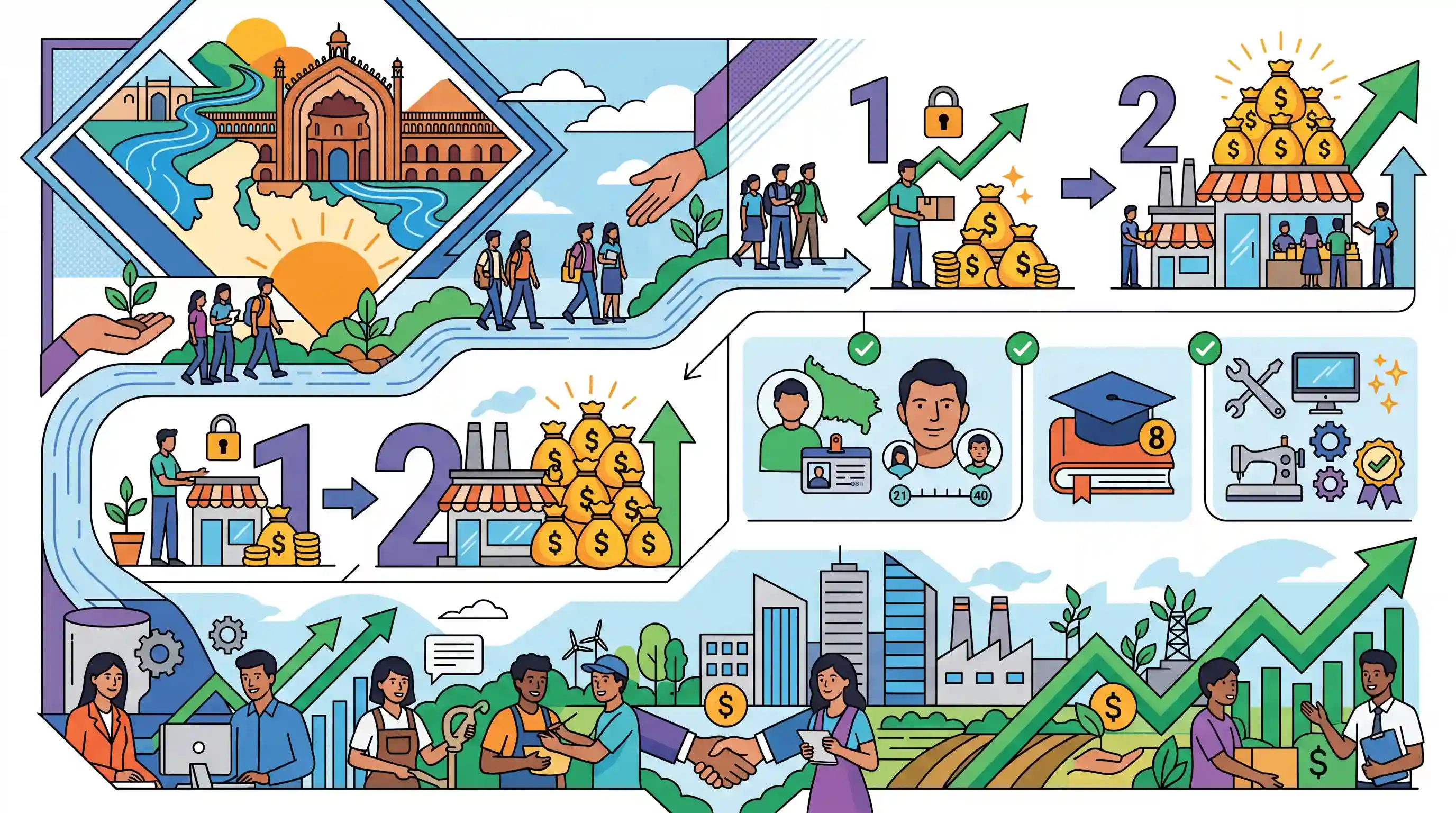
The Uttar Pradesh government has expanded the Mukhyamantri Yuva Udyami Vikas Abhiyan (MYUVA) scheme to nurture 10 lakh young entrepreneurs over the next decade. The scheme offers interest-free and collateral-free loans in two distinct phases (up to Rs 5 lakh in Phase 1, and Rs 10 to Rs 20 lakh in Phase 2) for permanent residents of UP aged 21-40 with a minimum Class 8 qualification and skill training.
Key Points
- The Mukhyamantri Yuva Udyami Vikas Abhiyan (MYUVA) scheme has been launched by the Uttar Pradesh government to address credit access issues for young entrepreneurs, targeting 1 lakh new entrepreneurs annually and 10 lakh over the next 10 years.
- Eligibility Criteria: Open strictly to permanent residents of Uttar Pradesh aged between 21 and 40 years who have completed at least Class 8. Applicants must also hold a technical diploma/degree or skill certification (including ODOP, ITI, or Vishwakarma Shram Samman Yojana).
- Phase 1 of MYUVA provides collateral-free, guarantee-free loans up to Rs 5 lakh with 100% interest subvention and a 10% margin money subsidy on project cost.
- Phase 2 offers larger loans ranging from Rs 10 lakh to Rs 20 lakh, featuring a 50% interest subsidy up to a prescribed limit upon timely repayment of previous credit.
- Applications are processed entirely online via the Directorate of Industries and Enterprise Promotion's UPMSME portal and the MYUVA portal, alongside state instructions to banks to improve the Credit-Deposit (CD) ratio.
Important Terms
Mukhyamantri Yuva Udyami Vikas Abhiyan (MYUVA)

A flagship Uttar Pradesh scheme targeting the creation of 10 lakh young entrepreneurs over 10 years by providing interest-free, collateral-free loans (up to ₹5 lakh in Phase 1; up to ₹10-20 lakh in Phase 2) for micro-enterprises.
UPSC context
GS Paper II & III (Govt Schemes, Employment, MSMEs); tests financial inclusion strategies, self-reliance, and youth employment policy models.
One District One Product (ODOP)
An Uttar Pradesh initiative launched in 2018 to preserve and globally scale one unique, signature craft or product from each of the 75 districts via financial, technical, and marketing support.
UPSC context
GS Paper III (Indian Economy, MSMEs, Exports); tests regional balanced development, local manufacturing, and 'Vocal for Local' strategies.
Vishwakarma Shram Samman Yojana
A 2018 Uttar Pradesh welfare scheme offering 6 days of free skill training, advanced toolkits, and concessional loans to traditional artisans (like carpenters and potters) to elevate livelihoods.
UPSC context
GS Paper II & III (Welfare Schemes, Skill Development); tests policies empowering marginalized, traditional handicraft workforces.
Mukhya Mantri Yuva Swarojgar Yojana
A state self-employment scheme of Uttar Pradesh providing loans (up to ₹25 lakh for industries, ₹10 lakh for services) with a 25% subsidy to educated unemployed youth.
UPSC context
GS Paper II & III (Employment, Government Schemes); tests economic intervention programs designed to mitigate youth unemployment.
Directorate of Industries and Enterprise Promotion
The executive agency under UP's MSME Department responsible for implementing industrial policies, promoting MSMEs, and managing state self-employment and artisan-centric schemes.
UPSC context
GS Paper II (Executive Bodies, Governance); tests institutional frameworks responsible for policy execution and grassroots economic promotion.
Prelims Trap
The MYUVA scheme provides interest-free, collateral-free credit up to Rs 20 lakh to any citizen aged 18 and above.
MYUVA is strictly for UP residents aged 21-40. Furthermore, the 100% interest subvention applies only to Phase 1 (up to Rs 5 lakh), not Phase 2.
Static Concepts Connected
What is the Credit-Deposit (CD) Ratio?
- Definition: It is the ratio of how much a bank lends out of the deposits it has mobilized, serving as a key indicator of credit absorption.
- Socio-Economic Impact: A very low CD ratio indicates that banks are not deploying resources locally, leading to regional financial neglect and capital flight.
- Regulatory Oversight: While there is no statutory national minimum, the RBI monitors this closely through SLBCs to promote balanced regional development.
What is the State Level Bankers' Committee (SLBC)?
- Genesis: An inter-institutional forum created under the Lead Bank Scheme (1969) to coordinate banking activities and state development programs.
- Composition & Role: Chaired by the representative of the designated Lead Bank of the state, meeting quarterly with state officials to review credit targets.
- Credit Governance: It acts as the primary coordinator for implementing and monitoring government-sponsored credit-linked schemes at the state level.
Cross-Topic Patterns
Regional credit imbalances & CD ratios
Divergent state CD ratios reflect structural economic disparities; while southern states often exceed 80%, lagging districts require targeted state-level credit interventions to reverse regional capital flight.
MSME formalization & credit integration
Linking localized manufacturing policies (like ODOP) with credit access creates a formalization pipeline, reducing high default risks traditionally associated with collateral-free micro-enterprise lending.

Expect questions linking the Lead Bank Scheme and SLBC operations to regional credit-deposit imbalances and state-led microcredit.
Linked PYQs · 2
Linked PYQs · 2
- 2021UPPSC_PRELIMSGS1
Which of the following is NOT the eligibility criterion before filling registration/ application forms for Uttar Pradesh Mukhya Mantri Swarojgar Yojna 2021 ?
- 2021UPPSC_PRELIMSGS1
Which of the following Schemes in Uttar Pradesh were introduced in Budget of 2021-22? I. Atmanirbhar Krishak Samanvit Vikas Yojna II. Mukhya Mantri Saksham Suposhan Yojna III. Mukhya Mantri Pravasi Shramik Udyamita Vikas Yojna IV. Yuva Udyamita Vikas Abhiyan Select the correct answer from the codes given below.
