Uttar Pradesh Emerges as Leading Mobile Manufacturing Hub
Source:fortune-india ↗
Why It Matters
Uttar Pradesh's transformation into a major electronics and semiconductor hub highlights successful state-level industrial policy and is highly relevant for UPPSC Prelims questions focusing on state economy, infrastructure development (Noida/Greater Noida), and investment policies.
Summary
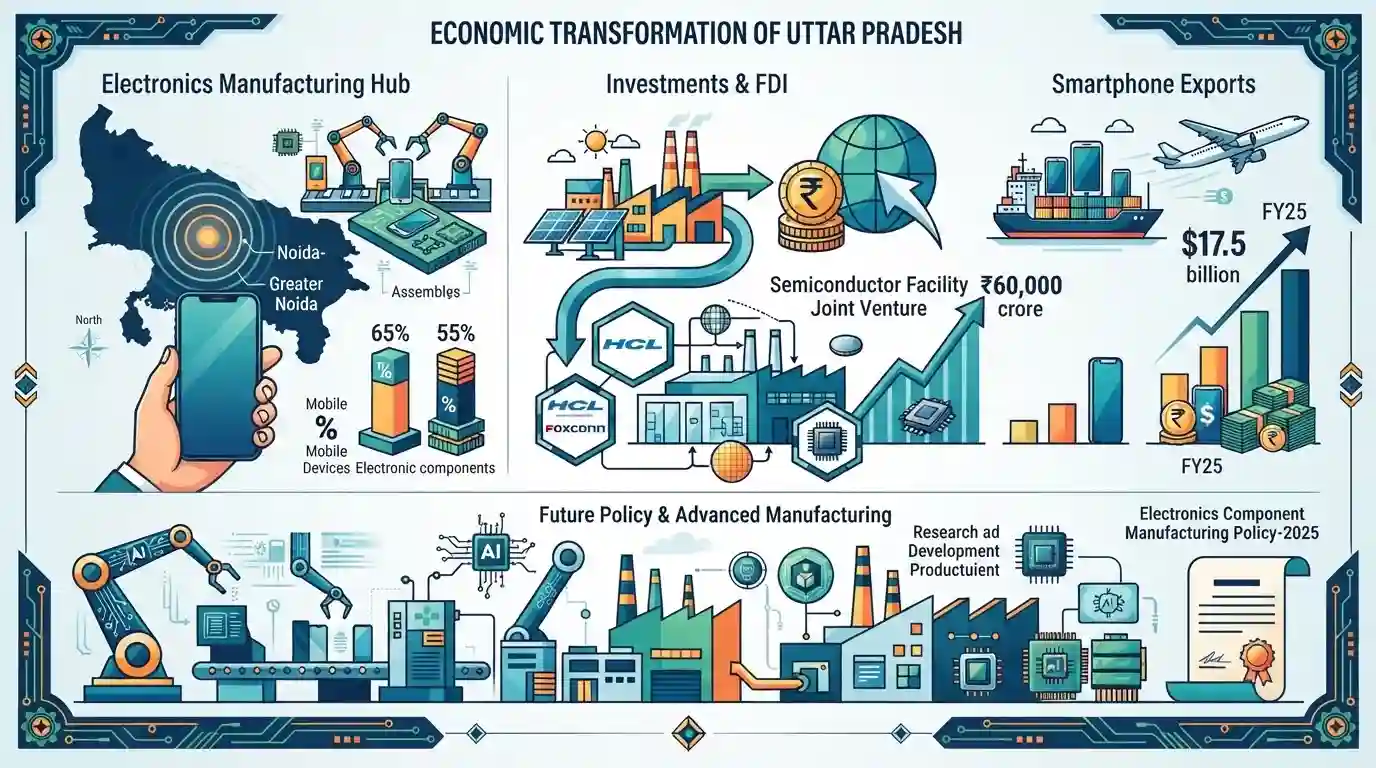
Uttar Pradesh has emerged as India's leading hub for electronics and mobile phone manufacturing, producing approximately 65% of the country's mobile devices and 55% of its electronic components. The state has attracted over ₹60,000 crore in investments in these sectors, highlighted by a ₹32,146 crore semiconductor facility joint venture between HCL and Foxconn. The Noida-Greater Noida region serves as the epicenter of this industrial growth. With smartphone exports hitting $17.5 billion in FY25, the state government is now aiming to attract advanced manufacturing and AI-driven industries through the new UP Electronics Component Manufacturing Policy-2025.
Key Points
- Uttar Pradesh accounts for nearly 65% of India's mobile phone manufacturing and 55% of electronic components production.
- The state has secured over ₹60,000 crore in electronics and semiconductor investments, including a massive ₹32,146 crore HCL-Foxconn semiconductor plant.
- Smartphone exports from Uttar Pradesh surged to a record $17.5 billion in FY25.
- The Noida-Greater Noida industrial belt acts as the core hub for this electronics manufacturing boom.
- Upcoming initiatives like the UP Electronics Component Manufacturing Policy-2025 aim to shift the state's focus towards AI and advanced semiconductor manufacturing.
Important Terms
UP Electronics Component Manufacturing Policy-2025

A 2025 state policy aiming to transition Uttar Pradesh from assembling electronics to manufacturing high-value components. It offers capital subsidies and tax exemptions, targeting $50 billion in production and comprehensive ecosystem development.
UPSC context
Important for GS3 (Industrial Policy) to illustrate state-level initiatives driving India's high-tech manufacturing, FDI attraction, and semiconductor self-reliance.
UP Electronics Manufacturing Policy-2017
A foundational Uttar Pradesh industrial policy that established the Noida-Greater Noida region as an 'Electronics Manufacturing Zone.' It rapidly achieved its investment targets, catalysing the state's emergence as India’s leading mobile phone assembly hub.
UPSC context
Relevant for GS3 (Economic Growth) as a case study of successful state intervention transforming regional industrial capacity and boosting hardware manufacturing.
HCL
An Indian multinational IT services and consulting giant. It is diversifying into hardware and advanced technology, notably entering a ₹32,146 crore joint venture with Foxconn to establish a semiconductor manufacturing facility in Uttar Pradesh.
UPSC context
Important for GS3 (Indigenisation of Technology), highlighting the pivotal role of domestic corporate giants in building India's strategic semiconductor ecosystem.
Foxconn
A Taiwanese multinational electronics contract manufacturer and a major global supply chain player. Its ₹32,146 crore semiconductor joint venture in Uttar Pradesh represents immense foreign direct investment and technology transfer into India.
UPSC context
Crucial for GS3 (Investment Models, FDI), illustrating global supply chain shifts and India’s growing appeal as a hub for advanced tech manufacturing.
Prelims Trap
Only the Central Government provides capital subsidies for setting up semiconductor fabrication units under national programs.
States offer substantial top-up capital incentives (often matching 25-50% of the central subsidy) under their own state-specific semiconductor policies.
Static Concepts Connected
What is the India Semiconductor Mission (ISM)?
- Nodal Agency: Established under the Digital India Corporation to drive India's long-term semiconductor and display ecosystem strategy.
- Fiscal Support: Provides a uniform 50% fiscal support of the project cost for setting up silicon fabs.
- DLI Component: Offers financial incentives and design infrastructure support to domestic companies through the Design Linked Incentive scheme.
How do Fab manufacturing and ATMP/OSAT differ?
- Wafer Fab: The highly capital-intensive front-end process where integrated circuits are etched onto raw silicon wafers.
- ATMP/OSAT: The back-end process where fabricated wafers are cut, packaged, and tested before final integration into electronics.
Cross-Topic Patterns
Federalism and industrial competition
States competing through tailored electronics policies showcases competitive federalism, shifting high-tech manufacturing from traditional southern clusters to northern industrial corridors.
Trade deficit and value addition
Transitioning from assembly to semiconductor and component fabrication directly targets India's trade deficit by reducing import reliance on electronic intermediates.

Mains 2026 will likely evaluate how state-level electronics policies complement the central PLI to scale up high-value manufacturing.
Linked PYQs · 4
Linked PYQs · 4
- 2016UPPSC_PRELIMSGS1
Largest concentration of software and business process outsourcing industry in U.P. is at
- 2006UPPSC_PRELIMSGS1
Special Economic Zones are being set up in U.P. at
- 2007UPPSC_PRELIMSGS1
The objective of Uttar Pradesh's Udyog Bandhu Scheme is the objective of Uttar Pradesh Udyog to
- 2008UPPSC_PRELIMSGS1
Long term loan to the small and medium enterprises in Uttar Pradesh is granted by the
