Uttar Pradesh Leads India in Domestic Tourism with Record Visits
Source:indianmasterminds ↗
Why It Matters
Tourism forms a crucial component of Uttar Pradesh’s goal to become a trillion-dollar economy. For UPPSC Prelims, the impressive ranking data, key religious destinations, and related central/state schemes are highly relevant for state-specific factual and governance questions.
Summary
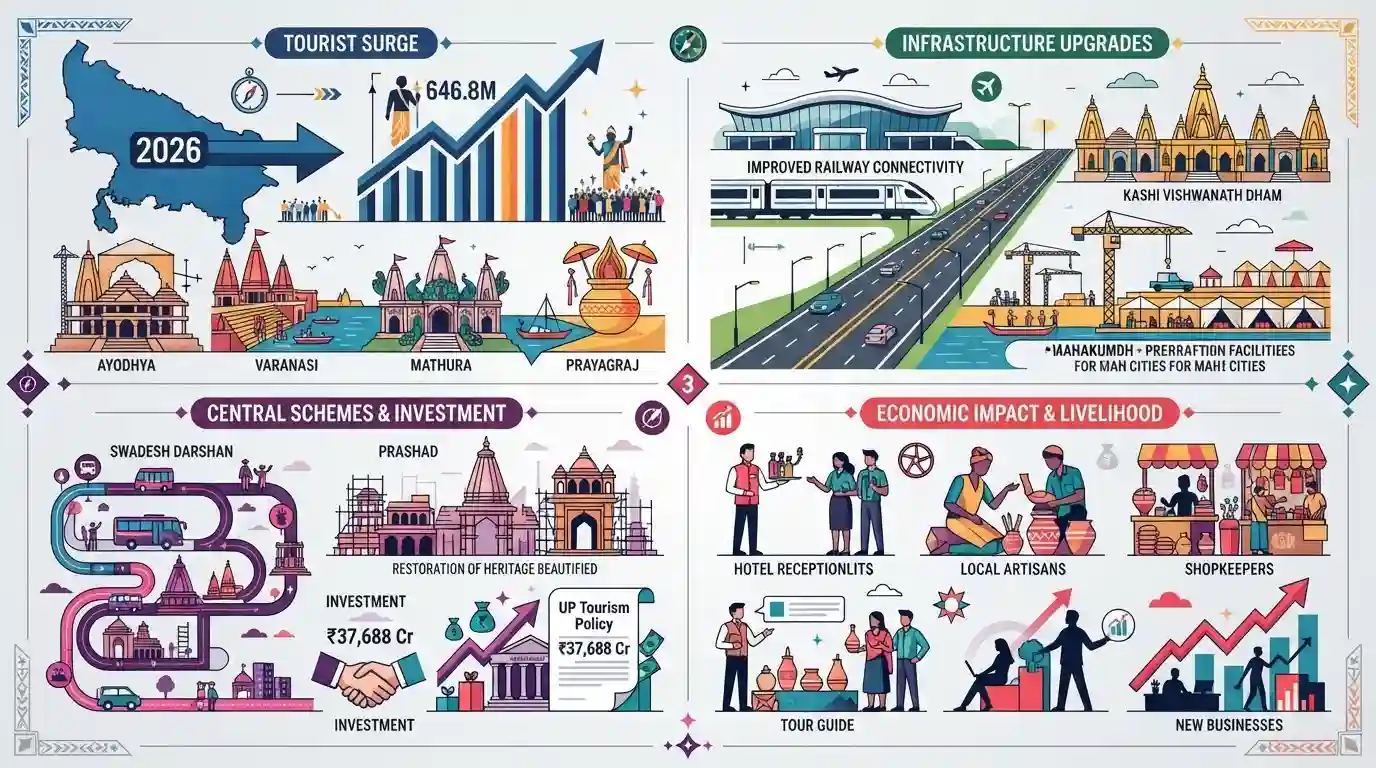
Uttar Pradesh has emerged as the premier destination for domestic tourism in India in 2026, welcoming an unprecedented 646.8 million domestic tourists. The surge is largely driven by religious and spiritual hubs such as Ayodhya, Varanasi, Mathura, and Prayagraj. Sustained infrastructural upgrades—epitomized by Kashi Vishwanath Dham and preparations for the Mahakumbh—have combined with central schemes like Swadesh Darshan and PRASHAD to enhance the tourist experience. Supported by the UP Tourism Policy, which has attracted nearly ₹37,688 crore in investments, this tourism boom is actively fueling the state's broader economic development and local employment.
Key Points
- Uttar Pradesh led India in domestic tourism for 2026, registering a record-breaking 646.8 million domestic tourist visits.
- Ayodhya and Varanasi were the major growth drivers, receiving 7.2 crore (in H1 2026) and 2.25 crore (Q1 2026) visitors respectively.
- Development of robust infrastructure, including Kashi Vishwanath Dham and Namo Ghat, alongside improved connectivity, catalyzed the tourism boom.
- The state leveraged central initiatives like Swadesh Darshan and the PRASHAD scheme, as well as its own Chief Minister Tourism Fellowship Programme.
- Under the state’s proactive Tourism Policy, investment proposals totaling ₹37,688.58 crore reflect strong confidence in UP’s hospitality sector.
Important Terms
Swadesh Darshan Scheme

A 100% centrally-funded scheme by the Ministry of Tourism to develop theme-based tourist circuits across India, aiming to boost tourism infrastructure, cultural preservation, and sustainable local employment.
UPSC context
Crucial for GS-2 (Policies) and GS-3 (Tourism/Economy) to discuss the tourism sector's potential for job creation and sustainable growth.
PRASHAD Scheme
The Pilgrimage Rejuvenation and Spiritual Heritage Augmentation Drive is a central sector scheme launched to provide integrated infrastructure development and improve visitor amenities at identified pilgrimage and heritage sites.
UPSC context
Important for GS-1 (Art & Culture) and GS-2 (Schemes) when analyzing state efforts to promote religious tourism and preserve heritage.
Uttar Pradesh Tourism Policy
A comprehensive state framework promoting thematic tourist circuits to attract private investments and generate local employment. It notably grants industry status to eligible tourism units to accelerate infrastructural expansion.
UPSC context
Relevant for GS-3 (Economic Development) and UP PCS exams as a model of state-level policy leveraging cultural assets for growth.
Chief Minister Tourism Fellowship Programme
A UP government initiative providing ₹40,000 monthly to young graduates, engaging them to monitor tourism projects, conduct research, and assist in developing heritage, ecological, and cultural destinations.
UPSC context
Highlights targeted youth employment schemes. Useful as a practical case study for GS-2 (Governance) and GS-3 (Employment) answers.
Prelims Trap
Swadesh Darshan and PRASHAD are Centrally Sponsored Schemes requiring matching state funds.
Both Swadesh Darshan and PRASHAD are Central Sector Schemes (100% Union funded). While state governments implement the projects, the Centre bears the entire financial burden.
Static Concepts Connected
What are the distinct objectives of the PRASHAD and Swadesh Darshan schemes?
- PRASHAD Mandate: Focuses on holistic infrastructure development and beautification of identified pilgrimage and heritage destinations across India.
- Swadesh Darshan: Aims at the integrated development of theme-based tourist circuits (e.g., Ramayana Circuit, Buddhist Circuit) to promote cultural and heritage value.
- Funding Nature: Both are Central Sector Schemes, receiving 100% funding from the Ministry of Tourism without state financial burden.
What is the historical background of the Kashi Vishwanath Temple's reconstruction?
- Maratha Patronage: The current temple structure was rebuilt by the prominent Maratha monarch Ahilyabai Holkar of Indore in 1780.
- Sikh Contribution: Maharaja Ranjit Singh of Punjab later donated approximately 1,000 kg of gold for plating the temple's domes in 1835.
- Modern Corridors: Recent infrastructural upgrades aim to decongest the complex and revive the direct historical linkage between the temple and the Ganga river.
Cross-Topic Patterns
Heritage driving urban infrastructure
Temple corridors (Kashi, Ayodhya) are now catalysts for GS3 urban planning, integrating mass transit, river-front rejuvenation, and local economic revitalization alongside cultural heritage.
Lateral entry via State Fellowships
UP's Chief Minister Tourism Fellowship mirrors national capacity-building trends (like Aspirational Districts), integrating young professionals directly into district-level public administration and ecological planning.

A multi-statement Prelims question comparing PRASHAD vs. Swadesh Darshan funding mechanisms or mapping historical temple patrons is likely.
Linked PYQs · 1
Linked PYQs · 1
- 2017UPPSC_PRELIMSGS1
Swadesh Darshan Scheme launched by Government of India does not include development of which of the following tourist circuits?
