Uttar Pradesh mega plantation drive targets 35 crore saplings
Source:etvbharat ↗
Why It Matters
UPPSC Prelims frequently tests candidates on state-level environmental schemes, targets, statistical achievements, and specific details about forestry initiatives in Uttar Pradesh. Information regarding major targets (such as the 350 million saplings goal) and specific figures related to river greening along the Ganga and Yamuna is highly testable.
Summary
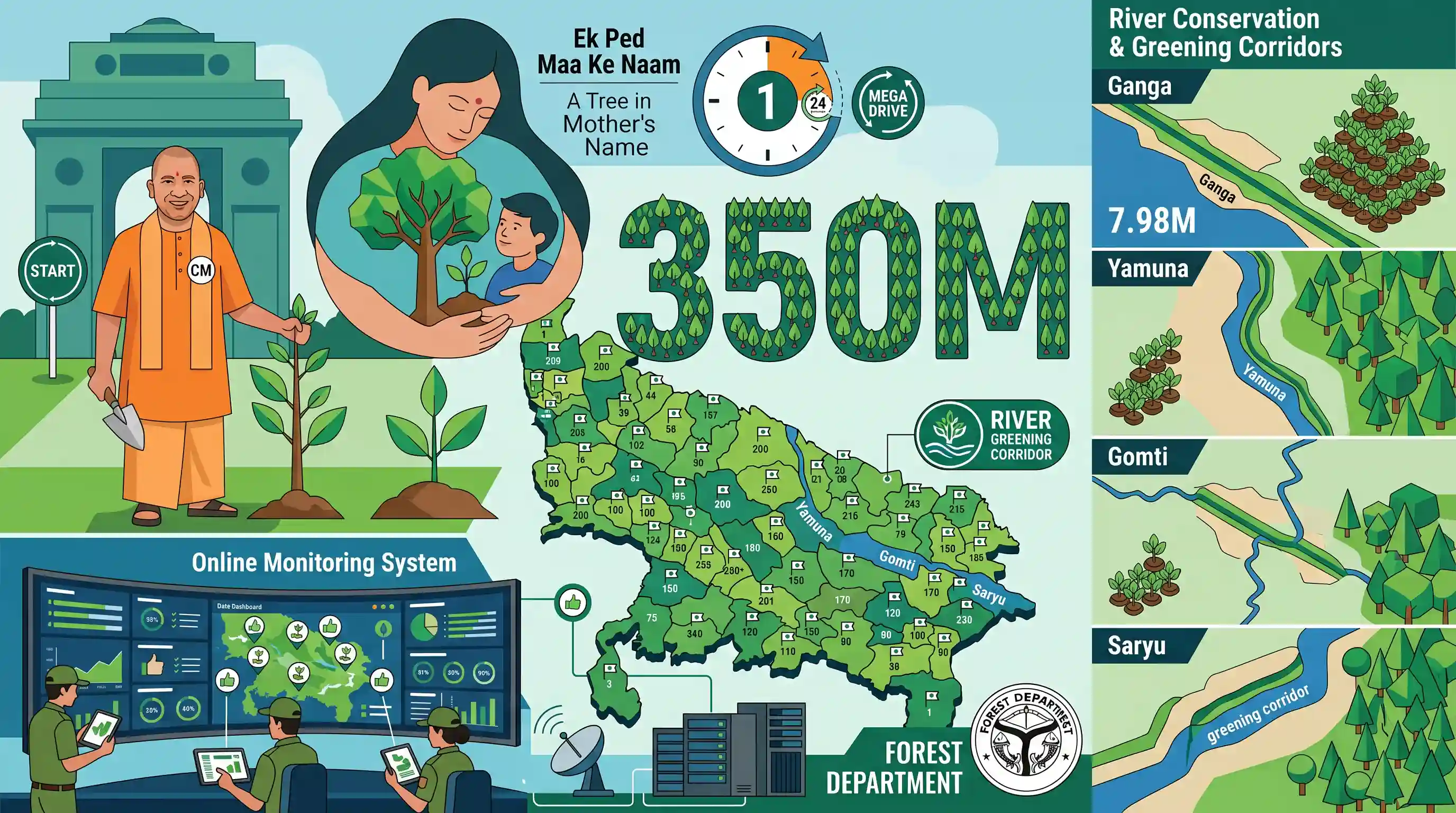
On July 12, 2026, Uttar Pradesh Chief Minister Yogi Adityanath launched the mega plantation drive 'Vriksharopan Mahayagya 2026' under the central theme 'Ek Ped Maa Ke Naam' (A Tree in Mother's Name). The campaign targets planting 350 million saplings across the state in a single day. Major activities include extensive greening along major rivers like Ganga, Yamuna, Gomti, and Saryu, with more than 7.98 million saplings designated for the banks of the Ganges. progress is monitored via an online system managed by the Forest Department.
Key Points
- Uttar Pradesh Chief Minister Yogi Adityanath launched the state's annual mega plantation drive, 'Vriksharopan Mahayagya 2026' under the theme 'Ek Ped Maa Ke Naam' on July 12, 2026.
- The ambitious campaign aims to plant 350 million (35 crore) saplings across the state in a single day.
- The drive was inaugurated in the Chief Minister's home constituency of Gorakhpur, where he planted banyan, peepal, maulsari, and neem saplings along the Bhagwanpur Link Expressway.
- To track the progress, the Forest Department used an online monitoring system where photographs and location data of all plantation sites were uploaded. By 10:00 AM on the launch day, over 52 million saplings had already been planted.
- Gorakhpur district has a local target of 5.53 million saplings, with the highest allocations to the Forest Department (1.94 million) and the Rural Development Department (1.86 million).
- The environmental conservation strategy includes riverbank greening, aiming to plant over 7.98 million saplings across 4,495.72 hectares along the Ganga river, and identifying 647 plantation sites along the Yamuna river, in addition to sites along the Gomti and Saryu rivers.
Important Terms
Ek Ped Maa Ke Naam

A nationwide citizen-centric campaign launched on World Environment Day 2024 that combines tree plantation with emotional respect for mothers, encouraging personal responsibility to expand India's forest cover and support climate action.
UPSC context
GS Paper III (Environment and Biodiversity); tests knowledge of community-driven climate action and voluntary carbon-sequestration models.
Vriksharopan Mahayagya 2026
The massive single-day afforestation drive launched on July 12, 2026, by Uttar Pradesh, targeting the planting of 350 million saplings across the state to boost green cover and create thematic forests.
UPSC context
GS Paper III (Environment & Conservation); tests knowledge of state-level climate targets, afforestation initiatives, and biodiversity conservation.
Uttar Pradesh Forest Department
The nodal state agency in Uttar Pradesh responsible for protecting forests and wildlife. It coordinates major afforestation initiatives, manages nursery stocks, and implements digital systems to monitor sapling survival rates.
UPSC context
GS Paper III (Environment & Governance); tests understanding of institutional execution of environmental policies and technology-driven ecological monitoring.
Rural Development Department
The state administrative organ managing rural livelihood, infrastructure, and development. In environmental drives, it coordinates massive decentralized tree-planting targets (e.g., 10 crore saplings) across rural sectors.
UPSC context
GS Paper II & III (Government Policies & Rural Development); tests knowledge of inter-departmental synergy in achieving national environmental and employment goals.
Panchayati Raj Department
The state department managing rural local self-governance, responsible for mobilizing Gram Panchayats to utilize village common lands and barren areas for community-led afforestation and social forestry.
UPSC context
GS Paper II (Local Self-Government); tests understanding of decentralized governance and the role of Panchayats in sustainable local development.
Prelims Trap
The national target of 33% forest and tree cover is a legally binding statutory mandate under the Forest Conservation Act.
The 33% target is a policy objective from the National Forest Policy 1988, not a statutory requirement in the Forest Conservation Act.
Static Concepts Connected
What is the difference between 'Forest Cover' and 'Tree Cover' in India's State of Forest Report (ISFR)?
- Forest Cover: Lands greater than 1 hectare in area with a tree canopy density of more than 10 percent, irrespective of land ownership.
- Tree Cover: All tree patches of size less than 1 hectare occurring outside the Recorded Forest Area, including scattered trees.
- Recorded Forest Area: All geographic areas recorded as forest in government records (e.g., Reserved/Protected Forests), regardless of actual canopy cover.
Cross-Topic Patterns
Sub-national diplomacy and NDCs
State-led mega-afforestation drives translate India's national NDC target (creating a 2.5–3 billion tonnes CO2e carbon sink) into regional land-use action.
Riverine afforestation and hydrology
Afforesting river basins like the Ganga integrates forestry with water conservation, reducing soil erosion and agricultural runoff into major river channels.

Expect questions linking ISFR tree vs forest cover definitions with India's NDC carbon sink commitments and Mission LiFE pillars.
Linked PYQs · 2
Linked PYQs · 2
- 2025UPPSC_PRELIMSGS1
As per the India State of Forest Report 2023, which of the following districts in Uttar Pradesh had forest over more than 20% of their total area? 1. Bahraich 2. Chandaili 3. Shravasti Select the correct answer from the code given below:
- 2004UPPSC_PRELIMSGS1
Presently total forest cover in Uttar Pradesh is only.
