Jewar Integrated Medical Hub Project in Uttar Pradesh
Source:swarajyamag ↗
Why It Matters
It highlights Uttar Pradesh's major infrastructure push in the healthcare sector, integrating airport connectivity with medical services to boost international Medical Value Tourism (MVT) in line with Union Budget objectives.
Summary
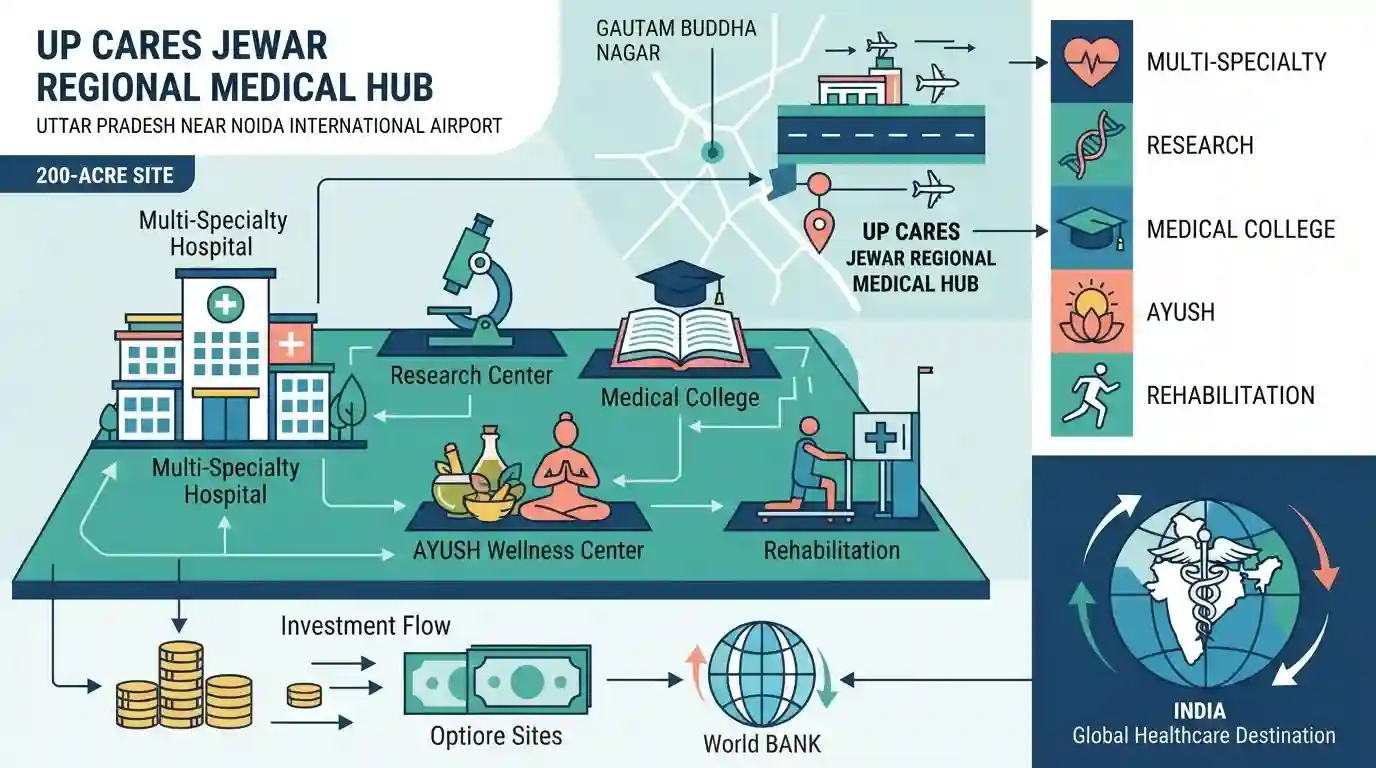
The Uttar Pradesh government plans to establish the "UP Cares Jewar Regional Medical Hub" on a 200-acre site in Gautam Buddha Nagar near the upcoming Noida International Airport. With an estimated investment of Rs 5,000 crore and a preliminary project report drawn up by the World Bank, the hub aims to position the state as a leading destination for Medical Value Tourism (MVT). The facility will include multi-specialty hospitals, research centres, medical colleges, AYUSH and wellness centres, and rehabilitation facilities. This development follows the Union Budget 2026-27 proposal to support states in setting up five regional medical hubs through PPP models, thereby promoting India as a global healthcare destination.
Key Points
- The Uttar Pradesh government is establishing the 'UP Cares Jewar Regional Medical Hub' on a 200-acre site near the Noida International Airport in Jewar.
- The project requires an estimated investment of Rs 5,000 crore, with the World Bank having drawn up a preliminary project report.
- The hub will feature multi-specialty hospitals, medical colleges, AYUSH centres, advanced diagnostics, and post-treatment rehabilitation facilities.
- The initiative aligns with the Union Budget 2026-27 announcement offering support to states for setting up five regional medical hubs via Public-Private Partnerships (PPP).
- The project aims to leverage its strategic location and connectivity to transform UP into a global destination for Medical Value Tourism (MVT).
Important Terms
Medical Value Tourism (MVT)

The practice of traveling across international borders to receive medical treatment, wellness therapies, or alternative clinical care, often combining healthcare with tourism.
UPSC context
GS Paper II (Social Sector/Health) and GS Paper III (Economy/Services Sector), evaluating service exports and healthcare diplomacy.
Union Budget 2026-27
The annual financial statement of India presented under Article 112, outlining estimated receipts and expenditures, introducing key schemes like the five Regional Medical Hubs.
UPSC context
GS Paper III (Government Budgeting/Indian Economy), assessing fiscal policies, infrastructure funding, and sector-wise allocations.
AYUSH
An acronym for India's traditional systems of healthcare, comprising Ayurveda, Yoga and Naturopathy, Unani, Siddha, Sowa-Rigpa, and Homeopathy, promoted for holistic wellness.
UPSC context
GS Paper II (Social Sector/Health), testing candidates on traditional healthcare integration, preventive medicine, and medical pluralism.
Public-Private Partnership (PPP)
A collaborative model between government agencies and private sector entities to design, finance, construct, and operate public assets or services like healthcare hubs.
UPSC context
GS Paper III (Investment Models/Infrastructure), testing knowledge of hybrid project financing, risk allocation, and public service delivery.
World Bank
An international financial institution providing low-interest loans, credits, and grants to developing countries to fund capital projects and support economic development.
UPSC context
GS Paper II (Bilateral and Global Groupings/Institutions), testing global governance, development financing, and international aid frameworks.
Prelims Trap
The majority of medical tourists visiting India come from high-income GCC countries and Western nations.
Aspirants often assume Western or GCC nations dominate medical arrivals, but Bangladesh is the single largest source country for medical tourists in India, followed by Iraq and Somalia.
Static Concepts Connected
What is Medical Value Tourism (MVT) and India's competitive edge?
- Cost Advantage: Treatments in India cost a fraction (roughly 10% to 30%) of comparable procedures in Western nations.
- Quality Standards: Presence of numerous hospitals accredited by Joint Commission International (JCI) and National Accreditation Board for Hospitals (NABH).
- AYUSH Integration: Unique global appeal for holistic wellness therapies, particularly Ayurveda and Yoga, integrated with modern clinical care.
How does the 'Heal in India' initiative facilitate health tourism?
- Campaign Objective: A flagship initiative by the Ministry of Health and Family Welfare to position India as a global healthcare hub.
- Digital Integration: A multi-lingual digital Medical Value Travel portal integrated with the 'Incredible India' website to ease hospital discovery and bookings.
- e-AYUSH Visa: A dedicated visa category introduced in 2023 for foreign nationals seeking traditional Indian clinical treatments.
Cross-Topic Patterns
Infrastructure-led service exports
Co-locating the Jewar Medical Hub with Noida International Airport demonstrates how civil aviation infrastructure acts as a primary economic multiplier for Medical Value Tourism (MVT).
Social-sector PPP trade-offs
Utilizing the PPP model for high-end medical hubs tests India's ability to balance lucrative health tourism exports with equitable local healthcare access.

Mains 2026: Expect questions on PPP-led regional medical hubs bridging the gap between domestic healthcare equity and service exports.
Linked PYQs · 4
Linked PYQs · 4
- 2020UPPSC_PRELIMSGS1
Which of the following Airports in Uttar Pradesh has been granted International Status on 24th June, 2020 by Union Cabinet of India ?
- 2022UPPSC_PRELIMSGS1
At which one of the following place, the World Health Organisation (WHO) is going to establish Global Traditional Medicine Centre ?
- 2023UPPSC_PRELIMSGS1
Which of the following Scheme/Programme is not the Central Government Programme and it is Uttar Pradesh Government's Programme?
- 2020UPPSC_PRELIMSGS1
With reference to the 'Ayushman Bharat Yojana', which of the following statements is/are correct? 1. This scheme provides free health insurance of five lakh rupees per person. 2. The expenditure in this scheme is shared between the Centre and the states in the ratio of 60:40. Select the correct answer using the code given below.
