Loco Pilot Averts Derailment Bid on Punjab Mail in Lucknow
Source:etv-bharat ↗
Why It Matters
The incident highlights serious vulnerabilities in critical national infrastructure (railways) and the constant threat of sabotage. For UPPSC, understanding the division of security mandates (RPF under Ministry of Railways vs. State GRP/Police forces) and transport safety measures is crucial for the internal security and regional administration syllabi.
Summary
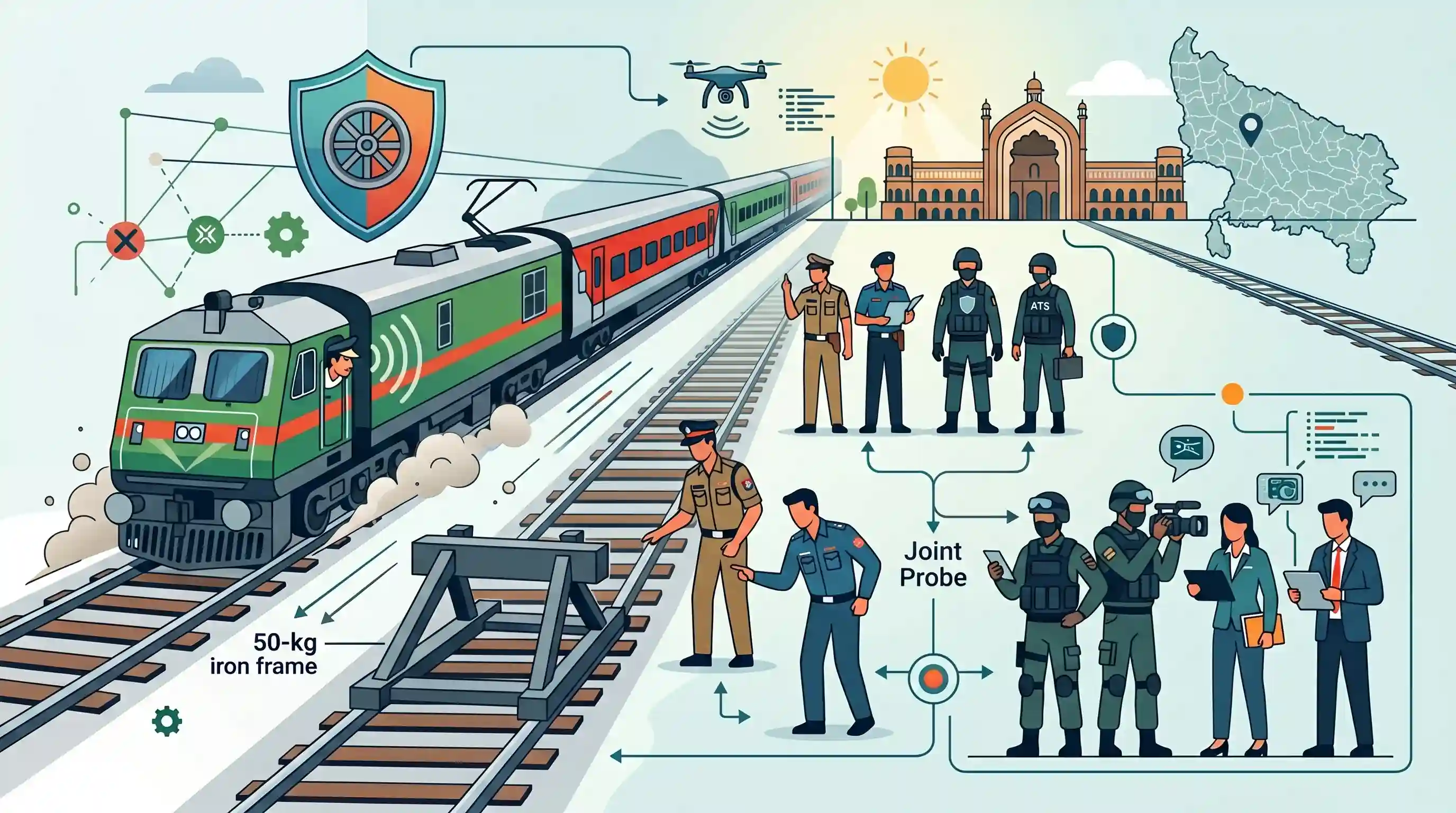
A major train derailment disaster was averted near Lucknow, Uttar Pradesh, on June 14, 2026, when an alert loco pilot applied emergency brakes upon spotting a 50-kg iron frame placed on the tracks of the Punjab Mail (Amritsar to Howrah). Security and counter-terror agencies, including the RPF, UP ATS, STF, and intelligence bodies, have initiated a joint probe to investigate suspected sabotage and conspiratorial angles.
Key Points
- An attempt to derail the Amritsar-Howrah Punjab Mail (Train No. 13006) was made near Dilkusha Block in the Cantt police area of Lucknow, Uttar Pradesh.
- The loco pilot's swift action in applying emergency brakes after spotting a 50-kg heavy iron frame on the tracks averted a major accident.
- The Railway Protection Force (RPF) registered a case under the Railway Act, and a joint probe is underway involving the UP Police, ATS, STF, and state intelligence agencies.
- The Punjab Mail, targeted in this incident, is one of India's oldest operating trains, having commenced services in 1912.
Important Terms
Railway Act

The principal Union legislation regulating all aspects of rail transport in India, including operations, safety standards, passenger liabilities, compensation, and penalties for offenses like sabotage.
UPSC context
GS Paper III (Infrastructure & Security), testing legislative frameworks for public safety, national transit, and critical infrastructure protection.
Railway Protection Force (RPF)
A Union armed force under the Ministry of Railways, established under the RPF Act 1957, responsible for protecting railway property, passenger areas, and passenger security.
UPSC context
GS Paper III (Security Forces & Their Mandate), testing internal security structures, center-state police coordination, and infrastructure safeguarding.
Government Railway Police (GRP)
A specialized wing of the state police forces responsible for maintaining law and order, and investigating cognizable criminal offenses inside railway stations and running trains.
UPSC context
GS Paper II (Federalism) and Paper III (Security), testing jurisdiction divisions between Central armed forces and State police units.
UP Anti-Terrorist Squad (ATS)
A specialized, intelligence-led counter-terrorism division of the Uttar Pradesh Police established in 2007 to investigate terror activities, dismantle sleeper cells, and counter-sabotage plots.
UPSC context
GS Paper III (Internal Security), testing state-level counter-terrorism architecture, intelligence networks, and specialized security agency mandates.
Special Task Force (STF)
An elite, specialized unit of state police forces (such as UP STF established in 1998) mandated to combat organized crime, mafia syndicates, and high-risk security threats.
UPSC context
GS Paper III (Internal Security/Organized Crime), testing state-level tactical capabilities, law enforcement specialization, and crime prevention strategies.
Indian Railways
The state-owned national railway system of India, managed by the Ministry of Railways, representing a vital economic lifeline and critical national infrastructure.
UPSC context
GS Paper III (Infrastructure: Railways), testing critical asset vulnerability, national security issues, and public transit network management.
Prelims Trap
The Commission of Railway Safety (CRS) is a statutory watchdog operating under the administrative jurisdiction of the Ministry of Railways.
The CRS actually functions under the Ministry of Civil Aviation to maintain complete administrative independence and avoid conflicts of interest during accident investigations.
Static Concepts Connected
Why is the Commission of Railway Safety under the Ministry of Civil Aviation?
- Conflict of Interest: Its separation from the Ministry of Railways ensures unbiased investigations into railway accidents and safety failures.
- Statutory Origin: Derived from the Railways Act, 1989, it performs inspectorial, investigational, and advisory safety duties.
- Administrative Head: Headed by the Chief Commissioner of Railway Safety in Lucknow, directing circle-level commissioners.
How do the mandates of RPF and GRP differ in railway policing?
- Constitutional Control: RPF is a Central Armed Force under the Union, while GRP operates under respective State police systems.
- RPF Mandate: Focuses on protecting railway property, passenger areas, and combating unlawful possession issues.
- GRP Mandate: Responsible for maintaining law and order, registering crimes, and investigating IPC offenses on trains.
Cross-Topic Patterns
Critical Infrastructure & Asymmetric Sabotage
Physical sabotage of transport networks represents low-cost asymmetric threats, highlighting vulnerabilities in supply chains and the need for unified critical infrastructure protection models.
Colonial Geopolitics & Border Reconfiguration
Historic colonial lines like the pre-partition Punjab Mail (Peshawar to Bombay) mapped military-economic integration, which was heavily disrupted and fragmented by 1947 borders.

The structural independence of the Commission of Railway Safety (CRS) and RPF-GRP mandates is a highly probable GS-3 security topic for 2026.
Linked PYQs · 2
Linked PYQs · 2
- 2017UPPSC_PRELIMSGS1
India's first semi-high speed train 'Tejas' will run between:
- 2016UPPSC_PRELIMSGS1
A well planned racket has been unearthed in Indian Railways recently. The scam is related to
