Uttar Pradesh Rural Water Schemes Maintenance Warranty Policy
Source:The Hindu ↗
Why It Matters
Demonstrates the vital shift from creating infrastructure to ensuring its long-term functionality. It serves as a strong case study for decentralized governance, illustrating how empowering local institutions like Paani Samitis can improve service delivery and community participation in public asset management.
Summary
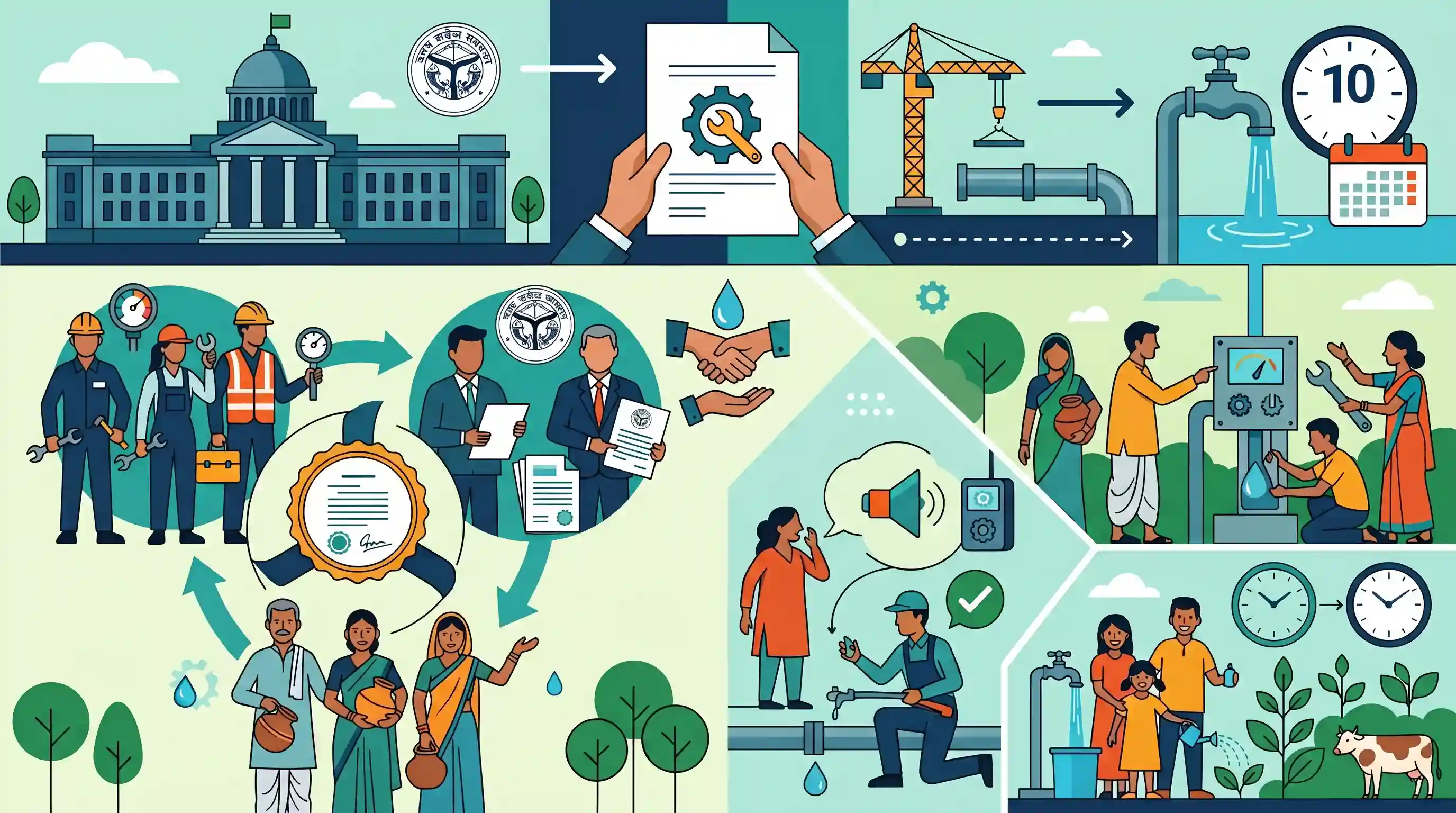
The Uttar Pradesh government has mandated a 10-year operation and maintenance (O&M) warranty for rural water schemes constructed under the Jal Jeevan Mission. Moving beyond a construction-centric approach, the policy prioritizes the long-term sustainability and quality of rural drinking water delivery. Under the ‘Jal Arpan’ initiative, local Village Water and Sanitation Committees (VWSCs) or 'Paani Samitis' are formally integrated into the management structure via a tripartite agreement with the UP Jal Nigam and O&M agencies. This model bolsters community participation and decentralized governance, ensuring effective grievance redressal and sustained maintenance of critical water infrastructure at the grassroots level.
Key Points
- The UP government introduces a mandatory 10-year operation and maintenance (O&M) warranty for rural water supply systems under the Jal Jeevan Mission.
- The policy shifts the focus of rural water schemes from mere construction to long-term sustainability and service delivery.
- A Tripartite Agreement among UP Jal Nigam, O&M agencies, and Village Water and Sanitation Committees (VWSCs) establishes clear maintenance responsibilities.
- The 'Jal Arpan' initiative actively empowers local communities and Paani Samitis to resolve issues locally and manage water infrastructure.
- This decentralized model strengthens the role of Panchayati Raj institutions in achieving Service Level Benchmarks for drinking water.
Important Terms
Jal Jeevan Mission

Central flagship scheme launched in 2019 aiming to provide Functional Household Tap Connections (FHTC) to every rural household by 2024 through community-led decentralized management and source sustainability.
UPSC context
GS Paper 2 (Government Policies); tests understanding of social sector interventions and sustainable development goals (SDG 6).
Jal Arpan initiative
A Uttar Pradesh government initiative mandating a 10-year operation and maintenance (O&M) warranty for rural water schemes, shifting from construction-focused to sustainability-focused service delivery.
UPSC context
GS Paper 2 (Governance); tests knowledge of state-level policy innovations and long-term asset management in rural development.
Village Water and Sanitation Committees (VWSCs)
Standing committees of Gram Panchayats responsible for planning, implementing, and managing village water supply. Membership must include at least 50% women and 25% from weaker sections.
UPSC context
GS Paper 2 (Devolution of Powers); tests knowledge of grassroots democratic institutions and community-led governance.
Paani Samitis
Local-level bodies (synonymous with VWSCs) empowered under the Jal Jeevan Mission to manage daily operations and maintenance of water systems, ensuring "Jan Bhagidari" (people's participation).
UPSC context
GS Paper 2 (Panchayati Raj); focuses on specialized local bodies in decentralized public service delivery.
Uttar Pradesh Jal Nigam (UP Jal Nigam)
The statutory executing agency in Uttar Pradesh responsible for the technical implementation of piped water supply projects and coordinating between contractors and local village bodies.
UPSC context
GS Paper 2 (Statutory Bodies); examines the role of state-level agencies in the federal implementation of central schemes.
Tripartite Agreement
A contractual framework used in UP’s water schemes involving the UP Jal Nigam, private O&M agencies, and Paani Samitis to ensure accountability and long-term service benchmarks.
UPSC context
GS Paper 2 (Governance); tests understanding of Public-Private-Community Partnerships (PPCP) in improving rural infrastructure sustainability.
Prelims Trap
VWSCs (Paani Samitis) are independent bodies established directly by the Union Ministry of Jal Shakti.
VWSCs are not independent central entities. They are standing statutory sub-committees of the local Gram Panchayats, embedded within the decentralized Panchayati Raj framework.
Static Concepts Connected
Institutional framework of Village Water and Sanitation Committees
- Statutory Status: VWSCs or Paani Samitis function as standing sub-committees of the Gram Panchayat, not as independent NGOs.
- Composition: Typically comprises 10-15 members, mandating at least 50% women representation and 25% from marginalized communities (SC/ST).
- Core Mandate: Responsible for planning, designing, operating, and maintaining in-village water supply infrastructure and collecting user charges.
Constitutional mandate for Panchayats in water management
- Article 243G: Empowers State legislatures to endow Panchayats with powers to implement schemes for economic development and social justice.
- 11th Schedule: Explicitly lists 'Drinking water' (Entry 11) and 'Minor irrigation, water management and watershed development' (Entry 3) as functional responsibilities.
- Functionary Devolution: Tripartite agreements operationalize this mandate by formally transferring technical and administrative service-delivery responsibilities to local bodies.
Cross-Topic Patterns
Asset creation vs. long-term sustainability
JJM's shift to a 10-year O&M warranty mirrors Swachh Bharat's transition to ODF+ sustainability, highlighting a broader policy maturity in India's rural welfare schemes.
PRIs as functional rural utilities
By signing tripartite agreements with contractors, Gram Panchayats transition from basic administrative units into active public utility managers, enforcing service accountability on private agencies.

Mains GS2 in 2026 will likely evaluate the capacity of Panchayati Raj Institutions to manage complex utilities like water under JJM.
Linked PYQs · 4
Linked PYQs · 4
- 2024MainsGS2
Analyse the role of local bodies in providing good governance at local level and bring out the pros and cons merging the rural local bodies with the urban local bodies.
- 2015MainsGS2
In absence of a well-educated and organized local level government system, 'Panchayats' and 'Samitis' have remained mainly political institutions and not effective instruments of governance. Critically discuss.
- 2020MainsGS2
The strength and sustenance of local institutions in India has shifted from their formative phase of 'Functions, Functionaries and Funds' to the contemporary stage of 'Functionality'. Highlight the critical challenges faced by local institutions in terms of their functionality in recent times.
- 2016MainsGS1
In what way micro-watershed development projects help in water conservation in drought-prone and semi-arid regions of India?
