Uttar Pradesh ODOP scheme drives traditional industries growth
Source:organiser ↗
Why It Matters
UP-specific schemes, especially ODOP, and traditional craft-district mapping are highly recurring themes in UPPSC Prelims (UP Special GS). Understanding the MSME and skill development landscape is crucial for both objective questions and Mains answers regarding UP's economic growth.
Summary
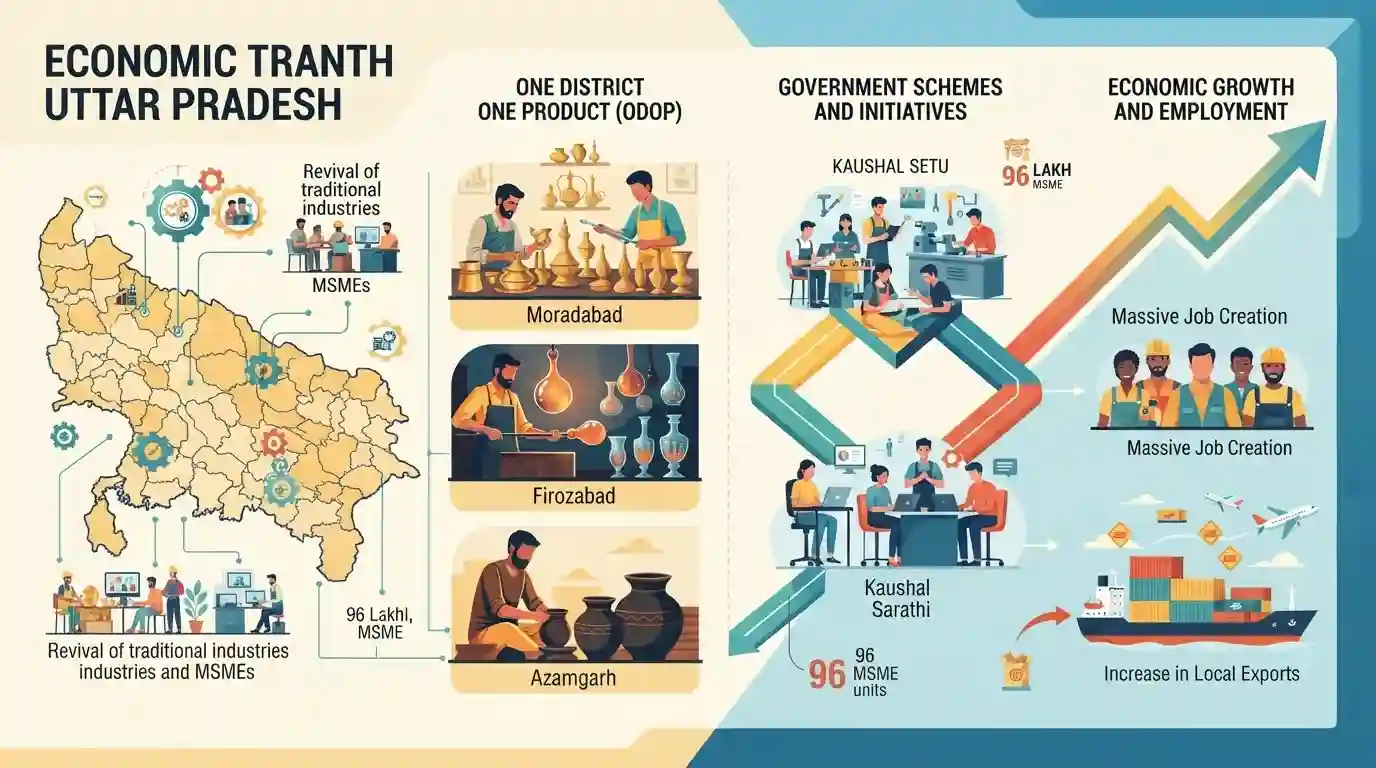
Uttar Pradesh's One District One Product (ODOP) initiative is driving economic growth and employment by reviving traditional industries and supporting the MSME sector. The state, home to over 96 lakh MSME units, is promoting unique regional crafts such as Moradabad's brassware, Firozabad's glassware, and Azamgarh's black pottery. Alongside ODOP, skill development programs like Kaushal Setu and Kaushal Sarathi are empowering the youth, resulting in massive job creation and an increase in local exports.
Key Points
- The One District One Product (ODOP) scheme in Uttar Pradesh has significantly revitalized traditional crafts and MSMEs, boosting the local economy and exports.
- Key traditional hubs promoted include Moradabad (brassware), Firozabad (glassware), Bhadohi (carpets), Varanasi (sarees), Lucknow (chikankari), and Azamgarh (black pottery).
- Uttar Pradesh hosts India's largest MSME base with over 96 lakh units, which serve as the backbone for employment generation.
- Initiatives like Kaushal Setu and Kaushal Sarathi have been launched to enhance youth employability, contributing to over 3.25 crore jobs created in the past 9 years.
Important Terms
One District One Product (ODOP)

A flagship initiative launched by Uttar Pradesh in 2018, and later adopted nationally, aiming to boost local economies by identifying, promoting, and exporting one unique traditional product or craft from every district.
UPSC context
Relevant for GS Paper 3 (Economic Development/MSME). Tests knowledge of grassroots economic policies, self-reliance, and export promotion strategies.
Kaushal Setu
A digital portal launched by the Uttar Pradesh Skill Development Mission (UPSDM) to enable the paperless, online registration and transparent empanelment of vocational training partners.
UPSC context
Important for GS Paper 2 (e-Governance). Highlights state-level digital initiatives streamlining administrative processes in skill development.
Kaushal Sarathi
An integrated digital platform in Uttar Pradesh that helps youth easily locate district-wise skill development centers, available courses, and training partners using an interactive digital map.
UPSC context
Relevant for GS Paper 2 (Skill Development/Human Resources). Demonstrates the use of technology to improve youth access to vocational training.
Moradabad Brassware
A world-renowned, GI-tagged traditional metal craft from Uttar Pradesh, celebrated for its intricate engraving. Promoted under the ODOP scheme, it has transformed the district into a major handicraft export hub.
UPSC context
Significant for GS Paper 1 (Art and Culture). Tests awareness of GI-tagged crafts, regional heritage, and traditional Indian industries.
Azamgarh Black Pottery
A GI-tagged craft from Nizamabad, Uttar Pradesh, known for its lustrous dark finish and silver-toned engravings achieved through a specialized smoke-firing process. Its revival is heavily supported by the ODOP scheme.
UPSC context
Important for GS Paper 1 (Art and Culture). Tests knowledge of regional heritage crafts and government schemes for their preservation.
Prelims Trap
"Maharashtra accounts for the highest number of MSME units in India."
Aspirants often assume heavily industrialized states like Maharashtra or Gujarat lead in MSMEs. However, Uttar Pradesh has the largest estimated MSME base in India.
Static Concepts Connected
What is the revised classification criteria for MSMEs (effective July 2020)?
- Micro Enterprise: Investment less than ₹1 crore and Turnover less than ₹5 crore.
- Small Enterprise: Investment less than ₹10 crore and Turnover less than ₹50 crore.
- Medium Enterprise: Investment less than ₹50 crore and Turnover less than ₹250 crore.
What are the key rules governing Geographical Indications (GI) in India?
- Legal Framework: Governed by the Geographical Indications of Goods (Registration and Protection) Act, 1999, complying with TRIPS.
- Nodal Body: Administered by the Geographical Indications Registry under DPIIT, Ministry of Commerce and Industry.
- Validity: A GI registration is valid for 10 years, but can be renewed indefinitely for subsequent 10-year periods.
Cross-Topic Patterns
ODOP & Districts as Export Hubs
The DGFT's 'Districts as Export Hubs' initiative mirrors UP's ODOP by decentralizing export promotion, pushing district-level export action plans, and aiding GI tag monetization.
Spatial mapping of GI Crafts
UPSC frequently tests regional crafts as pairs. Tracking GI-tagged ODOPs (e.g., Azamgarh Black Pottery, Bhadohi Carpets) bridges State economy news directly with the Art & Culture syllabus.

Expect a "How many pairs are correctly matched" Prelims question combining ODOP crafts, GI tags, and their native districts in 2026.
Linked PYQs · 3
Linked PYQs · 3
- 2022UPPSC_PRELIMSGS1
On the basis of 'one district one product' programme in Uttar Pradesh, which one of the following pairs is NOT correctly matched ?
- 2017UPPSC_PRELIMSGS1
Match List-I with List-II and select the correct answer from the code given below the lists: List-I (Centre): (A) Sports goods (B) Match box (C) Brassware (D) Wood List-II (Industry): 1. Moradabad 2. Saharanpur 3. Meerut 4. Bareilly carving
- 2025UPPSC_PRELIMSGS1
As per the One District One Product (ODOP) scheme of Uttar Pradesh, Moonj products are associated with which of the following districts? 1. Amethi 2. Sultanpur 3. Sant Kabir Nagar Select the correct answer from the code given below:
