Maharaja Surajmal Agra Fort Capture Vijay Diwas in Uttar Pradesh
Source:etv-bharat ↗
Why It Matters
UPPSC frequently tests candidates on historical events, regional kingdoms, and monument histories located within Uttar Pradesh. Maharaja Surajmal's military campaigns and the Jat administration of Agra Fort represent a crucial phase of 18th-century transitional history.
Summary
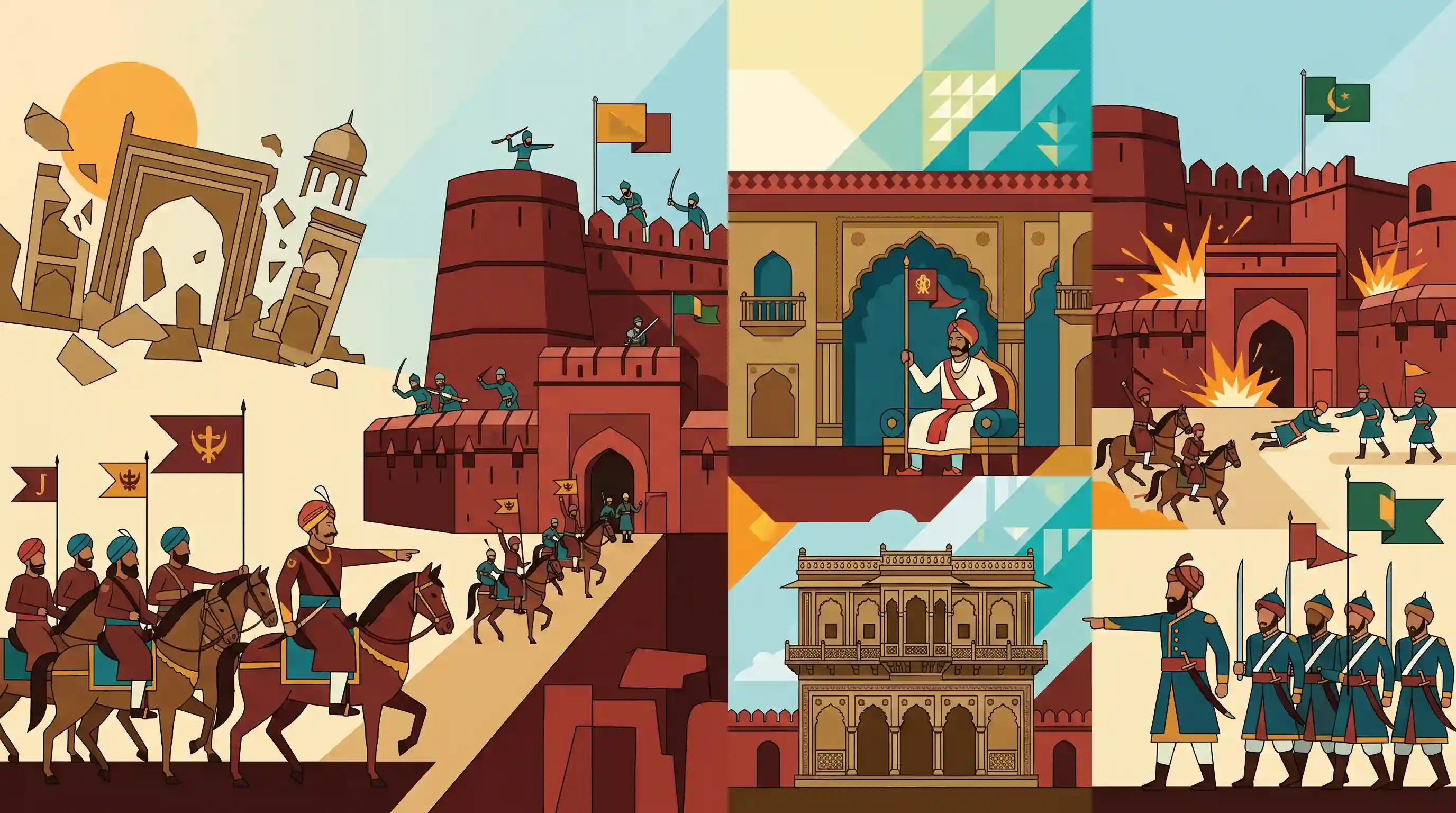
The Uttar Pradesh government will observe June 12 as 'Vijay Diwas' to mark the 265th anniversary of Bharatpur's Jat ruler Maharaja Surajmal capturing the Agra Fort from the Mughals on June 12, 1761. The 13-year Jat rule over the fort (1761-1774) represents a key phase of regional power consolidation during the decline of the Mughal Empire, and saw the construction of architectural landmarks like Raja Ratan Singh's Haveli. The rule ended when Mughal commander Mirza Najaf Khan recaptured the fort in 1774.
Key Points
- The Uttar Pradesh government will celebrate 'Vijay Diwas' on June 12 to commemorate the 265th anniversary of Jat ruler Maharaja Surajmal's historic capture of Agra Fort on June 12, 1761.
- Maharaja Surajmal, the ruler of Bharatpur, captured the fort after a 40-day siege, representing a watershed moment marking the rise of regional Jat power and the decline of the Mughal Empire.
- The celebration is scheduled to take place on the lawns of the Jahangiri Mahal inside Agra Fort, organized by the UP Tourism Department and the Archaeological Survey of India (ASI).
- Maharaja Surajmal was born on February 13, 1707, in Bharatpur, fought 80 battles in his lifetime, and died in 1763 while defending Delhi.
- During the 13 years of Jat rule over Agra Fort (1761–1774), structures such as Raja Ratan Singh's Haveli were constructed near the Diwan-i-Aam.
- Jat rule over Agra Fort ended on February 18, 1774, when Mughal Emperor Shah Alam sent commander Mirza Najaf Khan to recapture the fortress.
Important Terms
Archaeological Survey of India (ASI)

A premier government agency attached to the Ministry of Culture, responsible for archaeological research, excavation, and the conservation and protection of over 3,600 national monuments across India.
UPSC context
GS Paper I (Art & Culture); tests institutional roles in conserving heritage monuments.
Maharaja Surajmal
An influential 18th-century Jat ruler of Bharatpur state, often called the 'Plato of the Jat tribe,' known for his administrative acumen, military strategy, and capturing Agra Fort from the Mughals in 1761.
UPSC context
GS Paper I (Medieval/Modern History); tests knowledge of regional states emerging during Mughal decline.
Agra Fort
A historic 16th-century Mughal fort and UNESCO World Heritage Site in Uttar Pradesh, built by Emperor Akbar. It served as the primary residence of the Mughal emperors until the capital shifted to Delhi.
UPSC context
GS Paper I (Art & Architecture); tests understanding of Mughal architectural elements and historical preservation.
Jat Kingdom of Bharatpur
An autonomous 18th-century state in Rajasthan established by Churaman and Badan Singh. It reached its political and military zenith under Maharaja Surajmal, playing a key role during the decline of the Mughal Empire.
UPSC context
GS Paper I (18th-Century History); tests understanding of autonomous state formation and post-Mughal regional dynamics.
Uttar Pradesh Tourism Department
A state government body in Uttar Pradesh responsible for promoting tourism, developing tourist infrastructure, and organizing cultural events to preserve and showcase the state's historical and religious heritage.
UPSC context
GS Paper II & UP-specific GS; tests state-level initiatives for cultural preservation and tourism development.
Prelims Trap
Agra Fort remained continuously under Mughal control from Akbar's reign until its capture by the British or Marathas.
Agra Fort was occupied by the Jat ruler Maharaja Surajmal for 13 years (1761–1774), during which architecture like Raja Ratan Singh's Haveli was added, before being recaptured by the Mughals.
Static Concepts Connected
How did the Jat state of Bharatpur consolidate during the 18th century?
- Foundational phase: Churaman and Badan Singh founded and organized the Jat state, capitalizing on the decline of Mughal authority after Aurangzeb.
- Surajmal's expansion: Under Maharaja Surajmal (1756–1763), the state expanded across Agra, Meerut, and Mathura, reaching its political and military zenith.
- Administrative synthesis: The Jats adopted Mughal revenue systems and administrative patterns but retained strong agrarian clan alliances for military mobilization.
What are the key architectural features of the Jat monuments of Bharatpur and Deeg?
- Lohagarh Fort: Constructed by Maharaja Surajmal, its massive double mud walls successfully absorbed and neutralized British artillery fire during the 1805 siege.
- Deeg Garden Palace: Features beautiful palaces blending Mughal Charbagh layouts, bangaldar roofs, and marble jaalis with regional Hindu motifs and water-sprinkler systems.
Cross-Topic Patterns
18th-century regionalism vs Mughal decline
The Jat occupation of Agra Fort shows how regional kingdoms appropriated Mughal administrative symbols to legitimize their own sovereignty during the imperial collapse.
Indigenous defensive architecture
Lohagarh Fort's mud-walled design highlights pre-modern Indian engineering adapting specifically to neutralize heavy European gunpowder and artillery sieges.

UPSC may test the 18th-century transition era by contrasting Jat military architecture (Lohagarh mud walls) with late Mughal fortresses.
Linked PYQs · 3
Linked PYQs · 3
- 2025UPPSC_PRELIMSGS1
Arrange the following in chronological order of their rule and select the correct answer from the code given below. 1. Jahangir 2. Shah Jahan 3. Akbar 4. Aurangzeb
- 2025UPPSC_PRELIMSGS1
Given below are two statements, one is labelled as Assertion (A) and the other as Reason (R). Assertion (A) : Buland Darwaja was constructed at Fatehpur Sikri by the Mughal emperor Akbar. Reason (R) : Akbar built this monument to commemorate the birth of his son Jahangir. Select the correct answer from the code given below :
- 2022UPPSC_PRELIMSGS1
From which place Jayata and Kumpa were associated who impressed Shershah with their valour ?
