Centre replaces MGNREGA with Viksit Bharat rural job guarantee scheme
Source:freepressjournal ↗
Why It Matters
This is a major and historic transition in India's rural policy landscape, replacing MGNREGA, which has been the cornerstone of rural employment security since 2005. The shift from a demand-driven model to a geospatial-planned model with increased guaranteed days (125) and enhanced wages makes it highly relevant for UPPSC GS-I/III Prelims and GS-II/III Mains.
Summary
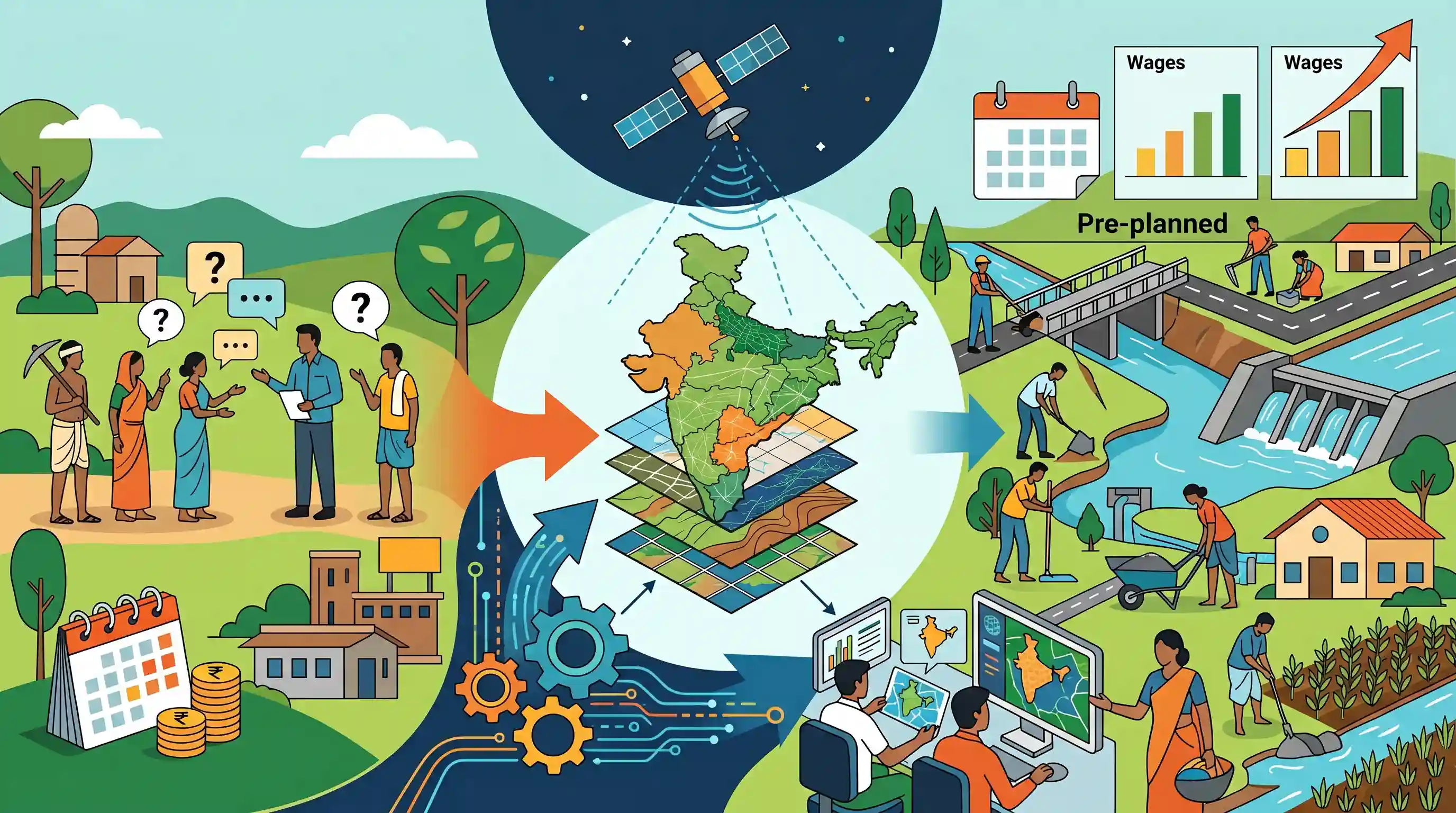
Effective July 1, 2026, the Government of India has replaced its flagship MGNREGA scheme with the 'Viksit Bharat-Guarantee for Rozgar and Ajeevika Mission Gramin (VB-G RAM G) Act'. The new scheme guarantees 125 days of rural wage employment per year (up from 100 days) and establishes a minimum daily wage of ₹300 in Uttar Pradesh (with the national average wage rising to ₹327.40). Crucially, the scheme transitions rural planning from a local demand-driven system to a scientific, pre-planned geospatial model utilizing GIS mapping, satellite imagery, and land records to create durable community assets.
Key Points
- The Government of India has replaced the 20-year-old MGNREGA with the Viksit Bharat-Guarantee for Rozgar and Ajeevika Mission Gramin (VB-G RAM G) Act, taking effect on July 1, 2026.
- The new act increases the annual guaranteed wage employment for eligible rural households from 100 days to 125 days.
- The minimum daily wage under the VB-G RAM G Act in Uttar Pradesh is set at no less than ₹300, and the national average daily wage is raised from ₹298.80 to ₹327.40.
- It shifts the employment generation mechanism from purely demand-driven to scientific, geospatial planning utilizing satellite imagery, land records, and GIS mapping to prepare village-level development projects.
- The act prioritizes works that build long-term durable community assets, such as road construction, irrigation facilities, water conservation, and community infrastructure.
- It allows for the integration of multiple rural development schemes to minimize duplication, improve resource utilization, and maximize development efficiency.
Important Terms
Viksit Bharat-Guarantee for Rozgar and Ajeevika Mission Gramin (VB-G RAM G) Act

A landmark social welfare legislation that replaced MGNREGA on July 1, 2026, guaranteeing 125 days of unskilled wage employment per financial year to eligible rural households through a technology-enabled, centrally sponsored framework.
UPSC context
GS Paper II & III: Welfare schemes, rural development, employment generation, and federal-state fiscal dynamics.
Mahatma Gandhi National Rural Employment Guarantee Act (MGNREGA)
A historical, demand-driven social security legislation enacted in 2005 that guaranteed 100 days of unskilled manual work per year to rural households. It was officially repealed and replaced by the VB-G RAM G Act.
UPSC context
GS Paper III: Growth, development, and employment. Important for comparative analysis of legacy versus modern welfare architectures.
Viksit Gram Panchayat Plan (VGPP)
A science-based, geospatially-enabled local development planning framework under the VB-G RAM G Act. Formulated by Gram Panchayats, it transitions rural public planning from local "wish-lists" to structured, GIS-mapped, and evidence-based development models.
UPSC context
GS Paper II: Local self-government, Panchayati Raj Institutions, decentralized planning, and application of technology in governance.
Viksit Bharat National Rural Infrastructure Stack (VB-NRIS)
A centralized digital registry that aggregates all proposed and completed rural public works from local VGPPs across India, aligning them with national development priorities and four key thematic domains like climate resilience.
UPSC context
GS Paper III: Infrastructure development, Digital Public Infrastructure (DPI), and disaster-resilient planning in rural economies.
Centrally Sponsored Scheme (CSS)
A category of government schemes in India implemented by state governments but funded jointly with the Central Government under a fixed cost-sharing ratio (e.g., 60:40), as applied under the new VB-G RAM G Act.
UPSC context
GS Paper II: Indian Federalism, devolution of financial resources, and fiscal relations between the Centre and States.
Prelims Trap
Under the VB-G RAM G Act, the Central Government continues to fund 100% of unskilled manual labor wages.
The new Act shifts to a uniform 60:40 cost-sharing ratio (90:10 for NE/Himalayan states) across all components, including unskilled wages.
Static Concepts Connected
What were the core statutory features of the repealed MGNREGA, 2005?
- Statutory Guarantee: Guaranteed 100 days of unskilled manual work per financial year to every rural household whose adult members volunteer.
- Demand-Driven Model: Designed as a demand-driven right; if work was not provided within 15 days, states had to pay an unemployment allowance.
- Funding Structure: The Central Government funded 100% of the unskilled labor wage, while materials and admin costs were shared.
- Social Audits: Mandated social audits by Gram Sabhas to ensure transparency and accountability in asset creation.
What are Centrally Sponsored Schemes (CSS) and their funding structures?
- Definition: Schemes implemented by state governments but largely funded by the Central government with a defined state-share percentage.
- Standard Split: Generally 60:40 for general category states and 90:10 for North-Eastern and Himalayan states.
- Fiscal Leverage: Unlike Central Sector Schemes (100% Union funded), CSS require states to mobilize revenue matching their designated share.
Cross-Topic Patterns
Fiscal Federalism + Welfare Schemes
Capping funds via normative allocation and shifting to a 60:40 wage split alters state budgetary priorities, testing cooperative federalism under tight state revenue conditions.
Agricultural Labor + Social Security
The 60-day peak-season pause directly balances rural social security with private agricultural labor supply, resolving a critical tension in farm productivity.

The shift from MGNREGA’s demand-driven model to VB-G RAM G’s allocation-capped and GIS-planned model will be a major GS-2/3 comparison theme.
Linked PYQs · 5
Linked PYQs · 5
- 2018UPPSC_PRELIMSGS1
Which of the following is the largest rural employment programme in India?
- 2015UPPSC_PRELIMSGS1
Consider the following statements about positive results of MNREGA: 1. Substantial increase in purchasing power of rural poor 2. Reduction in bargaining power of labourers. 3. Reduction in migration to cities. Choose the correct answer using the code given below:
- 2025UPPSC_PRELIMSGS1
Consider the following and arrange them in correct chronological order. 1. Jawahar Rojgar Yojana 2. Development of women and children in Rural Areas 3. Integrated Rural Development Programme 4. National Rural Employment Programme Select the correct answer from the code given below :
- 2025UPPSC_PRELIMSGS1
Consider the following and arrange them in correct chronological order. 1. Food for work programme 2. Community Development Programme 3. Training for Rural Youth for Self Employment (TRYSEM) 4. Drought Prone Area Programme Select the correct answer from the code given below :
- 2023UPPSC_PRELIMSGS1
Which of the following (Scheme - Year) is not correctly matched?
