Uttar Pradesh Launches Cow Urine Buyback Pilot Project in Bulandshahr
Source:abplive ↗
Why It Matters
This pilot project represents a multi-pronged policy approach by the UP Government, linking stray cattle management with organic farming and rural women's empowerment. It is highly relevant for UPPSC GS exams, covering aspects of UP-specific welfare schemes, agricultural transition (bio-fertilisers vs chemical fertilisers), and rural economic revitalization through FPOs.
Summary
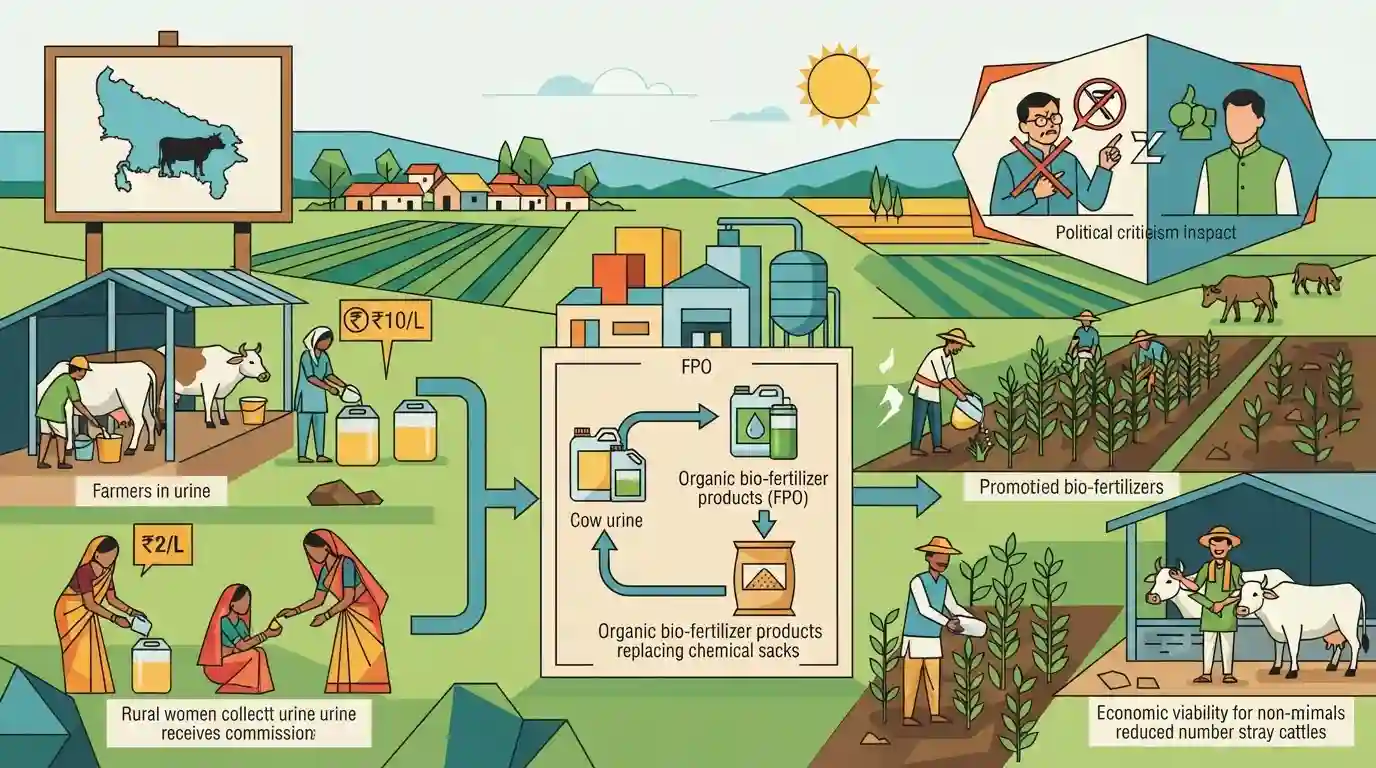
The Uttar Pradesh government has initiated a pilot project in Bulandshahr to purchase cow urine from farmers at ₹10 per litre. The scheme aims to produce bio-fertilisers through Farmer Producer Organisations (FPOs), promoting organic agriculture and curbing chemical usage. Additionally, the project is designed to empower rural women by providing them with a ₹2 per litre commission for collection. Crucially, the initiative offers economic viability to non-milking cattle, attempting to mitigate the widespread stray cattle menace in the state, although it has faced political criticism from the opposition Samajwadi Party.
Key Points
- The Uttar Pradesh government has launched a pilot project in Bulandshahr to procure cow urine from farmers at ₹10 per litre.
- A Farmer Producer Organisation (FPO) will process the collected urine to manufacture bio-fertilisers and bio-pesticides, replacing chemical alternatives.
- Women involved in the collection process will earn a commission of ₹2 per litre, serving as an avenue for rural women's empowerment and income generation.
- The initiative aims to provide economic value to non-milking and ageing cows, thus addressing the state's persistent stray cattle challenge.
- The opposition Samajwadi Party criticized the move, claiming it is a facade to hide the state's failure in effectively managing stray cattle and compensating farmers for crop damage.
Important Terms
Farmer Producer Organisation (FPO)

A legally registered collective of farmers that aggregates agricultural produce, shares resources, and links members directly to markets to achieve economies of scale and improve bargaining power.
UPSC context
Crucial for GS Paper III (Agriculture) topics like agricultural marketing, farm income, and cooperative models.
Uttar Pradesh Government
The elected subnational state executive and legislative authority of Uttar Pradesh, empowered by the Indian Constitution to govern state-list subjects including agriculture and animal husbandry.
UPSC context
Connects to GS Paper II (Polity) themes covering state governance, federalism, and the implementation of regional policies.
Samajwadi Party
A major recognized state political party in India, predominantly active in Uttar Pradesh, functioning as a key opposition voice often emphasizing agrarian and socialist policies.
UPSC context
Relevant for GS Paper II (Polity) under topics related to the multi-party system, regional political dynamics, and electoral democracy.
Bharatiya Janata Party (BJP)
One of India's prominent national political parties, currently forming the ruling government at the federal level and in several states, including Uttar Pradesh.
UPSC context
Pertains to GS Paper II (Polity) concerning the functioning of national political parties, governance frameworks, and Indian democracy.
Prelims Trap
"Cow urine directly provides essential NPK nutrients to crops as a complete bio-fertilizer in natural farming."
In Zero Budget Natural Farming, cow urine and dung (Jeevamrutha) act as microbial inoculants to revive soil biology, rather than acting as a direct replacement for NPK nutrients.
Static Concepts Connected
What are the four core pillars of Zero Budget Natural Farming (ZBNF)?
- Jeevamrutha: A fermented microbial culture of cow dung, urine, jaggery, and pulse flour used to stimulate soil microbial activity.
- Bijamrita: A natural seed treatment preparation using local cow dung and urine to protect young roots from soil-borne diseases.
- Acchadana: The practice of mulching to conserve soil moisture, prevent weed growth, and promote topsoil humus formation.
- Whapasa: Managing soil aeration and moisture levels to drastically reduce the crop's irrigation water requirements.
How are Farmer Producer Organisations (FPOs) promoted and supported in India?
- Legal Entities: They are legal entities formed by primary producers to leverage economies of scale, improve bargaining power, and add value to produce.
- Promoting Agencies: NABARD, SFAC, and NAFED act as the central Implementing Agencies to form and promote 10,000 new FPOs across India.
- Financial Support: The Small Farmers' Agri-Business Consortium (SFAC) provides Equity Grants and manages the Credit Guarantee Fund to ease early financial bottlenecks.
Cross-Topic Patterns
Stray Cattle Economics & Article 48
Creating economic viability for non-milking cattle mitigates crop depredation, practically implementing Article 48 (modernizing animal husbandry) without solely relying on state-run cattle shelters.
Women in Agri-waste Monetization
Providing a commission for rural women in the collection process mirrors successful dairy cooperative models, anchoring women's SHGs at the base of agri-waste supply chains.

Expect a combined Prelims question linking ZBNF components (Jeevamrutha) with the functional mandates of FPOs and SFAC.
Linked PYQs · 3
Linked PYQs · 3
- 2016UPPSC_PRELIMSGS1
Indiscriminate use of fertilizers have led to
- 2023UPPSC_PRELIMSGS1
Which of the following is not a biodegradable polluter?
- 2004UPPSC_PRELIMSGS1
NAFED is associated with
