Uttar Pradesh Targets 9 Percent Share of India Data Centre Capacity
Source:indianinfrastructure ↗
Why It Matters
This massive infrastructure push aligns with Uttar Pradesh's goal of becoming a USD 1 trillion economy and establishes the state as a major digital and technological hub, moving beyond traditional industries. UPPSC frequently questions factual economic targets, capacity figures, and state policy directions.
Summary
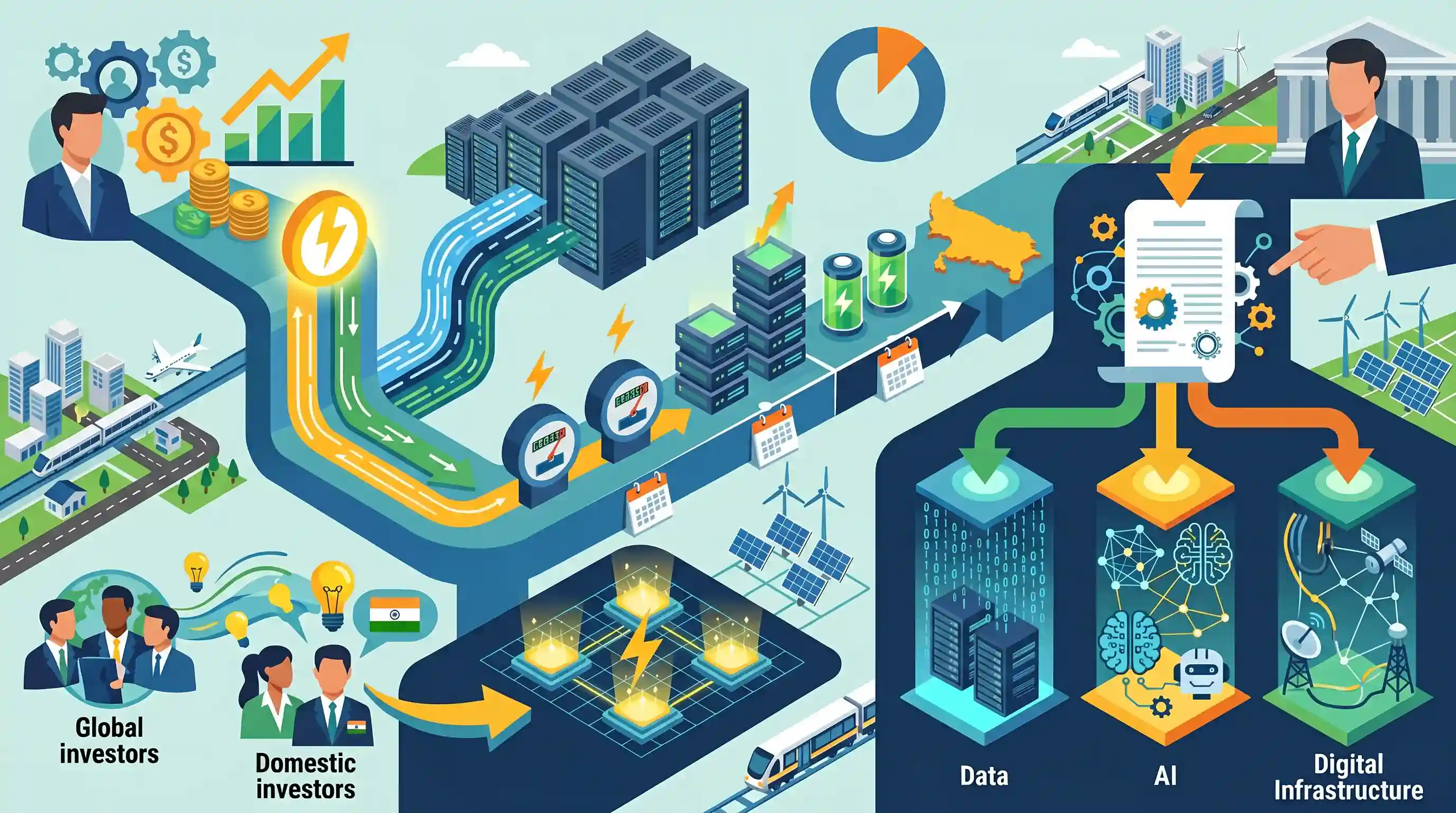
The Government of Uttar Pradesh is aiming to capture an 8-9% share of India's total data centre capacity through a massive Rs 4.9 trillion private investment push in energy-driven digital infrastructure. To achieve this, the state targets adding over 2 gigawatts (GW) of capacity by 2030. In response, various domestic and global investors have expressed interest in developing projects with a combined capacity of 5,410 MW. Chief Minister Yogi Adityanath has directed officials to draft a new, investor-friendly data centre policy based on the foundational pillars of data, artificial intelligence, and digital infrastructure.
Key Points
- The Uttar Pradesh government is targeting a private investment of approximately Rs 4.9 trillion in energy-driven digital infrastructure.
- The state aims to capture an 8-9% share of India's total data centre capacity in the near future.
- A target has been set to add more than 2 gigawatts (GW) of data centre capacity in Uttar Pradesh by 2030.
- Domestic and global investors have expressed interest in developing data centres with a combined capacity of 5,410 MW in the state.
- Chief Minister Yogi Adityanath directed officials to draft a new, practical data centre policy aligned with investor expectations, built around three pillars: data, artificial intelligence, and digital infrastructure.
Important Terms
Uttar Pradesh Data Centre Policy

A state government framework providing land subsidies, capital incentives, and tax exemptions to develop large-scale digital infrastructure and establish Uttar Pradesh as a leading regional data hub.
UPSC context
GS Paper III (Infrastructure & IT): Tests understanding of state policies driving digital economy development and private investments.
Nxtra by Airtel
The data center subsidiary of Bharti Airtel that operates a massive network of secure, energy-efficient, and hyper-connected core and edge data centers across India and Africa.
UPSC context
GS Paper III (Infrastructure & Telecom): Evaluates private sector participation in scaling digital networks and cloud infrastructure.
CtrlS Datacenters
India's leading Rated-4 hyperscale data center provider that operates highly resilient, sustainable, and energy-efficient digital infrastructure facilities catering to enterprise and cloud workloads.
UPSC context
GS Paper III (Infrastructure & Tech): Tests awareness of private players advancing India’s high-capacity, resilient digital storage capability.
Golden State Capital
A Singapore-based global investment firm that has committed significant FDI to construct large-scale data center and renewable energy projects in Uttar Pradesh.
UPSC context
GS Paper III (Investment Models): Evaluates foreign direct investment and state-level mobilization of resources for industrial development.
AM Green
An Indian clean energy platform focused on producing green molecules, including renewable hydrogen and green ammonia, to lead industrial decarbonization and net-zero transitions.
UPSC context
GS Paper III (Energy & Environment): Analyzes private sector contributions to the national green hydrogen mission and clean energy.
Grew Energy
A renewable energy company under the Chiripal Group specializing in solar PV module manufacturing and setting up utility-scale clean energy infrastructure in India.
UPSC context
GS Paper III (Energy): Tests domestic clean-tech manufacturing capabilities and sustainable energy security strategies.
Prelims Trap
Infrastructure status is granted to all data centres setup in India to facilitate easier access to institutional credit.
The Union Budget 2022-23 explicitly restricted infrastructure status to data centres with an IT load capacity of more than 5 MW, not all data centres.
Static Concepts Connected
What is 'Infrastructure Status' in India and its core benefits?
- Regulatory Authority: Granted by the Harmonized Master List of Infrastructure sub-sectors notified by the Ministry of Finance to vital sectors.
- Credit Access: Enables developer firms to access long-term, low-cost external commercial borrowings (ECBs) and institutional finance.
- Investment Incentives: Attracts long-gestation domestic and foreign insurance and pension funds, which have regulatory mandates to invest in infrastructure-graded assets.
What constitutes a Hyperscale Data Centre and its utility?
- Scale and Capacity: Large-scale facilities supporting thousands of physical servers running robust, high-performance applications, typically exceeding 10 MW IT load.
- Resource Efficiency: Offers vastly superior Power Usage Effectiveness (PUE) and highly centralized cooling systems compared to traditional, fragmented enterprise servers.
- Cloud Integration: Forms the foundational physical backbone of global public cloud providers and computationally heavy AI/ML pipelines.
Cross-Topic Patterns
Data Centres + Renewable Energy Integration
Massive data center expansion (>2 GW in UP) dramatically increases baseload electricity demand, driving the need for co-located solar/wind installations and open-access green energy policies.
Data Sovereignty + Competitive Federalism
The DPDP Act, 2023, mandates localized data storage, triggering a race among Indian states (UP, Maharashtra, TN) to offer fiscal incentives for building physical hosting infrastructure.

Criteria for infrastructure status (5MW threshold) paired with state-level data localization demands likely to feature in UPSC 2026.
Linked PYQs · 2
Linked PYQs · 2
- 2023UPPSC_PRELIMSGS1
The Indian Biological Data Centre is being set up in which state?
- 2022UPPSC_PRELIMSGS1
With reference to Budget of Uttar Pradesh for the Financial Year 2020 - 21, which of the following statement(s) is/are true ? 1. The size of the budget was Rs. 5,12,860.72 crores. 2. Certain new schemes were also included in this budget amounting to Rs. 10,967.87 crores. Select the correct answer from the code given below.
