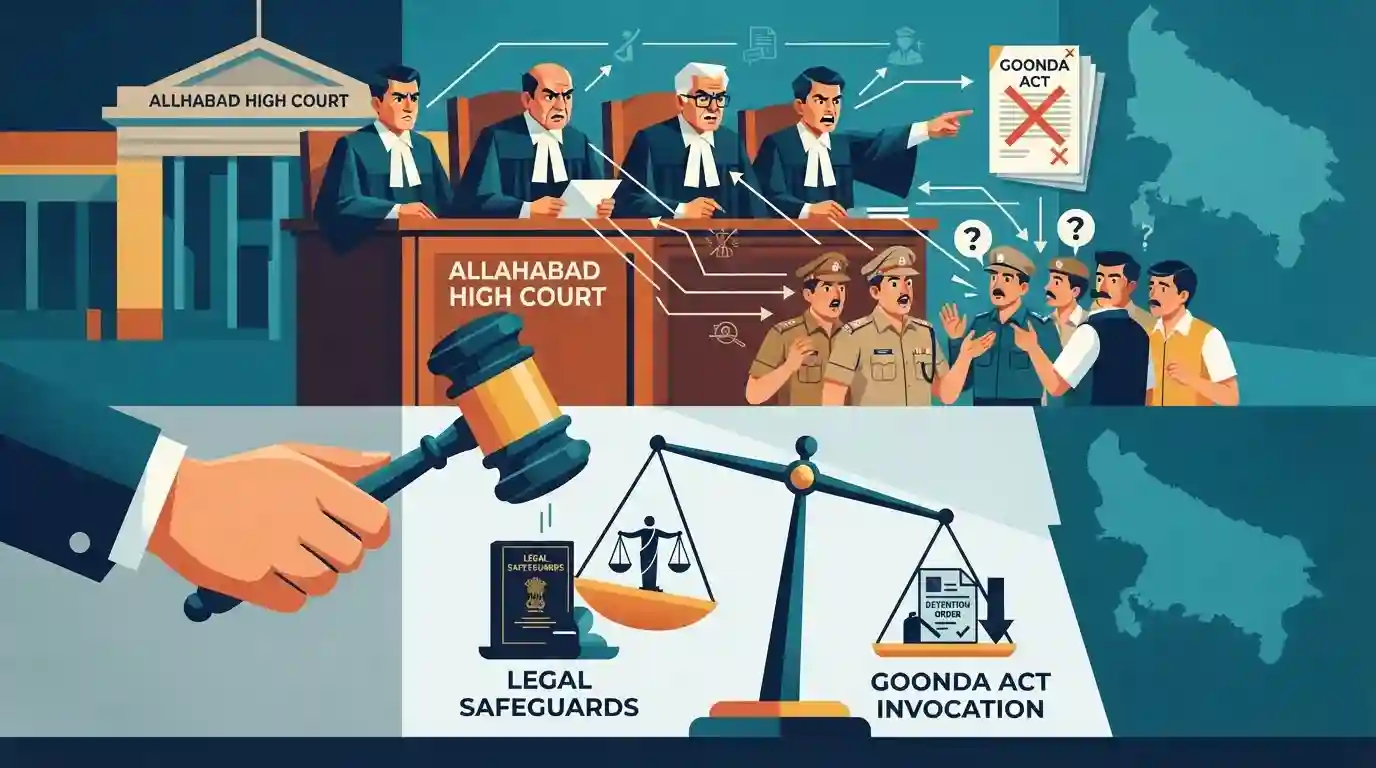
Allahabad High Court warns against arbitrary Goondas Act enforcement
Source:The Hindu ↗
Why It Matters
This ruling highlights important issues concerning the misuse of preventive and special state laws by executive authorities, underscoring the role of the High Court in protecting fundamental rights and checking administrative overreach in Uttar Pradesh.
Summary
The Allahabad High Court expressed strong disapproval of the Uttar Pradesh government's invocation of the Goonda Act, noting that authorities seem intent on using it as an instrument for harassment rather than maintaining public order, emphasizing the need for strict adherence to legal and constitutional safeguards.
Key Points
- The Allahabad High Court severely criticized the Uttar Pradesh government, observing that it appears determined to use the Uttar Pradesh Control of Goondas Act as a tool of harassment.
- The court highlighted instances of arbitrary and mechanical application of preventive detention and anti-social legislation against citizens without adequate statutory grounds.
- The judgment reinforces the judiciary's supervisory role over state executive actions and the misuse of special state legislative powers.
Important Terms
Uttar Pradesh Control of Goondas Act

A state legislation enacted to control habitual criminals, anti-social elements, and maintain public order through preventive measures like externment, which the High Court recently criticized for alleged misuse.
UPSC context
Relevant for UPPSC GS Paper II (State Governance, Polity, and Rule of Law); tests understanding of preventive detention and state laws.
Allahabad High Court
The constitutional court holding jurisdiction over the state of Uttar Pradesh, responsible for safeguarding fundamental rights and reviewing executive actions under state laws.
UPSC context
Important for UPPSC GS Paper II (Indian Judiciary and Judicial Review); tests the role of high courts in protecting citizens against executive overreach.
Uttar Pradesh Government
The executive organ of the state of Uttar Pradesh, responsible for implementing policies, maintaining public order, and administering state legislative enactments.
UPSC context
Relevant for UPPSC GS Paper V and VI (Uttar Pradesh Specific Administration and Governance); tests knowledge of state executive functioning and administrative accountability.
Static Concepts Connected
What are the constitutional safeguards against arbitrary arrest and preventive detention in India?
- Article 22 Rights: Guarantees protection against arrest and detention in certain cases under Articles 22(1) and 22(2).
- Advisory Board: Limits preventive detention to three months unless an Advisory Board recommends extended detention.
- Grounds Informed: Mandates that the detained person be informed of the grounds of detention as soon as possible.
Cross-Topic Patterns
Preventive Detention vs. Fundamental Rights
Judicial review of preventive detention under Article 22 intersects directly with executive overreach and human rights jurisprudence under GS Paper II.

Expect a statement-based question on the constitutional limits of state preventive detention laws and judicial review powers in UP.
Linked PYQs · 1
Linked PYQs · 1
- 2021UPPSC_PRELIMSGS1
The functions of the State Public Service Commission of Uttar Pradesh can be extended by
