UP Rabi Crop MSP Procurement Extension and Rural Housing Sanction
Source:indiatimes ↗
Why It Matters
UPPSC Prelims regularly features questions on agriculture (crop procurement, MSP determination by CACP, Rabi/Kharif classifications) and centrally sponsored rural development and welfare schemes (PMAY, PMGY, targets, and launch chronologies).
Summary
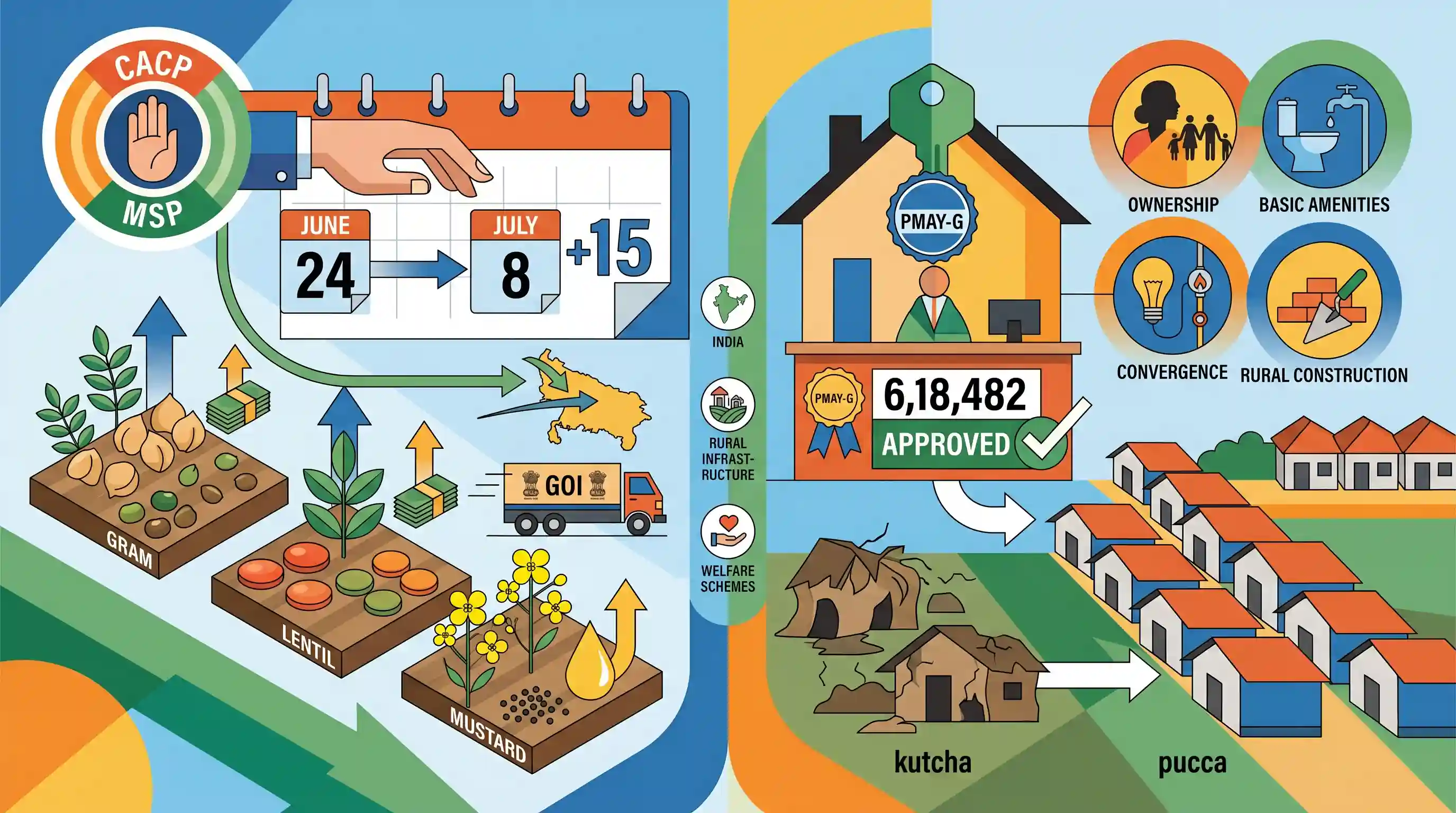
The Central government extended the MSP procurement window for key Rabi crops (gram, lentils, and mustard) in Uttar Pradesh by 15 days (June 24 to July 8) and approved the construction of 6,18,482 rural houses under the Pradhan Mantri Awas Yojana-Gramin (PMAY-G).
Key Points
- The Central Government approved a 15-day extension of the Minimum Support Price (MSP) procurement period for gram (chana), lentils (masur), and mustard in Uttar Pradesh.
- Following the request from the UP state government, eligible farmers can now sell these Rabi crops under MSP from June 24 to July 8.
- The Union Government also sanctioned the construction of 6,18,482 new permanent houses under the Pradhan Mantri Awas Yojana-Gramin (PMAY-G) in Uttar Pradesh.
- The approval letters for these initiatives were handed over to Uttar Pradesh Chief Minister Yogi Adityanath.
- These combined measures highlight the state and central government's ongoing support for agricultural stability and rural housing infrastructure in Uttar Pradesh.
Important Terms
Minimum Support Price (MSP)

A guaranteed floor price set by the Government of India to purchase agricultural crops directly from farmers, shielding them from market volatility and distress sales.
UPSC context
GS Paper III (Agriculture); tests agricultural pricing policies, price stabilization mechanisms, and food security.
Pradhan Mantri Awas Yojana-Gramin (PMAY-G)
A flagship rural housing scheme launched in 2016 by the Ministry of Rural Development, providing financial assistance to construct pucca houses for the rural poor.
UPSC context
GS Paper II (Social Justice & Schemes); tests government initiatives for poverty alleviation and rural infrastructure.
Rabi Crops
Winter crops sown in India from October to December and harvested in spring, requiring cool weather and moderate water, such as wheat, gram, and mustard.
UPSC context
GS Paper I (Geography) and Paper III (Agriculture); tests cropping patterns, agro-climatic conditions, and food production.
Commission for Agricultural Costs and Prices (CACP)
An advisory body under the Ministry of Agriculture and Farmers Welfare that recommends Minimum Support Prices (MSPs) for mandated agricultural crops.
UPSC context
GS Paper III (Agriculture); tests institutional mechanisms for price determination and agricultural economics.
Prelims Trap
PMAY-G beneficiaries are selected directly from State BPL lists to ensure local targeting of rural poor.
Beneficiaries are identified using SECC 2011 and Awaas+ data, filtered by 13 exclusion criteria, and validated by Gram Sabhas, bypassing BPL lists.
Static Concepts Connected
How does PMAY-G identify and verify its target beneficiaries?
- Primary Database: Uses deprivation parameters of SECC 2011 complemented by Awaas+ survey data to target housing-deprived households.
- Exclusion Criteria: Applies a strict 13-point exclusion list (e.g., landlines, vehicles, government jobs) to filter ineligible families.
- Gram Sabha Validation: Requires compulsory local Gram Sabha validation of the priority list to ensure community transparency and prevent leakage.
What is the composition and mandate of the CACP?
- Advisory Mandate: Recommends MSPs for 22 mandated crops and Fair and Remunerative Price (FRP) for sugarcane to the government.
- Organizational Structure: Functions as an attached office of the Ministry of Agriculture, comprising official, non-official, and farming community representatives.
- Pricing Factors: Analyzes cost of production (A2+FL, C2), demand-supply, market price trends, and inter-crop price parity.
Cross-Topic Patterns
Welfare convergence and fiscal efficiency
PMAY-G's integration with MGNREGA and Swachh Bharat Mission-Gramin demonstrates how multi-sectoral convergence optimizes budgetary resources and maximizes asset creation.
Cooperative federalism in agricultural procurement
Central extension of Rabi procurement windows on state requests reflects the collaborative administrative model essential to managing India's decentralised agricultural markets.

PMAY-G 2.0 targets, multi-scheme convergence (MGNREGA/SBM), and SECC-based exclusion criteria likely to feature in 2026 Prelims.
Linked PYQs · 3
Linked PYQs · 3
- 2008UPPSC_PRELIMSGS1
The minimum support price is determined by
- 2013UPPSC_PRELIMSGS1
Pradhan Mantri Gramodaya Yojana aims at
- 2024UPPSC_PRELIMSGS1
Consider the following events and arrange them in correct chronological order starting from the earliest to the last activity : 1. Pradhan Mantri Gramodaya Yojana 2. Rural Employment Generation Programme 3. Prime Minister Rozgar Yojana 4. Valmiki Ambedkar Awas Yojana Select the correct answer from the codes given below :
