Flood Management Deficits and Disaster Relief Gaps in Uttar Pradesh
Source:The Hindu ↗
Why It Matters
This article highlights the ground realities of disaster response in India, illustrating the gap between administrative planning and crisis execution. It serves as a real-world case study for the challenges in flood relief, the importance of proactive disaster management, and the role of governance and accountability during natural disasters, which are key components of the GS3 syllabus.
Summary
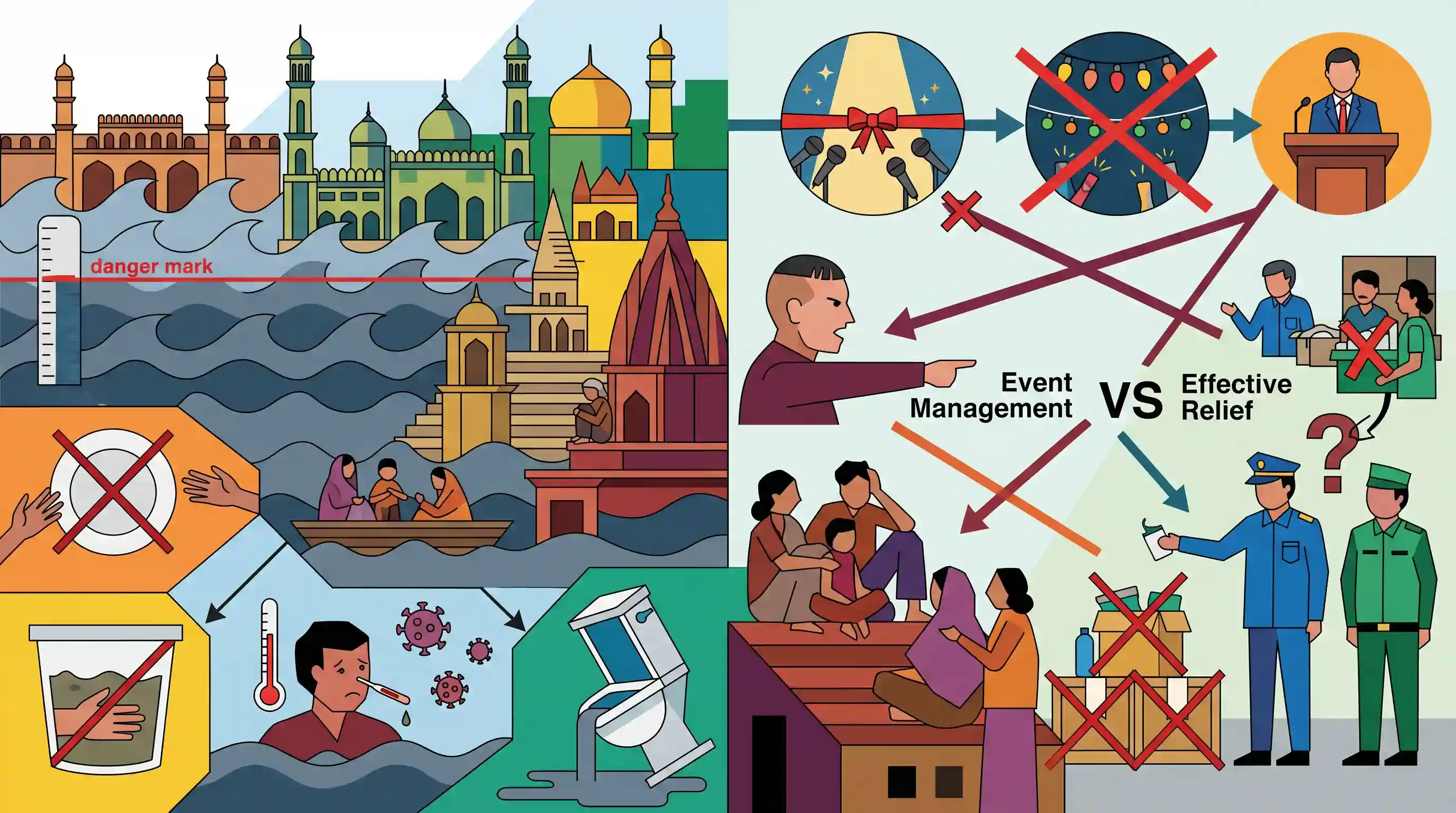
The ongoing flood situation in several districts of Uttar Pradesh has triggered political criticism, with Samajwadi Party chief Akhilesh Yadav accusing the state government of focusing on event management rather than providing effective disaster relief. Yadav highlighted the severe distress of flood victims, who lack access to food, clean water, sanitation, and medical care, thereby raising the risk of water-borne diseases. Furthermore, the rising water level of the River Ganga, which has crossed the danger mark in Varanasi and submerged the ghats, exacerbates the disaster management challenges in the region.
Key Points
- Samajwadi Party president Akhilesh Yadav criticized the UP government for prioritizing 'event management' over genuine flood relief efforts.
- Flood-affected citizens are facing severe shortages of food, clean drinking water, sanitation facilities, and adequate medical services.
- The lack of basic necessities is heightening the risk of water-borne diseases among the displaced populations.
- The River Ganga has crossed the danger mark in Varanasi, leading to the submergence of prominent ghats and adjoining infrastructure.
- The situation underscores critical gaps in disaster preparedness, relief administration, and the delivery of public welfare during natural calamities.
Important Terms
Disaster Management

A multi-stage process involving prevention, mitigation, preparedness, and response to minimize the impact of calamities. It focuses on saving lives and restoring essential services.
UPSC context
GS Paper 3; critical for understanding India's shift from a relief-centric to a proactive risk-reduction approach.
Disaster Management Act, 2005
The 2005 legislation providing the legal framework for managing disasters in India. It established the NDMA, SDMAs, and the specialized National Disaster Response Force (NDRF).
UPSC context
GS Paper 2 & 3; tests knowledge of India's statutory disaster architecture and institutional roles.
State Disaster Response Fund (SDRF)
The primary fund with state governments for immediate relief from notified disasters like floods. The Centre contributes 75% for general states and 90% for special category states.
UPSC context
GS Paper 3; relevant to disaster financing and fiscal federalism between the Centre and States.
Central Water Commission (CWC)
The nodal organization in India for flood forecasting and monitoring river levels. It tracks the "danger mark" at various stations to issue early warnings to local authorities.
UPSC context
GS Paper 3; tests knowledge of specialized technical bodies involved in national disaster preparedness.
River Ganga
India's largest river system, originating in the Himalayas. It faces frequent seasonal flooding, especially in the plains of Uttar Pradesh and Bihar, often crossing critical danger levels.
UPSC context
GS Paper 1 & 3; important for physical geography, river basin management, and environmental sustainability.
Water-borne Diseases
Infections like cholera and typhoid that spread through contaminated water. These represent a major post-disaster public health challenge in flood-affected regions due to poor sanitation.
UPSC context
GS Paper 2 & 3; relates to public health infrastructure and the humanitarian impact of disasters.
Prelims Trap
The Central Government holds primary responsibility for flood relief operations.
State Governments hold the primary constitutional responsibility for disaster relief. The Centre only supplements efforts logistically and financially during severe disasters.
Static Concepts Connected
What is the funding pattern and role of the State Disaster Response Fund (SDRF)?
- Statutory Basis: Constituted under the Disaster Management Act, 2005, it is the primary fund available with State governments for responses to notified disasters.
- Contribution Ratio: The Central Government contributes 75% for general category states and 90% for special category states/UTs (e.g., North-East and Himalayan states).
- Fund Allocation: The annual Central contribution is released in two equal installments based on Finance Commission recommendations.
How has India's National Disaster Management policy paradigm shifted over time?
- Proactive Shift: It has shifted from a reactive, 'relief-centric' approach focused on post-disaster response to a proactive paradigm.
- Core Pillars: The current framework prioritizes pre-disaster preparedness, early warning systems, hazard zonation, mitigation, and building long-term resilience.
Cross-Topic Patterns
Urban Hydrology and Heritage Vulnerability
The submergence of Varanasi's ghats links GS1 Heritage with GS3 Disaster Management, emphasizing the vulnerability of historical riverine infrastructure to altered monsoon patterns.
Ethics in Crisis Administration
Critiques of 'event management' over basic relief align with GS4 themes of administrative empathy, transparency, and equitable public service delivery during severe crises.

GS3 Mains 2026 may link riverine flooding in the Ganga basin with post-disaster epidemic risks and the efficacy of municipal preparedness.
Linked PYQs · 4
Linked PYQs · 4
- 2020MainsGS3
Discuss the recent measures initiated in disaster management by the Government of India departing from the earlier reactive approach.
- 2024MainsGS3
Flooding in urban areas is an emerging climate-induced disaster. Discuss the causes of this disaster. Mention the features of two such major floods in the last two decades in India. Describe the policies and frameworks in India that aim at tackling such floods.
- 2020MainsGS1
Account for the huge flooding of million cities in India including the smart ones like Hyderabad and Pune. Suggest lasting remedial measures.
- 2017MainsGS1
In what way can floods be converted into a sustainable source of irrigation and all-weather inland navigation in India?
