Uttar Pradesh balances fiscal discipline with capital investment push
Source:indianmasterminds ↗
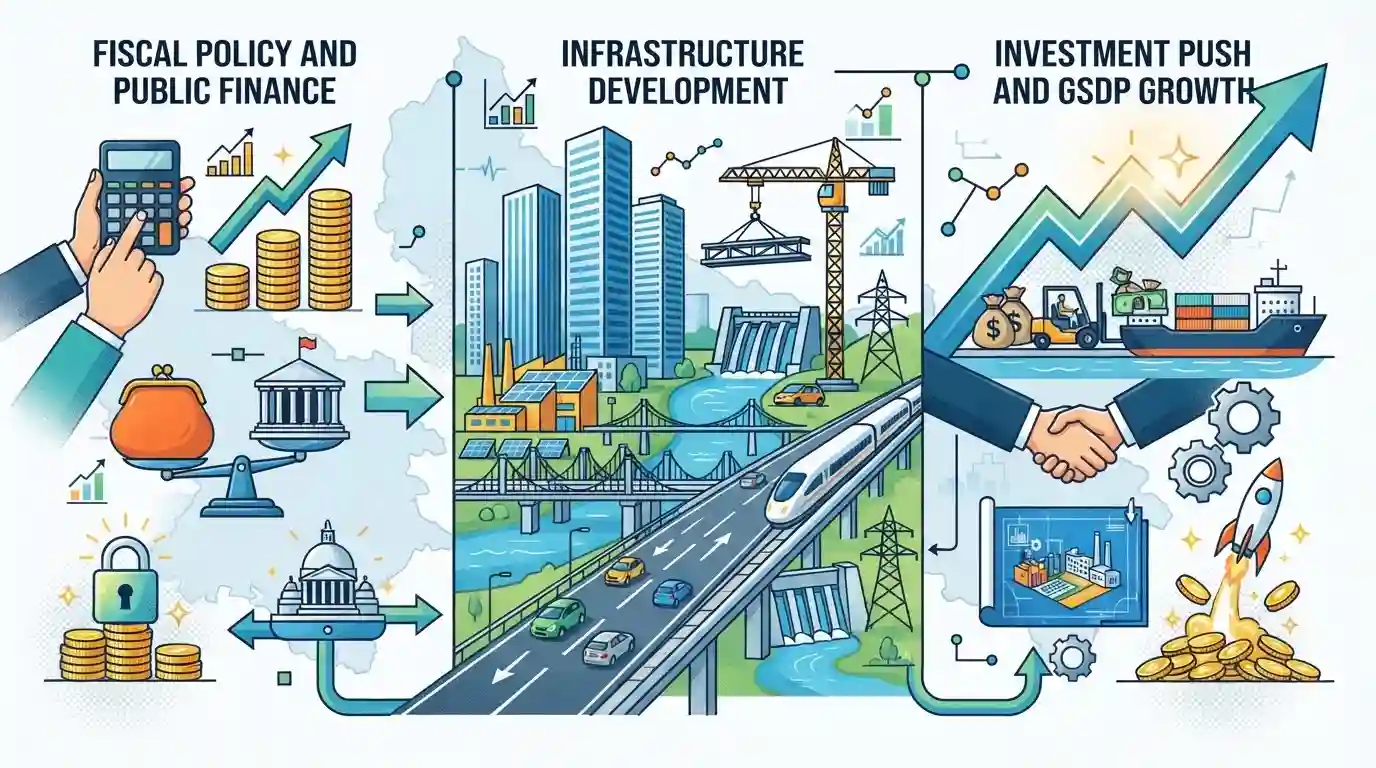
Why It Matters
Crucial for UPPSC aspirants to understand state-level economic governance, fiscal indicators, and major industrial push strategies in Uttar Pradesh.
Summary
The article highlights Uttar Pradesh's strategic approach toward combining fiscal discipline with major infrastructure development and investment pushes to boost its regional economy and achieve high GSDP growth targets.
Key Points
- Uttar Pradesh is focusing on maintaining strict fiscal discipline while executing an aggressive investment and infrastructure push.
- The state aims to boost Gross State Domestic Product (GSDP) through targeted capital expenditure and large-scale industrial projects.
- Initiatives include improving public financial management, streamlining fund allocation for major state infrastructure corridors, and attracting private investments.
Important Terms
Ganga Expressway

A 594 km greenfield access-controlled expressway in Uttar Pradesh linking Meerut to Prayagraj, built to enhance regional connectivity, economic integration, and industrial corridor development.
UPSC context
Important for GS Paper III (Infrastructure: Roads & Expressways) and Prelims, testing major transport corridors and regional development initiatives in UP.
UPEIDA
The nodal state government agency in Uttar Pradesh responsible for planning, developing, executing, and maintaining major access-controlled expressway projects and associated industrial corridors.
UPSC context
Relevant for GS Paper III/Prelims, highlighting state-level institutional mechanisms driving infrastructure and public-private partnerships in Uttar Pradesh.
Prelims Trap
Uttar Pradesh maintains its total debt-to-GSDP ratio strictly capped at 3% in line with fiscal discipline.
Aspirants often confuse the FRBM fiscal deficit ceiling of 3% of GSDP with total debt-to-GSDP ratios, which are maintained around higher sustainable thresholds like 23-25%.
Static Concepts Connected
What are the core parameters mandated under the Fiscal Responsibility and Budget Management (FRBM) Act framework for states?
- Deficit Ceiling: Fiscal Deficit Limit: States are generally permitted a fiscal deficit of up to 3% of their GSDP, with additional conditional borrowing space linked to power sector reforms.
- Debt Sustainability: Debt-to-GSDP Ratio: Fiscal consolidation paths require states to bring down total outstanding debt-to-GSDP ratios toward sustainable medium-term targets (typically around 20-25%).
- Revenue Account: Revenue Deficit: The framework encourages states to eliminate revenue deficits and generate revenue surpluses specifically for funding capital expenditure.
Cross-Topic Patterns
UP Capex + PM GatiShakti Convergence
Uttar Pradesh's infrastructure push aligns with central capital expenditure assistance schemes, linking state-level industrial corridors like the Ganga Expressway with national multimodal connectivity frameworks like PM GatiShakti.
FRBM Act + State Fiscal Discipline
Fiscal deficit limits under state FRBM rules directly constrain populist expenditures, forcing governments to rely on targeted capital outlays for long-term GSDP expansion.

UPPSC frequently tests exact budget allocations for capital expenditure and targeted GSDP milestones like the USD 1 trillion economy goal by 2029.
Linked PYQs · 2
Linked PYQs · 2
- 2023UPPSC_PRELIMSGS1
Which statement is true for Finance Sector (Fiscal Management) in the Union Budget-2023?
- 2023UPPSC_PRELIMSGS1
Which of the following Scheme/Programme is not the Central Government Programme and it is Uttar Pradesh Government's Programme?
